
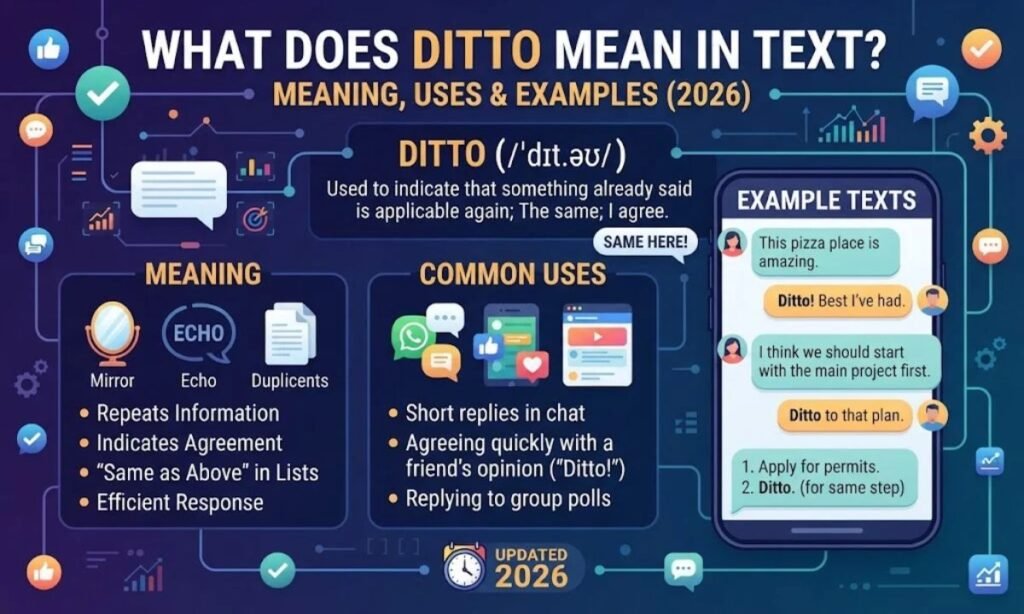
You may have seen someone reply “ditto” in a chat and wondered what it meant. It is a short and friendly word that people use all the time in messages. In text, ditto means “same here,” “me too,” or “I feel the same.” It saves time and keeps the chat flowing.
This guide explains the ditto meaning in text in simple words. You will see real chat examples and learn where the word comes from. You will also find common mistakes and smart ways to reply when someone says it.
Ditto Meaning in Text – Quick Definition
Ditto is a casual word used to agree with what someone just said. It means “the same goes for me.” Instead of repeating a full sentence, a person types one word and the message is clear.
For example, if a friend says “I am so tired today,” you can reply “ditto.” That tells them you feel tired too. It is quick, light, and easy to understand.
| Detail | What It Means |
| Word | Ditto |
| Plain meaning | Same here, me too |
| Tone | Casual, friendly |
| Used for | Agreeing, matching feelings, saving time |
| Common apps | WhatsApp, Instagram, iMessage, TikTok |
| Formal use | Rare, best avoided |
| Similar words | Same, me too, likewise, agreed |
Simple Examples
Short examples make the meaning clear. Here is how people use ditto every day:
- “I love this song.” Reply: “Ditto!” You love it too.
- “Can’t wait for the weekend.” Reply: “Ditto.” You feel the same way.
- “Thanks, you are the best.” Reply: “Ditto.” You think the same about them.
- “I hate Monday mornings.” Reply: “Ditto, 100 percent.” You strongly agree.
In each case, the word repeats the other person’s feeling without repeating their words.
Origin & Background
The word ditto comes from Italian. It is linked to the Italian word detto, which means “said.” Old Italian merchants used it in business records to mean “the same as above.” This saved them from writing the same thing again and again.
Later, the word moved into English. By the 1600s, people used it in lists, bills, and accounts. You would see a small mark or the word ditto under an item to show it repeated the line above.
Over time, the word left the business world. People began to use it in speech to say “same here.” Today it lives mostly in casual talk and texting.
How It Evolved
The journey of ditto is simple. It started as a writing shortcut, then became a spoken word, and finally a texting favorite.
| Period | How Ditto Was Used |
| Early trade records | “Same as above” in accounts |
| 1600s to 1800s | Lists, ledgers, and bills in English |
| 1900s | Casual speech meaning “the same” |
| Late 1900s | Popular in movies and love scenes |
| 2000s to today | Chat shorthand on phones and social media |
Movies helped a lot. Many people link the word to romantic scenes where one person says “I love you” and the other answers “ditto.” That made the word feel warm and personal.
Real-Life Conversations (How People Actually Use “Ditto”)
Ditto is a natural chat word. Here are four common situations where you might see it.
1. WhatsApp Chat
Ayesha: I am so ready for this exam to end.
Sana: Ditto! I have not slept properly in days.
Ayesha: Let’s get ice cream after.
Sana: Ditto, I need it badly.
Here, ditto works as a quick agreement. It shows both friends feel the same stress.
2. Instagram DMs
Leo: Your new post looks amazing.
Mia: Thank you! Your photos are great too.
Leo: Ditto to the compliment, you have a great eye.
In DMs, ditto is often used to return kind words. It feels polite and warm.
3. Text Messages
Dan: Love you, see you tonight.
Kim: Ditto. Bring snacks.
A short ditto can show affection without being too heavy. Some people prefer it over typing “love you too.”
4. TikTok Comments
User 1: This recipe changed my life.
User 2: Ditto, I make it every week now.
On TikTok, ditto lets viewers agree with a comment fast. It also helps comments feel friendly and united.
Emotional & Psychological Meaning
Ditto is more than a short word. It also carries a small emotional message. It says, “I hear you, and I feel the same.”
When people share a feeling, they want to feel understood. A quick “ditto” gives that comfort. It builds a tiny bridge between two people.
Why People Use It
People use ditto for a few simple reasons:
- Speed: It is much faster than typing a full sentence.
- Connection: It shows shared feelings.
- Comfort: It feels relaxed and low pressure.
- Humor: It can sound playful, especially in memes.
- Politeness: It returns kind words without extra effort.
What It Reflects
Using ditto often shows a friendly and easygoing nature. The person values quick connection over long speeches.
Sometimes, though, ditto can hide deeper feelings. A person who says “ditto” instead of “I love you” may feel shy or private. Or they may simply like short replies. Context matters, so look at the tone before you guess.
Usage in Different Contexts
Ditto changes slightly based on where and with whom you use it. Let us look at the main settings.
1. Social Media
On social media, ditto is used in comments, replies, and DMs. It shows quick agreement with a post, a joke, or a trend. Creators often see it under relatable videos.
It can also be a light way to join a crowd. When many users write “ditto,” it makes a post feel like a shared moment.
2. Friends & Relationships
Among friends, ditto is warm and relaxed. It works well for shared jokes, shared moods, and shared plans. It shows closeness without effort.
In couples, ditto may replace “I love you too.” Some partners find this sweet. Others want clearer words. If you use it in romance, add a few extra words now and then so your feelings stay clear.
3. Work or Professional Settings
At work, ditto is best kept for friendly chats with close coworkers. In emails to clients or managers, choose clearer words such as “I agree” or “same here.”
In team chat tools like Slack, ditto is usually fine when the tone is relaxed. Still, a full sentence is safer if the topic is serious.
4. Casual vs Serious Tone
| Situation | Is Ditto Okay? | Better Option If Not |
| Chat with a friend | Yes | None needed |
| Group chat | Yes | None needed |
| Compliments | Yes | “Thank you, same to you” |
| Team chat at work | Sometimes | “I agree” |
| Formal email | No | “I share your view” |
| Serious or sad talk | Use with care | A full, caring sentence |
When someone shares sad news, a one word reply can feel cold. Choose warmer words in such moments.
Common Misunderstandings
Because ditto is so short, people sometimes misread it. Here are four common mistakes.
1. Thinking It’s Always Romantic
Many people link ditto to love because of movies. But it does not always mean “I love you.” It simply means “same here.” A friend can say it about pizza, music, or sleep.
2. Assuming It Means Copying
Ditto does not mean you are copying someone. It means you share the same view or feeling. It is agreement, not imitation.
3. Using It in Formal Writing
Ditto feels too casual for reports, job emails, or school essays. It may look lazy or unclear. In formal writing, use phrases like “likewise” or “I agree.”
4. Overusing It
If you reply “ditto” to everything, the chat can feel dull. The other person may feel you are not really listening. Mix it up with full sentences and real questions.
Comparison Table
This table shows how ditto compares with similar chat replies.
| Reply | Meaning | Tone | Best Used For |
| Ditto | Same here | Casual, warm | Quick agreement |
| Me too | I feel the same | Simple, friendly | Everyday chats |
| Same | I feel that too | Very casual | Memes, fast replies |
| Likewise | The same to you | Polite | Greetings, compliments |
| Agreed | I think so too | Neutral | Opinions, work chat |
| Same here | I share that feeling | Friendly | Almost any chat |
Key Insight
Ditto is a small word with a big job. It shows agreement, builds connection, and saves time. But it works best when the tone is light. In deep or serious talks, add a few more words so the other person feels truly heard.
Variations / Types of “Ditto” (Modern Usage)
People have created many fun versions of ditto. Here are the most common ones.
- “Ditto!” A simple, cheerful agreement.
- “Ditto ditto” Extra emphasis, often playful.
- “Dittoooo” A stretched version that sounds excited.
- “Ditto to that” A clear way to agree with a full statement.
- “Ditto, same” A relaxed double agreement.
- “Ditto from me” A polite, slightly formal form.
- “Ditto 💯” Ditto with an emoji for strong agreement.
| Version | Feeling It Shows | Best Place to Use |
| Ditto | Calm agreement | Any casual chat |
| Dittoooo | Excitement | Friends, group chats |
| Ditto to that | Clear support | Social media |
| Ditto 💯 | Strong agreement | Comments, DMs |
| Ditto from me | Polite tone | Mixed or light work chats |
How to Respond When Someone Says “Ditto”
Sometimes you are on the other side of the chat. Someone says ditto, and you wonder what to say next. Pick a reply that fits the mood.
Casual Replies
- “Haha, great minds think alike.”
- “Glad we feel the same.”
- “Nice, we are on the same page.”
Funny Replies
- “Ditto? Are you a copy machine?”
- “Stop copying me. I said it first.”
- “We should start a ditto club.”
Keep jokes light. Make sure the other person is in a playful mood.
Mature / Confident Replies
- “I am glad we see it the same way.”
- “That means a lot. Thank you.”
- “Good to know we are on the same page.”
Private or Respectful Replies
- “Thanks for sharing that with me.”
- “I appreciate you saying it.”
- “Let’s talk more about it when you are free.”
Use these when the topic is personal. A calm and kind reply keeps the talk respectful.
Regional & Cultural Usage
Ditto is understood in many places, but how people use it can differ.
Western Culture
In the US, UK, and Canada, ditto is common in everyday speech and texting. It is popular in friendly chats, romantic replies, and social media comments. Movies and TV shows made the word famous.
Western users often treat it as a playful and warm reply. It is also common in workplace chats when the mood is relaxed.
Asian Culture
In many Asian countries, English words like ditto are used in chats among young people. Social media and global shows helped spread it. People often mix it with local language in the same message.
Some users prefer longer, more polite replies in respectful settings. For elders or seniors, a full sentence is usually better than a single word.
Middle Eastern Culture
In the Middle East, ditto is understood among English speaking youth and online users. People often mix English and Arabic in chats. A friend might type “ditto habibi” to show warm agreement.
In formal or family settings, people value respectful speech. A full, kind sentence often fits better than a short slang word.
Global Internet Usage
Online, ditto has become a universal shortcut. It appears in comments, group chats, gaming lobbies, and memes. Its short size makes it perfect for fast typing.
Because internet culture moves fast, new styles of ditto keep appearing. Stretched spellings, emojis, and mixed phrases are now very common.
Frequently Asked Questions
What does ditto mean in text?
Ditto means “same here” or “me too.” It shows you agree or feel the same way.
Does ditto mean “I love you too”?
Sometimes. In romantic chats, it can replace “I love you too,” but it does not always mean love.
Is ditto formal or informal?
Ditto is informal. It fits friendly chats but not formal emails or reports.
Where does the word ditto come from?
It comes from the Italian word detto, meaning “said.” It once meant “the same as above” in records.
Is it rude to reply with just ditto?
Not usually. But in serious or emotional talks, a longer reply feels kinder.
What can I say instead of ditto?
You can say “me too,” “same here,” “likewise,” or “I agree.”
How do you use ditto in a sentence?
You can say, “I am excited for the trip.” Reply: “Ditto, I can’t wait.”
Final Thoughts
Ditto is a small word with a long history. It began in old Italian records, grew through English trade and speech, and now thrives in modern texting. Today it works as a quick, friendly way to say “I feel the same.” It saves time, builds connection, and keeps chats light.
Still, good communication needs balance. Use ditto in casual moments, and switch to fuller words when the topic is serious or formal. A little extra care can turn a quick reply into a meaningful one, and that makes every chat stronger.

Muhammad Shoaib is a content creator and SEO professional who enjoys making language and vocabulary easy to understand. He writes helpful content about word meanings, phrases, slang, abbreviations, spelling differences, and everyday expressions. nThrough WhizzMean, Shoaib focuses on creating clear, simple, and practical explanations that help readers quickly understand confusing words and language-related questions.