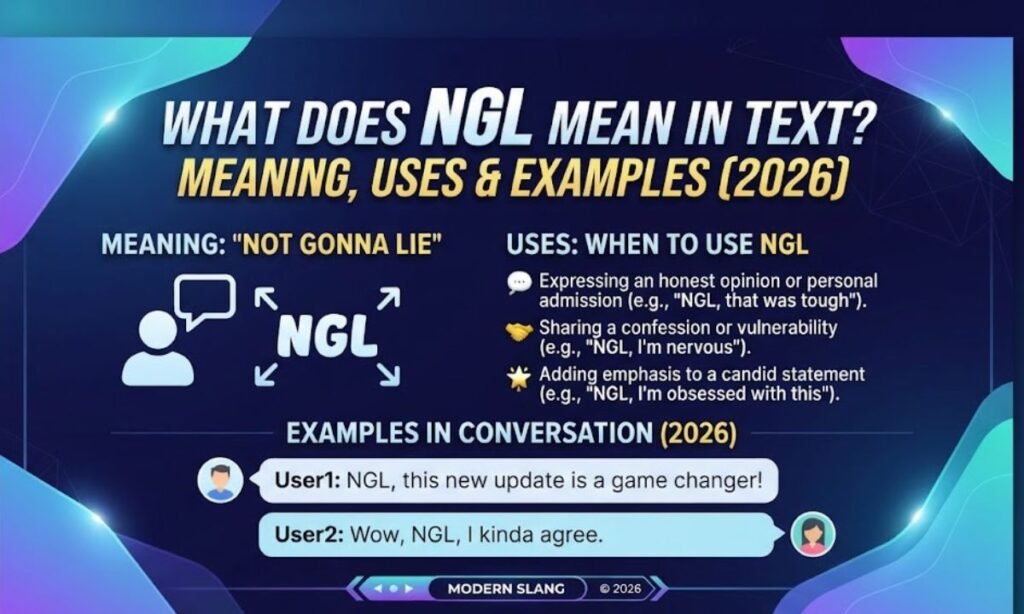
Have you ever seen “ngl” in a message and wondered what it means? NGL stands for “not gonna lie.” People use it before they share an honest thought, a compliment, or a small confession. It is a quick way to sound real and relaxed in a chat.
This guide explains the meaning of NGL in text, where it came from, and how people use it. You will see real chat examples, easy tables, and simple replies. You will also learn how it differs from similar slang like TBH. Let’s get started.
NGL Meaning in Text: Quick Meaning
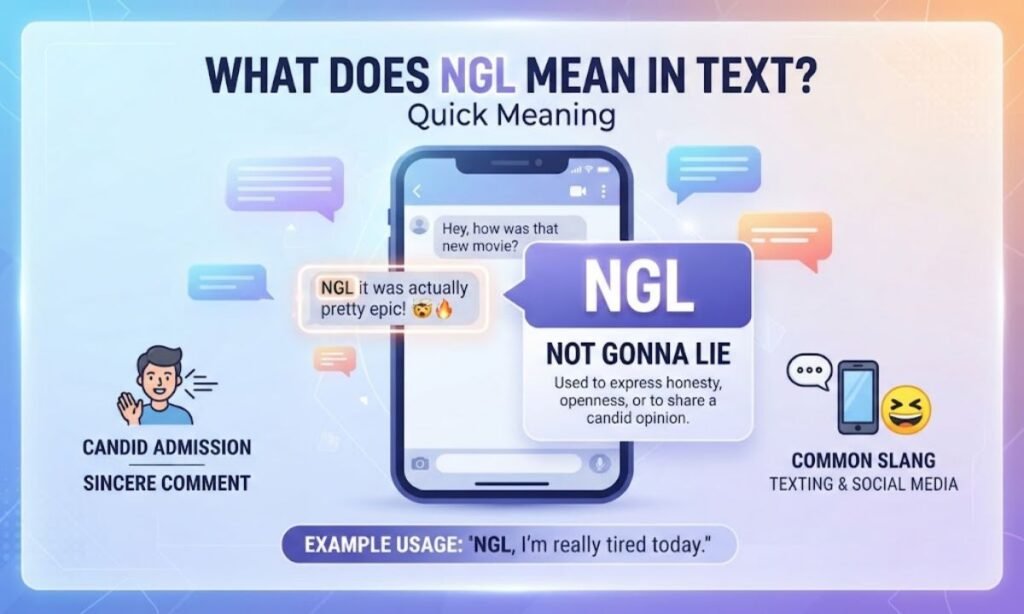
NGL is an abbreviation for “not gonna lie.” People type it before saying something honest, direct, or a little bold. It works like a soft warning that says, “Here comes my real opinion.”
The phrase often adds a casual and friendly feel. It can introduce a compliment, a confession, or a mild criticism. For example, “ngl that outfit looks great” is a compliment. “Ngl I did not like the movie” is an honest opinion.
NGL belongs to the same family as TBH, IDK, and OMG. These short forms save time and make chats feel natural.
Simple Definition
NGL means “to be honest” or “I’ll be real with you.” It tells the reader that the next words come from the heart.
Quick Examples
- “Ngl I was nervous before the exam.” (I was honestly nervous.)
- “Ngl this pizza is amazing.” (I truly love it.)
- “Ngl I forgot about the meeting.” (I admit I forgot.)
- “Ngl you are a great cook.” (I mean it.)
Quick Reference Table
| Feature | Details |
| Slang term | NGL |
| Full form | Not gonna lie |
| Type | Text and social media abbreviation |
| Core purpose | Introduce an honest opinion or confession |
| Tone | Casual and friendly |
| Common platforms | WhatsApp, Instagram, TikTok, Snapchat, X |
| Avoid in | Formal emails and professional writing |
Origin and Background of NGL
The phrase “not gonna lie” comes from everyday speech. People have long used “I won’t lie” or “to be honest” to show that they are speaking plainly. “Gonna” is the casual spoken form of “going to,” which gave the phrase its relaxed sound.
Early texting and online chat rooms pushed people to shorten long phrases. Typing three letters is faster than typing three words. NGL spread along with other short forms like LOL, BRB, and TBH.
Social media made it even more popular. Quick comments, captions, and replies fit short slang well. Platforms like TikTok, Instagram, and Snapchat helped NGL reach a global audience. Today, it is one of the most common honesty markers online.
Quick Timeline Table
| Stage | What Happened |
| Spoken use | People said “not gonna lie” to be direct |
| Early texting | Short forms saved time and space |
| Social media boom | NGL spread through captions and comments |
| Today | Widely used and easy to recognize online |
Real-Life Conversations
Slang is easier to learn when you see it in action. Here are four short chats that show how NGL works in daily talk.
WhatsApp Conversation
Hana: Did you like the cake I made?
Leo: Ngl it was the best cake I have ever had.
Hana: Stop, you are making me blush.
Leo: I mean it. Make another one soon.
Here, “ngl” adds warmth to a compliment.
Instagram DM
Ivy: How was the concert last night?
Ben: Ngl the sound was bad, but the band was great.
Ivy: That is a shame about the sound.
Ben: Yes, but I still had fun.
In this chat, “ngl” introduces an honest mixed opinion.
TikTok Comments
User 1: This dance trend is so hard.
User 2: Ngl I tried it ten times and failed.
User 1: Same, but it is fun to practice.
Short comments like this are very common on TikTok.
Text Message
Maya: Are you ready for the presentation?
Chris: Ngl I am a little scared.
Maya: You will do great. Take a deep breath.
Chris: Thanks, I needed that.
Here, “ngl” shows vulnerability and trust.
Emotional and Psychological Meaning
NGL often shows honesty and openness. When someone uses it, they usually feel comfortable enough to share a real thought. It can build trust between friends.
It can also soften a strong opinion. Starting with “ngl” makes a comment feel less harsh. For example, “ngl I think we should change the plan” sounds gentler than “We should change the plan.”
Sometimes it shows nervousness or courage. People use it before a confession or a hard truth. It gives them a small push to say what they feel.
Why People Connect With It
Honesty feels good. People like friends who speak plainly. NGL gives chats a real and human touch.
It also helps people avoid sounding too serious. A casual tone makes tough topics easier to share.
What It Reflects About Modern Communication
Modern chats are fast, short, and personal. People want quick ways to show tone and feeling. NGL does that in three letters.
It also shows that people value authenticity. Many users prefer honest and relaxed talk over polished and formal language.
Emotional Tone Table
| Phrase | Possible Feeling |
| Ngl I love this | Excited, sincere |
| Ngl I am nervous | Vulnerable |
| Ngl I did not like it | Honest, mild disagreement |
| Ngl you were right | Humble |
| Ngl that was funny | Playful |
Usage in Different Contexts
NGL changes slightly based on where you use it and who reads it. The right setting keeps your message clear and polite.
Social Media
On social media, NGL is everywhere. People use it in captions, comments, replies, and short videos. It adds personality and keeps posts short.
A caption might say, “Ngl Mondays hit different.” A comment might say, “Ngl this made my day.” Both sound natural and relaxed.
Friends and Relationships
Among friends, NGL feels easy and comfortable. It often comes before a compliment, a joke, or a small confession. Close friends rarely misread it.
In relationships, it can show care or concern. “Ngl I missed you today” sounds sweet. “Ngl I felt hurt” opens a calm talk. Choose your words with care so the message lands softly.
Work or Professional Settings
NGL does not belong in formal work messages. Emails, reports, and client chats need clear and complete words. Write “to be honest” or “frankly” instead.
In a casual chat with close coworkers, it may be fine. Still, many workplaces expect a careful tone, so it is safer to skip it.
Casual vs. Serious Tone
NGL fits casual talk best. In serious moments, such as sensitive topics or major decisions, plain language is better. It shows respect and avoids confusion.
Context Guide Table
| Setting | Is NGL Okay? | Better Choice |
| Group chat with friends | Yes | NGL is fine |
| Social media comments | Yes | NGL is fine |
| Dating or relationship chat | Sometimes | Watch your tone |
| Work email | No | “To be honest” or “frankly” |
| School essay | No | Formal wording |
| Serious talk | No | Clear and complete words |
Common Misunderstandings
Because NGL is short, people sometimes misread it. Here are the most common mix-ups.
People Think NGL Means Someone Was Lying Before
Some people believe “ngl” hints that the speaker has lied in the past. That is not true. It simply marks an honest or direct statement. It does not judge earlier messages.
It Isn’t Always Negative
Many people expect NGL to come before bad news. In reality, it often introduces praise. “Ngl you did amazing” is a perfect example.
It Can Sound Too Casual
NGL is relaxed and informal. In a formal or serious setting, it may seem careless. Use clear words when the situation needs respect.
It Doesn’t Guarantee Absolute Truth
Saying “ngl” shows honest intent, but it does not prove a fact. It reflects a personal opinion or feeling. People can still be mistaken or biased.
Comparison Table
NGL is often compared with other honesty phrases. Here is how they differ.
| Slang | Meaning | Example |
| NGL | Not gonna lie | “Ngl I am tired.” |
| TBH | To be honest | “Tbh I loved it.” |
| FR | For real | “Fr that was fun.” |
| IKR | I know, right | “Ikr it is so cute.” |
| IMO | In my opinion | “Imo it is too long.” |
| ISTG | I swear to God | “Istg I told you.” |
| LOWKEY | Slightly or quietly | “Lowkey I want pizza.” |
Key Insight
NGL and TBH are almost twins. Both introduce honest thoughts. The main difference is style. NGL sounds a bit more casual and confessional, while TBH feels a little more neutral.
Variations and Related Expressions
NGL has many cousins. These phrases also help people share honest thoughts.
1. TBH
It means “to be honest.” It is the closest match to NGL. Example: “Tbh I need a break.”
2. No Cap
It means “no lie” or “I am serious.” Example: “No cap, that was the best game.”
3. Honestly
A plain and standard word for sharing a real opinion. Example: “Honestly, I liked it.”
4. Real Talk
It signals a serious and honest moment. Example: “Real talk, you should rest.”
5. Low-Key
It means something is true in a quiet or modest way. Example: “Low-key I love this song.”
6. High-Key
It means something is true in a strong and open way. Example: “High-key excited for Friday.”
7. FR
It means “for real.” It adds emphasis. Example: “Fr this is amazing.”
8. I Mean
A spoken phrase that softens or explains a thought. Example: “I mean, it was not bad.”
9. No Joke
It shows that you are not kidding. Example: “No joke, I ran five miles.”
10. Truthfully
A more formal word for honest speech. Example: “Truthfully, I am not sure.”
Variations Summary Table
| Expression | Meaning | Tone |
| TBH | To be honest | Neutral |
| No cap | No lie | Playful, confident |
| Honestly | Truthfully | Standard |
| Real talk | Serious honesty | Direct |
| Low-key | Quietly true | Relaxed |
| High-key | Openly true | Strong |
| FR | For real | Emphatic |
| I mean | Softening phrase | Gentle |
| No joke | Not kidding | Firm |
| Truthfully | Honestly | Formal |
How to Respond When Someone Uses NGL
Your reply depends on the mood and the person. Here are simple options for each situation.
Casual Replies
- “Haha, I get that.”
- “Same here.”
- “Thanks for being honest.”
Funny Replies
- “Okay, now I am scared of the next sentence.”
- “Ngl, I did not see that coming.”
- “Brutal honesty, I love it.”
Mature and Confident Replies
- “I appreciate your honesty. Let’s talk about it.”
- “Thanks for sharing that. What would you change?”
- “Fair point. I will think about it.”
Private and Respectful Replies
- “Thank you for trusting me with that.”
- “I’m here if you want to talk more.”
- “Let’s chat about it privately.”
Reply Guide Table
| Situation | Best Reply Style |
| Friendly chat | Casual and short |
| Joking with friends | Funny |
| Disagreement | Mature and calm |
| Sensitive topic | Private and respectful |
Regional and Cultural Usage
Slang changes from place to place. NGL is widely understood, yet its use still differs by region and culture.
Western Culture
In the United States, the United Kingdom, Canada, and Australia, NGL is very common in texts and social media. Young people use it daily. Older groups may know it too, but they use it less often.
Asian Culture
In many parts of Asia, people learn NGL through social media, music, and videos. Younger users often understand it and use it with friends online. In formal settings, people tend to prefer full and polite English.
Middle Eastern Culture
In the Middle East, English slang spreads mostly through TikTok, Instagram, and gaming. Young users may use NGL in casual chats. In family or professional settings, people often choose more formal language.
Global Internet Usage
Online, slang crosses borders fast. NGL appears in chats, memes, and comments around the world. Because it is short and clear, it is easy for new English learners to pick up. A quick explanation can still help in mixed groups.
Regional Usage Table
| Region | Level of Use | Notes |
| Western countries | High | Common among young people |
| Asia | Medium to high | Learned through social media |
| Middle East | Medium | Used mostly online with friends |
| Global internet | High | Understood in casual online spaces |
Frequently Asked Questions
What does NGL mean in text?
NGL means “not gonna lie.” People use it to introduce an honest opinion or confession.
What does NGL stand for?
NGL stands for “not gonna lie.” It is a casual way to say “to be honest.”
Is NGL the same as TBH?
Almost. Both introduce honest thoughts, but NGL sounds a little more casual and confessional.
Is NGL rude?
No. It is usually friendly, but the message that follows can still sound blunt.
Can I use NGL in a work email?
No. Use words like “to be honest” or “frankly” in professional writing.
Is NGL always followed by bad news?
No. It often introduces compliments, jokes, or happy confessions.
How do you reply to NGL?
Keep it simple and kind, like “Thanks for being honest” or “Same here.” Match the mood of the message.
Final Thoughts
NGL is a simple and popular slang term that means “not gonna lie.” It helps people share honest thoughts, compliments, and confessions in just three letters. Once you know its common forms and similar phrases, you can read most chats with ease.
Use NGL with friends and in casual online spaces. Skip it in formal writing, and think about your tone when the topic is serious. When you match your words to the setting, your messages stay clear, honest, and respectful.

Muhammad Shoaib is a content creator and SEO professional who enjoys making language and vocabulary easy to understand. He writes helpful content about word meanings, phrases, slang, abbreviations, spelling differences, and everyday expressions. nThrough WhizzMean, Shoaib focuses on creating clear, simple, and practical explanations that help readers quickly understand confusing words and language-related questions.