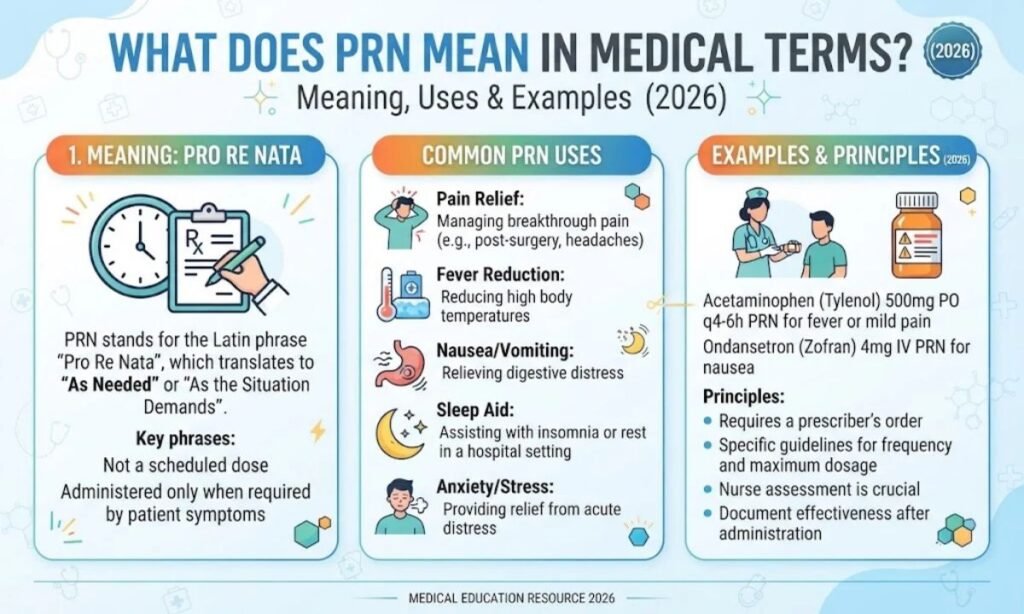
PRN is a short term you will often see on prescriptions, medicine labels, and hospital charts. In medical terms, PRN means “as needed.” It comes from the Latin phrase pro re nata. It tells you a medicine or service should be used only when a real need appears.
This guide explains the PRN meaning in simple words. You will learn how it works in hospitals, at home, and in mental health care. You will also see real examples, common myths, and tips to use PRN medicine safely.
PRN Quick Meaning
PRN stands for the Latin phrase pro re nata. It means “for the thing born” or, in plain English, “as the situation arises.” In healthcare, it simply means “take or give this only when needed.”
A PRN medicine is not taken on a fixed clock. You take it when a specific symptom shows up. When the symptom is gone, you do not need the medicine.
Here is the PRN meaning at a glance:
| Item | Details |
| Full form | Pro re nata |
| Language | Latin |
| Plain meaning | As needed |
| Used by | Doctors, nurses, pharmacists, caregivers |
| Where you see it | Prescriptions, medication charts, care plans |
| Opposite idea | Scheduled or routine dosing |
| Key rule | Only when the listed symptom appears |
Simple Examples
Examples make the PRN medical abbreviation easier to understand. Look at these common cases:
- Ibuprofen 400 mg every 6 hours PRN for pain. You take it only when you have pain, and never sooner than 6 hours apart.
- Ondansetron PRN for nausea. You take it only when you feel sick to your stomach.
- Salbutamol inhaler PRN for wheezing. You use it when breathing becomes tight.
- Lorazepam PRN for severe anxiety. A clinician gives it only when symptoms reach a certain level.
Notice the pattern. Each PRN order has a reason, a dose, and a time limit between doses. That is what keeps PRN use safe.
Origin & Background
The term goes back to Latin, which was the shared language of medicine for centuries. Doctors wrote prescriptions in Latin so that they could be understood across countries. Many short forms from that era are still in use today.
Pro re nata was used long before modern hospitals existed. Physicians needed a quick way to say, “Give this if the problem returns.” PRN became the shorthand.
Today, PRN appears in electronic health records, pharmacy systems, and nursing notes. Some Latin abbreviations have been dropped because they caused errors. PRN has stayed because it is short, clear, and widely understood.
Modern safety guidelines now ask prescribers to add detail. A good PRN order names the symptom, the dose, the route, and the maximum amount in 24 hours. This turns a loose “as needed” into a clear instruction.
Real-Life Conversations (How People Actually Ask About PRN)
Most people first meet PRN on a label or in a hospital discharge note. They then ask friends, family, or a caregiver what it means. These short chats show how real questions sound.
WhatsApp Chat
Sara: The doctor wrote “paracetamol PRN” on my dad’s paper. What does PRN mean?
Ali: It means as needed. He takes it only when he has pain or fever.
Sara: So not every morning?
Ali: Right. Check the paper for the gap between doses and the daily limit.
People often use chat apps to double check a medical word. The best habit is to confirm the details with the pharmacist too.
Instagram DM
Mina: My nurse friend wrote “PRN shift today” in her story. Is that a medicine thing?
Jo: Not this time. It means she works on call, only when the hospital needs extra staff.
Mina: Oh, that is a new one for me!
This is a good reminder that PRN has more than one use. The context tells you which meaning applies.
Text Message
Mom: Pharmacy says my inhaler is PRN. Should I use it daily?
Lena: No, Mom. PRN means use it when you feel wheezy. Your other inhaler is the daily one.
Mom: Okay, I will keep it in my bag.
Short messages like this are very common. They show that people want a simple, calm answer.
Emotional & Psychological Meaning
For many patients, “as needed” feels confusing. They wonder, “Am I allowed to take it? Is my pain bad enough?” That doubt is normal.
Some people feel guilty about using PRN medicine. They think they should be strong and avoid it. Others feel afraid they will depend on it. These worries can lead to needless suffering.
On the other side, PRN can bring comfort. Knowing a backup option exists lowers stress. A person with panic attacks, for example, may feel calmer just because their PRN plan is in the bag.
Here are common feelings linked to PRN:
- Relief: “I have a plan if symptoms come back.”
- Guilt: “Maybe I should tough it out.”
- Fear: “What if I take too much or get hooked?”
- Control: “I decide when I need it, within safe limits.”
Talk openly with your care team about these feelings. A good clinician will explain when to use PRN medicine and when to call for help.
Usage in Different Contexts
PRN shows up in many places. The core idea stays the same, but the details change by setting.
Hospital Settings
In hospitals, a doctor writes a PRN order. A nurse then decides when the patient meets the need. The order lists the symptom, the dose, and the minimum time between doses.
Nurses assess the patient before giving a PRN dose. They check pain scores, vital signs, or symptoms. After the dose, they check again to see if it worked and write it in the chart.
Common hospital PRN items include pain relievers, anti nausea drugs, sleep aids, and laxatives. Oxygen or a repeat test can also be PRN in some plans.
At Home
At home, you are your own first line of care. PRN labels guide you on when to take a dose. Keep the label, the daily limit, and the time of each dose in view.
A simple notes app or paper log helps. Write the time and the reason for each dose. This stops accidental double dosing, especially for families with several caregivers.
Store PRN medicine safely, away from children. Check expiry dates often. If you need it more often than planned, call your doctor instead of taking extra.
Mental Health Treatment
In mental health care, PRN medicines may be used for short term anxiety, agitation, or trouble sleeping. The care team sets clear triggers for use. Many plans also include non drug steps, such as breathing exercises or a quiet room.
PRN does not replace therapy or daily treatment. It is a short term tool for hard moments. If a person needs PRN doses often, the treatment plan usually needs a review.
Always report side effects like heavy drowsiness or confusion. Some mental health PRN drugs can cause dependence if overused, so follow the prescriber’s limits closely.
Work & Professional Settings
PRN also describes a type of job. A PRN nurse or PRN staff member works only when a facility needs extra help. Schedules are flexible and hours are not guaranteed.
You may also hear the term per diem, which means “by the day.” In many places, PRN and per diem are used in a similar way.
| Work Term | What It Means | Typical Benefit | Typical Drawback |
| PRN staff | Works when needed | Flexible schedule | Uncertain hours |
| Part time | Fixed, smaller hours | Steady routine | Fewer benefits in some jobs |
| Full time | Standard weekly hours | Stable income | Less flexibility |
Common Misunderstandings
Many mistakes come from reading PRN too loosely. Let us clear up the biggest ones.
“PRN means once daily.”
This is false. PRN has nothing to do with a daily schedule. Once daily is a fixed routine. PRN depends on symptoms, not on the clock.
“You can take unlimited doses.”
This is dangerous. PRN always has limits. Orders include a minimum gap between doses and a maximum total in 24 hours. Going past those limits can cause overdose or serious side effects.
“PRN means optional, so it doesn’t matter.”
PRN is not careless or optional in the sense of unimportant. The medicine matters a lot when the need arises. The flexibility is about timing, not about safety.
“If I feel better, I can stop everything.”
Be careful here. You can stop a PRN medicine when symptoms are gone. But do not stop your other scheduled medicines without asking your doctor. PRN and daily treatments often work as a team.
Comparison Table
This table shows how PRN differs from other order types.
| Order Type | Meaning | When It Is Given | Example |
| PRN | As needed | When a set symptom appears | Pain tablet for headache |
| Scheduled | At fixed times | Every day at set hours | Blood pressure pill each morning |
| STAT | Immediately | Right now, urgent | Emergency injection |
| One time order | A single dose | Once only | Vaccine dose |
| Standing order | Pre approved protocol | When criteria are met | Flu shot protocol in a clinic |
Key Insight
PRN is flexible, but it is never unlimited. The “as needed” part is about timing. The dose, the gap, and the daily maximum are still strict. Think of PRN as a safety net with clear edges.
Variations / Types of PRN Use
PRN can look different depending on the situation. Here are the main types you will meet.
- PRN medication: A drug used only when a symptom appears, such as pain or nausea.
- PRN dose: A single extra dose given for a breakthrough symptom, often alongside a regular dose.
- PRN order: The written instruction from a prescriber that allows the PRN use.
- PRN with parameters: An order that adds rules, such as “give only if blood pressure is above a set number.”
- PRN staffing: A job role where work is offered only when needed.
- PRN care task: A service done when needed, like wound dressing changes or oxygen checks.
| Type | Common Example | Who Decides |
| Pain PRN | Acetaminophen for mild pain | Nurse or patient, within the order |
| Nausea PRN | Ondansetron for vomiting | Nurse or patient |
| Anxiety PRN | Short term calming medicine | Nurse or clinician |
| Breathing PRN | Rescue inhaler | Patient |
| Job PRN | Extra shift coverage | Employer and worker |
How to Respond When Someone Uses It
Sometimes a friend, patient, or coworker says, “That is a PRN medicine,” or “I work PRN.” You may want to reply in a helpful way. Choose a tone that fits the moment.
Casual Replies
- “Oh, so you only take it when you need it? Got it.”
- “Thanks for explaining. That makes sense.”
- “Good to know. Do you keep it with you?”
Funny Replies
- “So it is a medicine with no fixed schedule. Just like my sleep!”
- “PRN sounds like a superhero. Pro Re Nata to the rescue.”
- “Finally, a medicine that works on my terms.”
Keep humor light and kind. Do not joke if the person is in pain or upset.
Mature / Confident Replies
- “PRN means as needed, so it is taken only when symptoms appear.”
- “I understand. As long as the dose limits are followed, that sounds like a good plan.”
- “Please check with your doctor if you need it more often than planned.”
Private / Respectful Replies
- “Thanks for telling me. I will keep it between us.”
- “If you ever want company when you need to take it, I am here.”
- “No pressure to explain. I just want you to feel supported.”
Respect privacy with health topics. Not everyone wants to share why they take a medicine.
Regional & Cultural Usage
The PRN abbreviation is used worldwide in English language healthcare. Still, how people talk about it can change by place and culture.
Western Countries (US, UK, Canada)
In the US, UK, and Canada, PRN is standard on prescriptions, hospital charts, and pharmacy labels. Patients often hear it from nurses and pharmacists. Many pharmacy labels now write “as needed” in full words for clarity.
In nursing jobs, PRN staffing is very common in the US. In the UK, you may hear “bank staff” for similar flexible work, while “PRN” is more common on medicine charts.
Asian Countries
In many Asian countries, hospitals use English medical abbreviations such as PRN in records and training. Patients may get instructions in the local language on the label, and the doctor explains PRN in simple words. In this case, family members often help manage doses at home.
Because language can be a barrier, it helps to ask the pharmacist to write the instructions in your own language. Clear translation prevents mix ups.
Middle Eastern Countries
In Middle Eastern healthcare systems, English is widely used in hospitals, and PRN appears in orders and nursing notes. Many patients receive spoken guidance in Arabic or another local language along with the written English label.
Family involvement in care is often strong. Relatives may ask about PRN medicines on behalf of a patient, so clear, simple instructions and a written dose log are useful.
Global Internet Culture
Online, PRN has a few extra meanings. Chat users may mention “PRN” when talking about medicine routines, nursing jobs, or health tips. Social media nurses often post about “PRN shifts” and flexible work life.
Be careful with online advice. A forum post cannot replace your own prescription. Use the internet to learn the word, but rely on your healthcare team for your dose.
Frequently Asked Questions
What does PRN mean in medical terms?
PRN means “as needed.” It comes from the Latin phrase pro re nata.
What does PRN stand for?
PRN stands for pro re nata, a Latin phrase meaning “as the situation arises.”
How often can I take a PRN medicine?
Only as often as your prescription allows. Check the minimum gap between doses and the daily maximum.
Is PRN medicine safe to use every day?
It depends on the drug and your doctor’s plan. If you need it daily, talk to your doctor about your treatment.
What is the difference between PRN and scheduled medicine?
Scheduled medicine is taken at fixed times. PRN medicine is taken only when a symptom appears.
What does a PRN nurse do?
A PRN nurse works flexible shifts and fills in when a facility needs extra staff.
Can I take two PRN medicines at once?
Only if your doctor or pharmacist says it is safe. Some drugs interact or contain the same ingredient.
Final Thoughts
PRN is a small abbreviation with a big job. It tells you that a medicine or service is used only when the need arises. The idea is simple, but safe use depends on the details: the reason, the dose, the time gap, and the daily limit.
If you ever feel unsure, ask. Your doctor, nurse, or pharmacist can explain your PRN plan in plain words. A short question today can prevent a mistake tomorrow, and it helps you use your medicine with confidence and care.

Muhammad Shoaib is a content creator and SEO professional who enjoys making language and vocabulary easy to understand. He writes helpful content about word meanings, phrases, slang, abbreviations, spelling differences, and everyday expressions. nThrough WhizzMean, Shoaib focuses on creating clear, simple, and practical explanations that help readers quickly understand confusing words and language-related questions.