
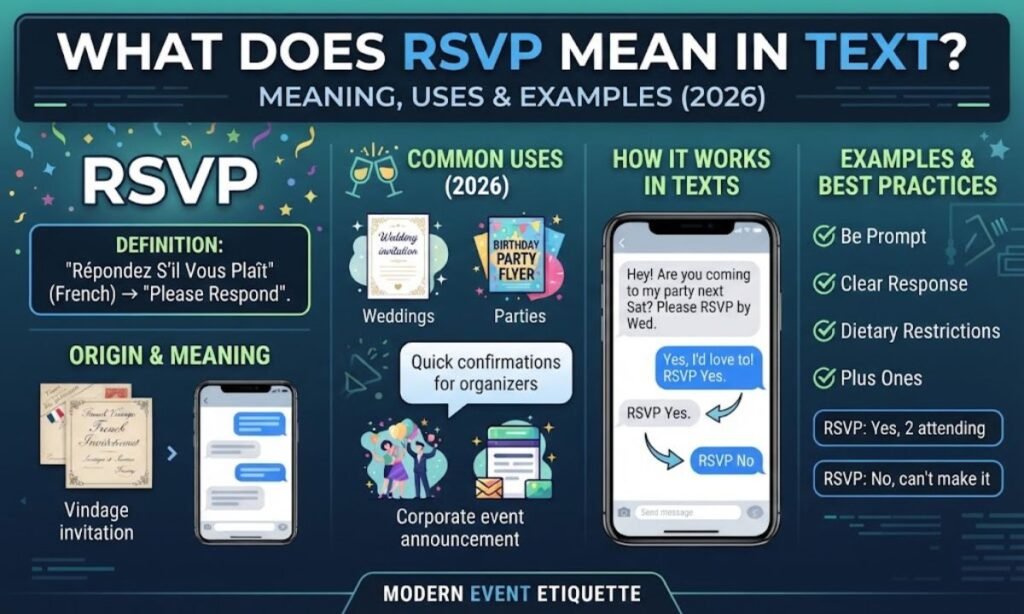
You may have seen “RSVP” at the end of an invite and wondered what it asks you to do. It shows up on party invites, group chats, and event pages. In text, RSVP means “please reply” and asks you to confirm if you will attend. It helps the host plan with less stress.
This guide explains the RSVP meaning in text in simple words. You will see real chat examples and learn where the term comes from. You will also find common mistakes, smart replies, and how people use it around the world.
RSVP Meaning in Text – Quick Meaning
RSVP is short for the French phrase répondez s’il vous plaît. It means “please respond.” When someone adds RSVP to a message, they want to know if you are coming or not.
A host needs a headcount. It helps them book seats, order food, and plan space. A quick reply from you makes their job much easier.
| Detail | What It Means |
| Abbreviation | RSVP |
| Full form | Répondez s’il vous plaît |
| Language | French |
| Plain meaning | Please reply |
| Used for | Parties, weddings, meetings, events |
| Tone | Polite, can be casual or formal |
| Common apps | WhatsApp, Instagram, iMessage, email |
| Expected action | Say yes, no, or maybe |
Simple Examples:
Short examples make the meaning clear. Here is how people use RSVP every day:
- “Dinner at my place on Friday. RSVP by Wednesday.” Tell the host if you can come before Wednesday.
- “Birthday party on Saturday! Please RSVP.” Reply yes or no.
- “Team lunch tomorrow. RSVP in the group.” Confirm your spot in the chat.
- “Please RSVP if you are bringing a guest.” Tell the host about your plus one.
In each case, the word is a polite nudge to answer.
Origin & Background
RSVP comes from French. In the 1700s and 1800s, French was the language of high society in Europe. Fancy invitations often used French phrases to look elegant. Répondez s’il vous plaît became a standard line at the bottom of formal cards.
English speakers soon adopted the short form. They kept it on wedding cards, dinner invites, and royal events. The letters made the phrase quick to write and easy to spot.
Over time, the term moved from paper cards to phones. Today it appears in texts, emails, and online event pages. The meaning stayed the same, but the style became more relaxed.
How It Evolved:
The path of RSVP is simple. It began on printed cards and now lives in chat apps.
| Period | How RSVP Was Used |
| 1700s to 1800s | Formal French invites in high society |
| 1900s | Standard on wedding and party cards |
| Late 1900s | Used on printed and mailed invitations |
| 2000s | Email invites and online event pages |
| Today | Texts, group chats, and social media |
Digital tools made replies faster. Many apps now have a “Going” or “Not going” button. Still, people often type “RSVP” in plain chat messages.
Real-Life Conversations (How People Actually Use RSVP)
RSVP is a very natural chat word. Here are three common situations.
1. WhatsApp Group Chat
Hira: Hi all! Farewell lunch for Sam on Thursday at 1 pm. Please RSVP by tomorrow.
Omar: Count me in!
Zoya: I can’t make it this time. Enjoy!
Hira: Thanks both. Noted.
In group chats, RSVP helps the organizer get fast answers. A short reply is enough.
2. Instagram DMs
Nina: We are doing a small rooftop movie night on Saturday. RSVP here if you want to join.
Jake: Sounds fun! I am in. Can I bring a friend?
Nina: Of course. I will add you both.
On Instagram, RSVP often happens right in the DM. It feels casual and friendly.
3. Casual Text Message
Mom: Aunt Rita’s dinner is on Sunday. RSVP so I can tell her how many are coming.
Sam: Yes, I will be there with Leo.
Mom: Perfect, thank you.
Even in family texts, RSVP keeps plans clear. It shows respect for the host’s effort.
Emotional & Psychological Meaning
RSVP seems like a small word, but it carries feelings. For hosts, it brings hope and a little worry. They want to know who will show up.
For guests, it can bring pressure. Some people feel nervous about saying no. Others hesitate because they are unsure of their plans. These feelings are normal.
A quick, honest reply shows kindness. It tells the host, “I value your time and effort.” It also makes you look reliable.
What It Reflects:
Using RSVP often reflects a few traits:
- Respect: You care about the host’s planning.
- Reliability: You give a clear answer on time.
- Organization: You manage your plans well.
- Care: You think about how your reply affects others.
- Honesty: You say yes or no without false hope.
Ignoring an RSVP can send the opposite signal. The host may feel unimportant or confused. A simple reply avoids that.
Usage in Different Contexts
RSVP changes a little based on where you see it. Let us look at the main settings.
1. Social Media
On social media, RSVP appears on event pages, stories, and posts. Many platforms let you click “Going,” “Interested,” or “Not going.” These count as digital RSVPs.
Creators and small businesses also use it for launches, workshops, and live sessions. A clear call to RSVP helps them plan.
2. Friends & Relationships
Among friends, RSVP is relaxed. A quick “I am in” or “Can’t make it” is perfect. Friends often skip the formal word and just ask, “Are you coming?”
In romantic plans, RSVP may be used for dinners, trips, or family events. A fast answer shows you care about the plan and the person.
3. Work or Professional Settings
At work, RSVP is common for meetings, trainings, and office parties. Replying on time helps managers book rooms and order food. It also shows professionalism.
In work emails, use clear wording such as “I will attend” or “I am unable to join.” Short and polite works best.
4. Casual vs Serious Tone
| Situation | Tone | Example Reply |
| Friend’s party | Casual | “I am in!” |
| Group chat | Casual | “Count me in.” |
| Work meeting | Professional | “I will attend. Thank you.” |
| Wedding invite | Formal | “We are delighted to accept.” |
| Sad or tough event | Respectful | “I will be there to support you.” |
Match your reply to the tone of the invite. A formal card needs a polite answer. A friendly text can have a lighter one.
Common Misunderstandings
RSVP is simple, but people still get it wrong. Here are four common mistakes.
1. Thinking RSVP Means “You Must Come”
RSVP does not force you to attend. It only asks for a reply. You can say yes, no, or maybe. What matters is that you answer.
2. Ignoring RSVP Requests
Some people believe no reply means no. That is not fair to the host. Silence leaves them guessing. Always respond, even if the answer is no.
3. Assuming It’s Always Formal
Many think RSVP belongs only on wedding cards. In truth, it is common in casual texts and group chats too. You can use it for a small hangout.
4. Responding Too Late
A late reply can cause real problems. The host may have already booked seats or ordered food. Reply by the date given, or as soon as you know your plans.
When NOT to Use RSVP
RSVP is helpful, but it does not fit every message. Skip it in these cases:
- Open events with no headcount: If anyone can walk in, you do not need replies.
- Quick everyday questions: “Are you free later?” works better than “RSVP.”
- Emergency messages: Use clear, direct words instead.
- Serious or sensitive talks: A warm, personal question feels kinder.
- Mass spam style posts: Too many RSVP demands feel pushy.
Use RSVP only when you truly need a reply. That keeps it meaningful.
Comparison Table
This table compares RSVP with similar words used in invites and chats.
| Term | Meaning | Tone | Best Used For |
| RSVP | Please reply | Polite | Parties, events, meetings |
| Confirm | Verify your attendance | Neutral | Appointments, bookings |
| Let me know | Tell me your answer | Casual | Friendly plans |
| Save the date | Mark your calendar | Formal or friendly | Early event notice |
| Regrets only | Reply only if not coming | Formal | Weddings, large events |
| TBD | To be decided | Neutral | Plans not finalized |
Key Insight:
RSVP is a polite request for a clear answer. It protects the host’s time and helps the event run smoothly. A prompt reply, even a “no,” is always better than silence.
Variations / Types of RSVP Usage
People use RSVP in many forms. Each one changes the message slightly.
1. RSVP ASAP
This means “reply as soon as possible.” The host needs your answer quickly. Use it when plans are close.
2. RSVP by [date]
This sets a deadline. For example, “RSVP by Friday.” Reply before that date.
3. RSVP only if attending
This means the host wants replies from yes guests only. If you are not coming, you do not need to answer. Read this one carefully.
4. RSVP required
This means a reply is a must. Guests may not get entry or a seat without it.
5. RSVP via link
Here you reply by clicking a link. It may open a form or event page.
6. RSVP in DM
You send your answer through a direct message. It keeps replies private and organized.
7. RSVP to confirm seat
Your reply holds a spot. Common for workshops, dinners, and limited events.
8. RSVP +1
You can bring one guest. Tell the host if you plan to do so.
9. RSVP maybe
You are unsure. Some hosts allow this option, but update them soon.
10. No RSVP needed
The host does not need a reply. You can simply show up.
| Variation | What You Should Do |
| RSVP ASAP | Reply quickly |
| RSVP by [date] | Reply before the deadline |
| RSVP only if attending | Reply only if you will come |
| RSVP required | Reply without fail |
| RSVP via link | Click and fill the form |
| RSVP in DM | Send a private message |
| RSVP to confirm seat | Reply to reserve your spot |
| RSVP +1 | Mention your guest |
| RSVP maybe | Share your status and update soon |
| No RSVP needed | Just attend if you wish |
How to Respond When Someone Uses RSVP
A good reply is short, clear, and polite. Pick a tone that fits the invite and the person.
Casual Replies
- “Yes, I will be there!”
- “Count me in.”
- “Sorry, I can’t make it this time.”
Funny Replies
- “RSVP received. Snacks will be judged.”
- “I am in, as long as there is cake.”
- “Yes! My calendar just did a happy dance.”
Keep humor light. Do not joke if the event is serious or sad.
Mature / Confident Replies
- “Thank you for the invitation. I will attend.”
- “I appreciate the invite, but I am unable to join.”
- “I plan to be there and will confirm if anything changes.”
Private / Respectful Replies
- “Thank you for inviting me. I cannot attend, but I wish you the best.”
- “I will send my answer in a private message soon.”
- “I appreciate the thought. I prefer not to share details, but I hope it goes well.”
You never have to explain why you cannot attend. A kind and short reply is enough.
Regional & Cultural Usage
RSVP is known worldwide. Still, habits around replying differ by culture.
Western Culture
In the US, UK, and Canada, RSVP is a standard part of event planning. Hosts expect a reply, and guests usually give one. Weddings, baby showers, and office events all use it.
Western hosts often set clear deadlines. Replying on time is seen as good manners.
Asian Culture
In many Asian countries, invitations are often given in person or by phone call. Formal RSVP cards are common for weddings, but casual events may rely on chat messages. Some guests may reply less directly out of politeness.
Hosts may follow up with a call or message. A clear and kind answer helps avoid confusion.
Middle Eastern Culture
In the Middle East, hospitality is very important. Invitations are often sent through WhatsApp or by phone. Guests may reply with warm phrases and confirm closer to the date.
For big family gatherings, hosts may expect a clear headcount. A short, polite reply is always appreciated.
Global Internet Usage
Online, RSVP is built into many event tools. People click “Going” buttons, fill forms, or reply in group chats. The word is also used in webinars, live streams, and virtual meetups.
Because online events can be joined from anywhere, RSVP helps organizers plan links, slots, and reminders.
Frequently Asked Questions
What does RSVP mean in text?
RSVP means “please reply.” It asks you to confirm if you will attend.
What does RSVP stand for?
It stands for the French phrase répondez s’il vous plaît, meaning “please respond.”
Do I have to reply to an RSVP?
Yes, it is polite to reply. Even a “no” helps the host plan.
How do you reply to an RSVP in a text?
Say yes or no clearly. For example, “Thanks for the invite, I will be there.”
What does “RSVP only if attending” mean?
It means reply only if you plan to come. If you are not coming, you may skip it.
Is RSVP formal or casual?
It can be both. It suits formal cards and casual chats alike.
How long before an event should I RSVP?
Reply by the deadline given, or as soon as you know your plans.
Final Thoughts
RSVP is a small word with a big purpose. It turns a simple invite into a clear plan. A quick reply helps the host organize food, seats, and time. It also shows that you respect their effort and care about the event.
Next time you see RSVP in a message, answer promptly and kindly. Keep your reply short, honest, and fitting for the tone. A clear yes or no may seem minor, but it makes every gathering smoother for everyone involved.

Muhammad Shoaib is a content creator and SEO professional who enjoys making language and vocabulary easy to understand. He writes helpful content about word meanings, phrases, slang, abbreviations, spelling differences, and everyday expressions. nThrough WhizzMean, Shoaib focuses on creating clear, simple, and practical explanations that help readers quickly understand confusing words and language-related questions.