
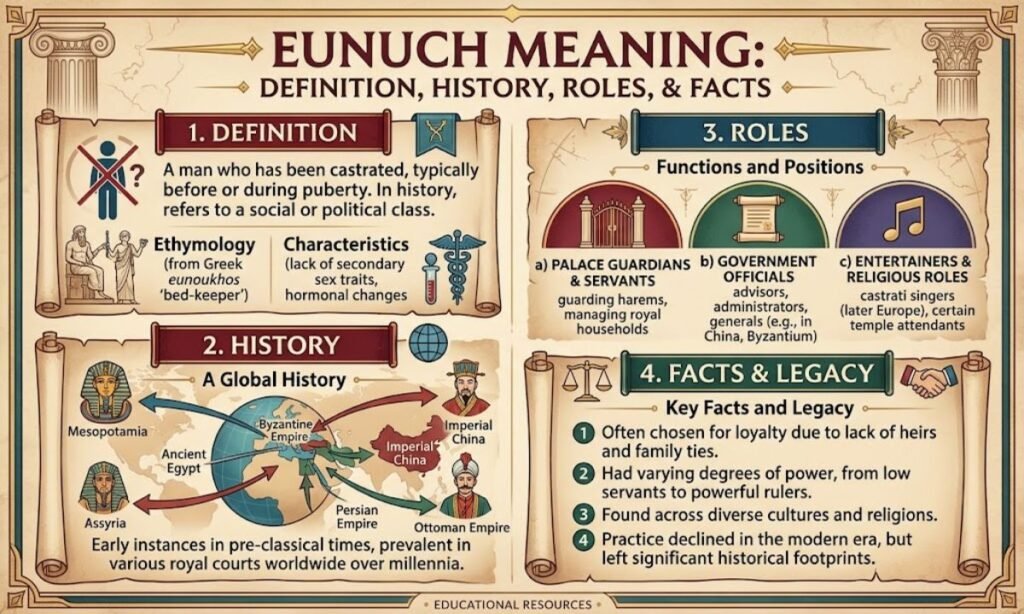
A eunuch is a man who has been castrated. This means his testicles were removed or made non-functional. The word is also used for men born without working testicles. In most cases, people use it for the castrated men who served in royal courts, temples, and households in the past.
This guide explains the eunuch meaning in simple words. You will learn where the word comes from, why eunuchs existed, and what roles they played. You will also see how the term is used today.
What Is the Meaning of Eunuch?
The dictionary definition of a eunuch is simple. A eunuch is a castrated man. Castration stops the body from making normal levels of testosterone. This changes how the body grows, how the voice sounds, and whether a man can have children.
In history, the term most often points to men who worked as palace servants, guards, or officials. Many were castrated by force. Some chose it to gain a career. Others were castrated as a punishment.
The word can also describe a man with a medical condition that affects the testes. In everyday speech, people sometimes use it as an insult. That use is rude and inaccurate.
Here are the key points to remember:
- A eunuch is a male who lacks functioning testes.
- Castration can happen before or after puberty.
- The effects depend on the age at which it happens.
- The term is mostly historical today.
Origin and Word History of Eunuch
The word “eunuch” comes from the ancient Greek word eunouchos. Most scholars break it into two parts: eune, meaning bed, and echein, meaning to keep or guard. So the word is often explained as “keeper of the bed.”
This fits how eunuchs were used. Rulers trusted them to guard the private rooms of queens and royal women. A castrated man was not expected to father children with the women he guarded.
The Greek word later passed into Latin as eunuchus. From there it entered English and other European languages. Similar roles existed in many cultures that used different words for the same idea.
Types of Eunuchs
Not every eunuch was made the same way. Experts group them by cause and by method. The table below gives a quick view.
| Type | How it happened | Common setting |
| Forced eunuch | Castrated as a child or captive | Slavery, war, palace service |
| Voluntary eunuch | Chose the procedure for a career | Imperial China |
| Punishment eunuch | Castrated as a legal penalty | Ancient China, other courts |
| Religious eunuch | Castrated for faith or temple service | Ancient temples, some sects |
| Congenital eunuch | Born without working testes | Medical cases |
| Medical eunuch | Surgery for illness such as cancer | Modern medicine |
Age matters a great deal. A boy castrated before puberty never develops typical adult male traits. A man castrated after puberty keeps some of them, but the body still changes over time.
Why Were Eunuchs Created in History?
Rulers had practical reasons. A eunuch could not start a family dynasty. This made him seem safer to put in a position of trust. He had no sons to inherit power or to plot a takeover.
Eunuchs were also seen as ideal guards for royal women. Kings wanted to protect the bloodline. A castrated servant was believed to be no threat to it.
Other reasons included:
- Loyalty: Many eunuchs depended entirely on one ruler for status.
- Outsider status: Often they were foreigners or slaves with no local clan to support them.
- Singing: In Europe, some boys were castrated to keep high voices.
- Punishment: Some legal systems used castration to humiliate and silence a person.
These reasons do not make the practice ethical. Most eunuchs had no real choice. Many were children when it happened, and many died from the surgery.
Eunuchs in Ancient Empires
Eunuchs appeared across the ancient and medieval world. They are recorded in Mesopotamia, Persia, Egypt, Greece, Rome, China, and the Islamic world. Their roles changed by region.
| Empire or region | Typical role of eunuchs |
| Assyria and Persia | Court officials, attendants, guards |
| Roman Empire | Household servants, priests of some cults |
| Byzantine Empire | Senior administrators, generals, church officials |
| Imperial China | Palace staff, advisers, sometimes powerful ministers |
| Ottoman Empire | Harem guards and palace managers |
In Byzantium, eunuchs could rise very high. Some became commanders and top advisers. Because they could not found a ruling family, emperors often trusted them with major tasks.
The Ottoman court had a well known head of harem guards. He was called the Chief Black Eunuch, or Kizlar Agha. This office carried real influence in the palace.
Eunuchs in Imperial China
China had one of the largest eunuch systems in history. Thousands served in the Forbidden City at times. Some men even chose castration to enter palace service, hoping for wealth and rank.
A few became very powerful. They managed the emperor’s household, handled letters, and sometimes shaped state policy. Others held military or naval command. The admiral Zheng He, who led Ming dynasty sea voyages, is the most famous example.
The historian Sima Qian of the Han dynasty is another well known case. He was castrated as a punishment, yet he went on to finish a major history of China.
The system ended in the early twentieth century. After the last emperor, Puyi, was pushed out of the Forbidden City in 1924, the palace eunuchs were dismissed.
Eunuchs in Religion and Culture
Religious texts mention eunuchs in several places. The Bible refers to them, including in the New Testament story of an Ethiopian official who met the apostle Philip. Another passage records a teaching about men who live without marriage for spiritual reasons.
In ancient Anatolia, priests of the goddess Cybele, called Galli, were known for ritual castration. In 19th century Russia, a sect called the Skoptsy practiced castration as a religious act.
Music is another area. From the 16th to the 18th century, some Italian boys were castrated to keep a high singing voice. They were called castrati. Church choirs and opera houses valued them.
The practice faded as public opinion changed. The last famous castrato, Alessandro Moreschi, recorded early audio in the early 1900s.
Physical and Health Effects of Castration
Testosterone shapes many male traits. Without it, the body changes. The changes are stronger when castration happens before puberty.
Common effects include:
- A higher voice that does not deepen
- Little or no facial hair
- Longer arms and legs, because bone growth plates close late
- Lower muscle mass
- Loss of fertility
- Reduced sex drive in many cases
- Weaker bones over time, known as osteoporosis
- Hot flashes, mood changes, and low energy
Modern doctors treat low testosterone with hormone therapy. This can reduce many of these effects. In the past, eunuchs had no such option, and many faced lifelong health problems.
Eunuch Meaning in the Modern World
Today, the traditional eunuch role has almost vanished. Forced castration for palace service is illegal in nearly every country. The word now appears mostly in history books, religious studies, and literature.
Medical castration still exists in a different form. Doctors may remove the testes, a procedure called orchiectomy, to treat advanced prostate cancer. Some transgender women also choose it as part of gender-affirming care. These are medical decisions made with consent.
In South Asia, the word is sometimes linked with the hijra community. Many hijras are not eunuchs in the strict sense. Hijra is a recognized social identity, and people within it have different life stories. Using “eunuch” for them can be inaccurate or disrespectful, so careful language is best.
Common Myths About Eunuchs
Many ideas about eunuchs are only half true. Here are a few worth correcting.
- Myth: All eunuchs were weak. Fact: Some were generals, admirals, and top ministers.
- Myth: All eunuchs chose their fate. Fact: Most had no choice.
- Myth: Eunuchs only guarded harems. Fact: They also served as clerks, tax officers, singers, and priests.
- Myth: Eunuch is a modern gender label. Fact: It is mainly a historical and medical term.
Frequently Asked Questions
What does eunuch mean in simple words?
A eunuch is a man who has been castrated or was born without working testes. The term mostly describes servants and officials in historical courts.
Where does the word eunuch come from?
It comes from the Greek word eunouchos, often explained as “keeper of the bed.” It linked to guarding private royal rooms.
Why were eunuchs used in palaces?
Rulers saw them as trustworthy because they could not start a rival family line. They were also trusted to guard royal women.
Could eunuchs have children?
No. Castration removes the testes, so a eunuch cannot father children naturally.
Were eunuchs powerful in history?
Some were. In China, Byzantium, and the Ottoman court, certain eunuchs held major offices and influenced rulers.
Are there eunuchs today?
The traditional court eunuch no longer exists. Some men undergo castration for medical reasons, such as prostate cancer treatment.
Is eunuch an offensive word?
It can be, depending on use. As a historical or medical term it is neutral, but as an insult it is hurtful and inaccurate.
Final Thoughts
The eunuch meaning is simple on the surface, but the history behind it is deep. A eunuch was a castrated man, and in many empires he became a servant, guard, adviser, or even a state leader. The role shows how rulers used power, trust, and fear to build their courts. It also shows the high human cost that came with those systems.
Today, the word belongs mainly to history, religion, and medicine. Knowing its origin and context helps you read old texts with more clarity. It also helps you avoid careless use of the term. If you meet the word in a book, a museum, or a news story, you now have the background to understand it well.

Muhammad Shoaib is a content creator and SEO professional who enjoys making language and vocabulary easy to understand. He writes helpful content about word meanings, phrases, slang, abbreviations, spelling differences, and everyday expressions. nThrough WhizzMean, Shoaib focuses on creating clear, simple, and practical explanations that help readers quickly understand confusing words and language-related questions.