Have you read the word “facetious” and wondered what it really means? You are not alone. People often see it in books, emails, and news stories, then stop and search for it.
In short, facetious means joking about something, often at the wrong time. The speaker is not serious. They are being playful, cheeky, or silly on purpose.
This guide explains the facetious meaning in plain words. You will learn its origin, synonyms, and real examples. You will also learn how it differs from sarcasm and how to use it well.
What Does Facetious Mean?
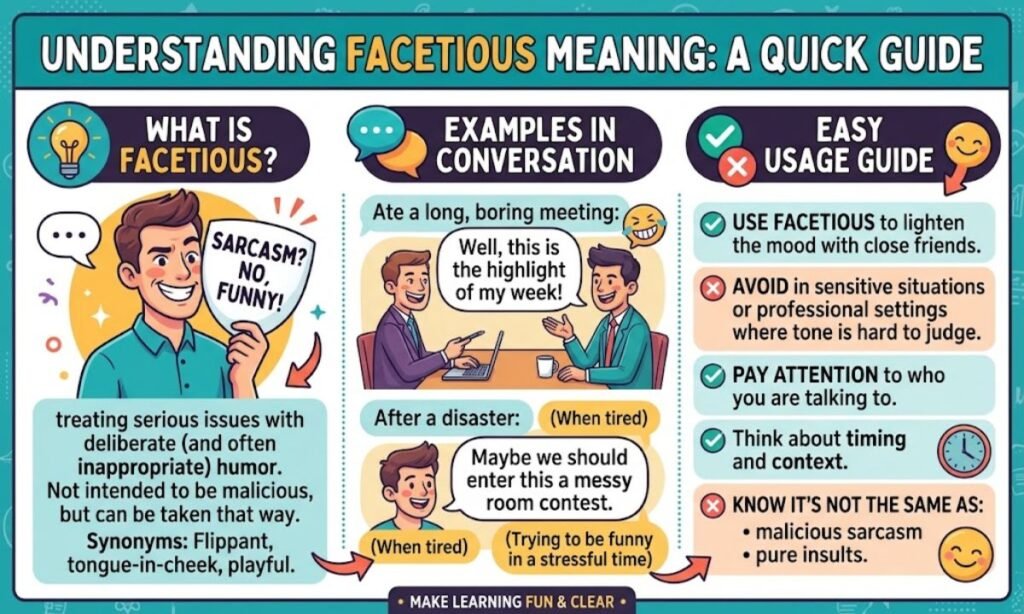
Facetious is an adjective. It describes words or actions that treat a serious subject with humor. The person does not mean what they say, or they do not want it taken seriously.
Dictionaries often define it as “not meant to be taken seriously” or “joking at an unsuitable time.” That second part matters. A facetious remark often lands in a moment that calls for a straight answer.
Here is a quick example. A teacher asks, “Why are you late?” A student says, “A dragon blocked the road.” The student is being facetious. Nobody believes the dragon story, and the student did not expect them to.
Key ideas to remember:
- Facetious remarks are playful, not honest.
- They often appear in serious or formal moments.
- The speaker usually knows the joke is not true.
- The tone can be light, cheeky, or a little rude.
Facetious Pronunciation and Word Forms
Many people ask how to say it. The word is pronounced fuh-SEE-shus. The stress falls on the second syllable. Say it slowly at first, then speed up.
The word also has related forms. You can use them in different sentence types. The table below shows each one.
| Word Form | Part of Speech | Example |
| Facetious | Adjective | That was a facetious comment. |
| Facetiously | Adverb | He answered facetiously. |
| Facetiousness | Noun | Her facetiousness annoyed the manager. |
Notice the spelling too. There is no “h” and no double “s” in the middle. It is f-a-c-e-t-i-o-u-s.
Origin and History of the Word Facetious
The word came into English in the late 1500s. It traces back to the French word facétieux. That word comes from facétie, which means a jest or a witty remark.
French took it from the Latin word facetia, meaning wit or joke. So the root has always been about humor. Over time, English speakers added a small twist. The word began to suggest humor that is out of place.
That twist explains why people use “facetious” with a hint of criticism. Calling someone witty is a compliment. Calling them facetious can mean they should have been more serious.
Facetious Examples in Everyday Life
Examples make any word easier to grasp. Below are common situations where people speak facetiously. Each one shows a joke in a place where a plain answer was expected.
At work
A manager says, “We need to cut costs.” A coworker replies, “Let’s stop paying the electricity bill.” Everyone knows it is a joke.
At home
A parent asks, “Did you clean your room?” A teenager says, “Yes, I buried everything in the backyard.” The answer is playful, not true.
In a shop
A customer asks if a coat is warm. The seller says, “Sure, it can survive on Mars.” The seller is not making a real claim.
In the news
A politician is asked about a long delay. He says, “We simply forgot about it for ten years.” Reporters may call the remark facetious.
Notice the pattern. The joke is clear, the topic is real, and the mood is light. That mix is the heart of facetious speech.
Facetious Synonyms and Antonyms
Knowing similar and opposite words helps you understand the term better. It also gives you more choices when you write. Some synonyms are stronger or milder than others.
| Synonyms (Similar Meaning) | Antonyms (Opposite Meaning) |
| Flippant | Serious |
| Jocular | Earnest |
| Tongue-in-cheek | Sincere |
| Joking | Solemn |
| Glib | Grave |
| Playful | Genuine |
| Teasing | Straightforward |
“Flippant” is the closest match. It also suggests a lack of respect for the topic. “Jocular” is gentler. It means jolly and fond of jokes, without much edge.
Facetious vs Sarcastic vs Humorous vs Ironic
These words get mixed up all the time. They overlap, but each has its own flavor. Here is a simple way to tell them apart.
| Word | Main Idea | Example |
| Facetious | A joke that is not serious, often at a bad time | “Let’s solve traffic by banning roads.” |
| Sarcastic | Saying the opposite to mock or hurt | “Great job,” after someone spills coffee. |
| Humorous | Anything funny, in any setting | A funny story at a party. |
| Ironic | A result that is the opposite of what you expect | A fire station burns down. |
Sarcasm usually has a sharp edge. The speaker wants to sting. Facetious remarks are lighter. The speaker wants to joke, or to dodge a serious answer.
Still, one comment can be both. If you say “Oh, brilliant plan” to mock a bad idea, that is sarcastic and a little facetious. Context decides which label fits best.
How to Recognize a Facetious Comment
Spotting a facetious remark takes practice. In person, you have many clues. In writing, you have fewer. Look for these signs.
- The answer is clearly absurd. Nobody could believe it.
- The tone is light. The speaker may smile or raise an eyebrow.
- The topic is serious. The joke does not match the mood.
- The speaker avoids a direct answer. The joke replaces facts.
- Exaggeration is heavy. Words like “obviously” or “of course” often appear.
Here is a quick test. Ask yourself, “Does the speaker want me to believe this?” If the answer is no, the comment is likely facetious.
When Is It Good to Be Facetious?
Facetious humor is not always bad. Used well, it can help people. It works best among friends, close teammates, or family who share the same sense of humor.
It can ease stress. A light remark during a tense meeting can make people breathe again. It can also make a long day feel shorter.
Good times to use it:
- With people who know you well
- In casual chats, not formal talks
- When the problem is small, not painful
- When you are sure the joke is clear
When Facetious Humor Goes Wrong
The same joke can hurt in the wrong room. Remember that the word often means “joking at a poor time.” Timing is everything.
Avoid facetious comments when someone is sad, sick, or scared. A joke can feel like you do not care. It can also hide the real answer they need.
Be careful in job interviews, legal matters, and customer service. A facetious reply there can sound rude or unprofessional. Some people may even take it as a real statement.
Online, the risk is higher. Readers cannot hear your voice. A joke in a text or comment may look like a serious claim. When in doubt, add a smile, an emoji, or a clear note that you are kidding.
How to Use Facetious in a Sentence
Using a new word is the best way to remember it. Here are sample sentences you can copy and adapt. Each one shows a slightly different shade of meaning.
- “I was being facetious when I said I would move to the moon.”
- “Her facetious reply made the whole class laugh.”
- “Don’t take him seriously. He is just being facetious.”
- “The mayor’s facetious remark about the pothole upset many voters.”
- “He answered facetiously, so I did not get a real answer.”
You can also use it to describe yourself. Saying “I was only being facetious” is a polite way to clear up a joke that did not land. It tells the listener, “Relax, I did not mean it.”
Facetious in Writing and Text Messages
Writers often use facetious tone to add personality. Bloggers, columnists, and comedians use it to keep readers smiling. It works well when the topic is heavy and the writer wants to keep things light.
In text messages, the challenge is tone. Without a voice, a joke can read as rude. Many people use “/s” at the end of a line to show sarcasm or a joke. Emojis serve a similar purpose.
If you write for work, use a lighter touch. One playful line in an email can be charming. A whole message of jokes may confuse the reader. Keep the key facts clear and the joke small.
A Fun Fact About the Word Facetious
Here is a bit of word trivia. “Facetious” contains all five vowels in alphabetical order: a, e, i, o, u. Very few English words do this. “Abstemious” is another famous one.
Word lovers enjoy sharing this fact. It also makes the spelling easier to remember. Just picture the vowels lining up in a neat row.
Frequently Asked Questions
What does facetious mean in simple words?
Facetious means joking or not serious, often at a time when a serious reply is expected.
How do you pronounce facetious?
It is pronounced fuh-SEE-shus, with the stress on the second syllable.
Is facetious the same as sarcastic?
No. Facetious is playful and not serious, while sarcastic usually mocks or stings with the opposite meaning.
Is being facetious rude?
It can be. It is fine among friends, but it can seem rude when the moment is serious.
What is a good example of a facetious comment?
Telling your boss “I finished the report by asking a wizard” is a facetious comment.
What is the opposite of facetious?
Words like serious, sincere, earnest, and solemn are the opposites of facetious.
Where does the word facetious come from?
It comes from the French word facétieux, which grew out of the Latin word facetia, meaning jest.
Final Thoughts
The facetious meaning is easy to hold on to once you see the pattern. It is a joke, told in a place where people may expect a serious answer. The speaker does not want to be believed. The goal is humor, relief, or a playful dodge.
Use the word with care, and use the tone with care too. Among friends, a facetious remark can brighten a day. In sensitive moments, it can sting. Read the room, keep your joke clear, and you will use this word and this style with confidence.

Muhammad Shoaib is a content creator and SEO professional who enjoys making language and vocabulary easy to understand. He writes helpful content about word meanings, phrases, slang, abbreviations, spelling differences, and everyday expressions. nThrough WhizzMean, Shoaib focuses on creating clear, simple, and practical explanations that help readers quickly understand confusing words and language-related questions.