Have you seen the word “elope” in a wedding story or a news post and wondered what it really means? You are not alone. The elope meaning has changed over time, and today it can point to a few different things.
This guide explains the word in plain English. You will learn its definition, origin, modern use, and related terms. You will also see examples, a few tables, and clear answers to common questions.
Elope Meaning in Simple Words
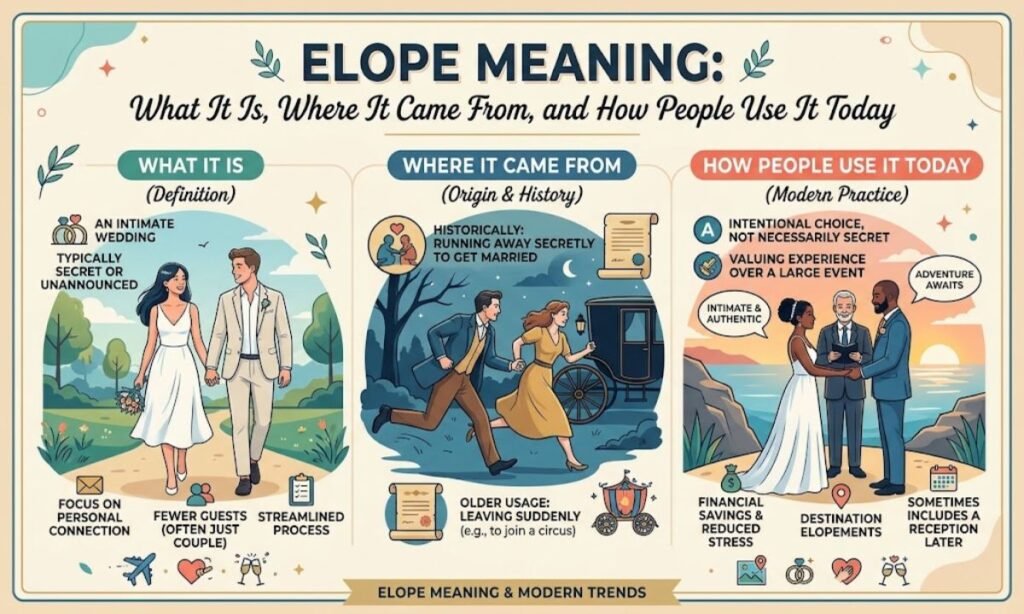
To elope means to run away and get married in secret. The couple usually leaves without telling family or friends. They marry first and share the news later.
In everyday talk, the word has a softer meaning now. Many people use it for any small, quiet wedding with no big guest list. The couple may even tell everyone ahead of time. They just skip the large party.
So the elope meaning depends on who is speaking. Older texts stress the secret and the escape. Modern wedding blogs stress the simple, private ceremony.
Here is a quick view of the word:
- Part of speech: verb (to elope)
- Noun form: elopement
- Past tense: eloped
- Present participle: eloping
- Person who does it: eloper
How to Pronounce Elope
The word is said as “ih-LOHP.” The stress falls on the second syllable. The “e” at the start sounds short, like the “i” in “it.”
The long “o” in the middle matches the sound in “hope” and “rope.” A simple trick is to think of “e” plus “lope.” Say it fast and you have it.
People often mix it up with “envelope” because of the similar ending. The two words are not related. One is about marriage and the other is about mail.
Origin and History of the Word
The word comes from older European roots. Many language experts link it to Anglo French and Middle Dutch words about running away. In early English, it first described a wife who left her husband to go with another man.
Over time, the meaning shifted. By the 1800s, it was tied to couples who ran off to marry. Young lovers often did this when parents did not approve.
History gives us a famous example. In the 1700s, English law made it hard for young people to marry without parental consent. Scotland had looser rules. A village called Gretna Green, just across the border, became a well known stop for couples in a hurry.
That story helped build the romantic image that still clings to the word. Many people still picture a late night dash, a fast car, and a quiet ceremony.
Modern Meaning of Elope in Weddings
Today, an elopement is often a planned choice. Couples pick it because they want a simple day. They may marry at a courthouse, on a beach, in a forest, or on a mountain top.
Some couples bring a photographer and two witnesses. Others bring a handful of close guests. The key idea is a smaller, calmer event with less stress.
You will also hear related wedding terms. These include micro wedding, intimate wedding, destination elopement, and courthouse wedding. They overlap, but they are not the same thing.
Here is how they compare:
| Wedding Type | Typical Guest Count | Planning Effort | Main Feel |
| Elopement | 0 to 10 | Low | Private and simple |
| Micro wedding | 10 to 50 | Medium | Small and personal |
| Courthouse wedding | 0 to 10 | Very low | Quick and legal focused |
| Traditional wedding | 50 or more | High | Big and formal |
Elope Meaning in Other Contexts
The word has another use that surprises many readers. In health care and special education, “elopement” means a person leaves a safe place without permission or supervision. It has nothing to do with marriage.
This usage appears often in dementia care, hospitals, and schools. A resident may walk out of a care home. A child with autism may bolt from a classroom or a yard. Staff and families treat this as a serious safety issue.
Caregivers often use these steps to reduce the risk:
- Use door alarms or sensors.
- Keep a recent photo and ID details ready.
- Teach the person their name and a contact number if possible.
- Make a clear plan for who to call first.
If you read the word in a care setting, do not think of weddings. Think of wandering or leaving without notice.
Synonyms and Related Words for Elope
Several words and phrases carry a similar sense. Some fit the secret marriage meaning. Others fit the idea of running away. Pick the one that matches your sentence.
| Word or Phrase | Best Used For | Example |
| Run off to marry | Casual, story style | They ran off to marry in May. |
| Secret wedding | Hidden ceremony | They had a secret wedding. |
| Marry in private | Neutral tone | The pair chose to marry in private. |
| Slip away | Leaving quietly | He slipped away with his partner. |
| Abscond | Formal, negative | The cashier absconded with funds. |
| Bolt | Sudden leaving | The child bolted from the yard. |
Be careful with “abscond.” It often suggests wrongdoing, such as taking money. It is not a warm word for a wedding.
Elope in a Sentence: Easy Examples
Seeing a word in action makes it easier to remember. Here are a few simple examples.
- “They decided to elope in Las Vegas instead of planning a big party.”
- “My cousins eloped last spring and told us by phone.”
- “The couple’s elopement took place on a quiet beach at sunrise.”
- “She wants an elopement with just her partner and a photographer.”
- “The nursing home added new alarms after a resident tried to elope.”
Notice that the last example uses the care home meaning. The context tells you which one is intended. Always check the surrounding words before you decide.
Why Do Couples Choose to Elope?
People have many reasons, and most are practical. Money is a big one. A small ceremony costs far less than a full reception, and the savings can go toward a home, travel, or debt.
Stress is another reason. Planning a large wedding can take months. Guest lists, seating charts, and family opinions can wear couples down. An elopement removes most of that pressure.
Other couples want privacy or a deeper focus on each other. Some face family conflict or cultural differences. Others live far apart from relatives and prefer a simple trip.
Common motivations include:
- Lower cost
- Less stress and faster planning
- Privacy
- A chance to marry in a dream location
- Avoiding family pressure
- Spending more time on the honeymoon
Pros and Cons of Eloping
Eloping is not right for everyone. It helps to look at both sides before you decide. Think about your family, your budget, and your own wishes.
| Pros | Cons |
| Lower cost overall | Loved ones may feel left out |
| Quick and simple planning | Fewer shared memories with guests |
| Flexible location | Less chance for a traditional celebration |
| Calm, personal mood | Possible family hurt or tension |
| More money for the honeymoon | Some travel rules and paperwork to handle |
Many couples solve the “left out” problem with a small party later. They elope first, then host a casual dinner or open house. This gives them the best of both worlds.
Legal Steps to Elope
An elopement is still a legal marriage. The rules depend on the country, state, or region. Always check the local office before you travel.
Most places ask for the same basic items. You will usually need a marriage license, valid photo ID, and proof of age. Some areas also ask for proof of past divorces or a waiting period before the ceremony.
Witness rules differ too. Some places need one or two witnesses. Others do not require any. An officiant must often be approved by the local authority.
A simple checklist can help:
- Choose your location and read its marriage rules.
- Apply for the marriage license if needed.
- Book an officiant or confirm a courthouse slot.
- Arrange witnesses and, if you wish, a photographer.
- Sign the paperwork and request a certified copy of the certificate.
Keep the certificate safe. You will need it for name changes, insurance, visas, and bank records.
Tips for a Smooth and Memorable Elopement
A small day still deserves good planning. A few early choices can save time and worry. Start with the legal side, then build the fun parts around it.
Pick a season and time that suit the place. A mountain trail may be closed in winter. A beach can be crowded at noon. Check permits too, since some parks and public sites require them.
Think about how you will share the news. Some couples call close family before the ceremony. Others send a photo afterward. Choose what feels kind and honest to you.
Helpful ideas to consider:
- Hire a photographer or ask a friend to capture the moment.
- Write your own short vows.
- Pack comfortable shoes and weather gear.
- Plan a small meal or toast after the ceremony.
- Set a budget and track it from day one.
Frequently Asked Questions
What does elope mean?
To elope means to marry in secret or with very few people, often without telling family first. It can also mean to run away together to wed.
Is eloping legal?
Yes. An elopement is a legal marriage if you follow local rules for the license, witnesses, and officiant.
Is elope a positive or negative word?
It depends on the context. In weddings, it is usually positive and romantic, but in care settings, it signals a safety risk.
What is the difference between elope and run away?
Run away is a broad phrase for leaving a place. Elope adds the purpose of getting married.
Do you need guests to elope?
No. Many couples marry with only an officiant and witnesses, or with a few loved ones.
Is an elopement cheaper than a wedding?
Usually yes, because you skip large venues, catering, and long guest lists. Final costs still depend on travel and extras.
Can you have a party after eloping?
Yes. Many couples host a casual reception or dinner later to celebrate with family and friends.
Final Thoughts
The elope meaning is simple at its core. It describes a quiet, quick marriage that skips the big wedding. The word began with a hint of scandal and escape, and it now often stands for a calm and personal choice. Context matters, because the same word can also describe someone leaving a care setting without permission.
If you are thinking about an elopement, start with the legal rules and your own goals. Talk honestly with the people who matter to you. Then plan a day that fits your budget and your style. A small ceremony can be just as meaningful as a large one, and sometimes it feels even closer.

Muhammad Shoaib is a content creator and SEO professional who enjoys making language and vocabulary easy to understand. He writes helpful content about word meanings, phrases, slang, abbreviations, spelling differences, and everyday expressions. nThrough WhizzMean, Shoaib focuses on creating clear, simple, and practical explanations that help readers quickly understand confusing words and language-related questions.