Texting was supposed to make communication faster, but it stripped away the one thing that makes talking easy in person: tone. When you say something out loud, your voice does the heavy lifting. When you type it, all that nuance disappears unless you know how to emphasize meaning in text on purpose.
That’s exactly why so many people misread simple messages every single day. A flat “fine” can sound calm or furious depending on who sends it and how. Learning to emphasize meaning in text is basically learning to give your words a voice again, using caps, punctuation, emojis, and formatting instead of tone of voice.
This guide breaks down every practical way to emphasize meaning in text, where these habits came from, how to use them naturally, and when to leave them out completely. By the end, you will know exactly how to make sure your texts say what you actually mean.
Emphasize Meaning in Text: Quick Answer 🎯💬
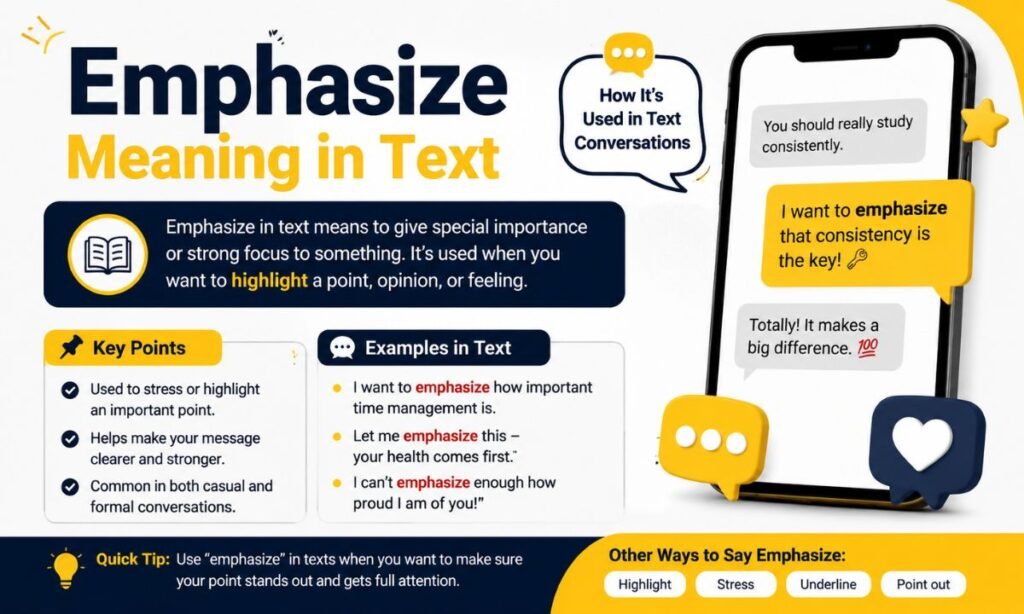
Quick answer: To emphasize meaning in text, you use tools like CAPS LOCK, asterisks, repeated punctuation (!!! or ???), emojis, and bold or italic formatting to signal tone, urgency, or emotion that plain words cannot show on their own. 📱✨
In short: Emphasis in texting replaces the tone of voice you would normally use when speaking face to face.
Primary Meanings and Full Forms of Emphasize Meaning
There is no single abbreviation behind this phrase. Instead, “emphasize meaning in text” refers to a toolkit of techniques people use to make their intended tone clear in writing. Here are the core methods:
- CAPS LOCK – used to show shouting, excitement, or strong emphasis on a specific word (e.g., “I am NOT joking”).
- Asterisks (word) – a text based stand in for italics, often used to stress a single word or add sarcasm.
- Repeated punctuation (!!, ??, …) – signals urgency, disbelief, or hesitation.
- Emojis – add facial expression and emotional context that words alone cannot carry.
- Bold or italic formatting – used on platforms that support rich text, like WhatsApp or Slack, to visually highlight key words.
- Letter stretching (soooo, whaaat) – mimics vocal tone by drawing out a word for dramatic effect.
Each of these exists for one reason: to help the reader feel the message the way the sender intended, not just read it.
Origin and History of Emphasize Meaning in Online Slang
The need to emphasize meaning in text is almost as old as texting itself. In the early SMS and instant messaging era of the late 1990s and early 2000s, people quickly realized that plain text felt cold and easy to misread.
Chat rooms and early messengers like AOL Instant Messenger and MSN Messenger were where habits like using CAPS for shouting and asterisks for actions (laughs) first became mainstream. As SMS texting exploded in the 2000s, character limits pushed people to compress emotion into small, punchy signals like “!!!” or “…” instead of full sentences.
The rise of emojis in the 2010s, followed by rich text formatting on apps like WhatsApp, iMessage, and Slack, gave people even more precise tools to emphasize meaning in text. Today, this blend of punctuation, emojis, and formatting has become second nature to nearly every texter, whether they realize it or not.
How to Use Emphasize Meaning in Daily Chats (With Examples)
Using these techniques well is about matching the tool to the emotion, not stacking every trick into one message. Here is how it plays out in real conversations.
Example 1: Showing genuine excitement
Friend: We got the apartment!!! 🎉🎉
You: WAIT REALLY?? That’s amazing!!
Example 2: Adding light sarcasm
Coworker: Another meeting got added to the calendar.
You: Great. Just what today needed.
Example 3: Clarifying urgency
Roommate: can you call me ASAP, it’s kind of important
You: omw, calling now
Example 4: Softening a serious message
You: Hey, I need to talk to you about something… nothing bad, just want to check in 💛
In every case, the goal is the same: to emphasize meaning in text so the reader instantly understands the emotional weight behind the words, not just the literal sentence.
Popular Platforms Where Emphasize Meaning Habits Are Common
These emphasis techniques show up almost everywhere people type casually, but a few platforms lean into it more than others.
- iMessage and WhatsApp: Bold, italics, and strikethrough formatting are built in, making it easy to emphasize meaning in text directly.
- TikTok comments: Heavy use of caps, repeated punctuation, and emojis to convey reaction and humor quickly.
- Instagram DMs and captions: Emphasis through emojis and stretched words (“soooo good”) is extremely common.
- Snapchat chats: Fast, informal exchanges rely heavily on caps and emojis since tone is easy to lose in quick back and forth messages.
- Reddit and Discord: Asterisks for italics and double asterisks for bold are almost a built in language for emphasis.
Other Meanings of Emphasize Meaning in Different Contexts
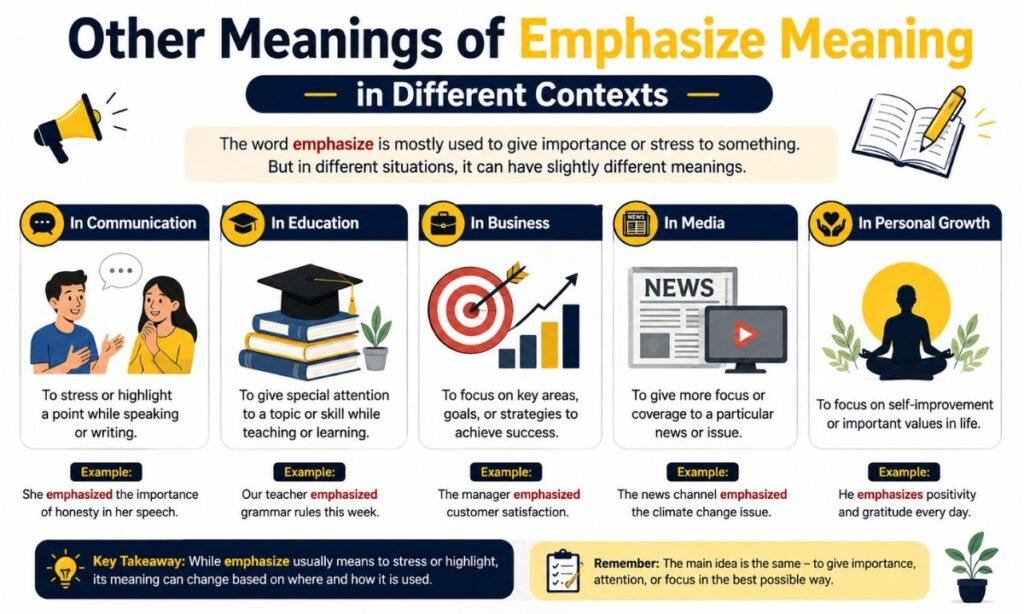
Outside of casual texting, the idea of emphasizing meaning shows up in more formal or technical settings too, just with different tools.
- Writing and editing: Authors emphasize meaning in text through italics for internal thought, bold for key terms, or short punchy sentences for impact.
- UX and product design: Designers emphasize meaning in text using font weight, color, and size to guide a reader’s eye to what matters most.
- Marketing copy: Copywriters emphasize meaning in text with headlines, bullet points, and bolded benefits to make key selling points impossible to miss.
- Legal and business documents: Emphasis is used sparingly, usually through bold terms or underlined clauses, to flag critical obligations.
The core idea stays the same across every context: making sure the most important part of the message actually stands out.
Emphasize Meaning vs Similar Texting Abbreviations
It helps to see how the general practice of emphasizing meaning in text compares to specific texting shorthand people often mix it up with.
| Term / Technique | What It Means | Tone | Best Use Case |
| Emphasize meaning in text (general technique) | Using caps, punctuation, emojis, or formatting to show tone | Flexible, depends on tool used | Any message where tone could be misread |
| NGL (Not Gonna Lie) | Signals honesty before a blunt statement | Casual, direct | Sharing an honest opinion |
| IYKYK (If You Know You Know) | Implies an inside reference without explaining it | Playful, exclusive | Inside jokes with close friends |
| SMH (Shaking My Head) | Expresses disbelief or disappointment | Short, expressive | Reacting to something frustrating |
| TBH (To Be Honest) | Introduces a candid or blunt opinion | Casual, sincere | Giving honest feedback |
Key takeaway: Abbreviations like NGL or SMH are specific phrases, while emphasizing meaning in text is the broader skill of making any message land the way you intend.
How to Respond When Someone Texts You With Strong Emphasis?
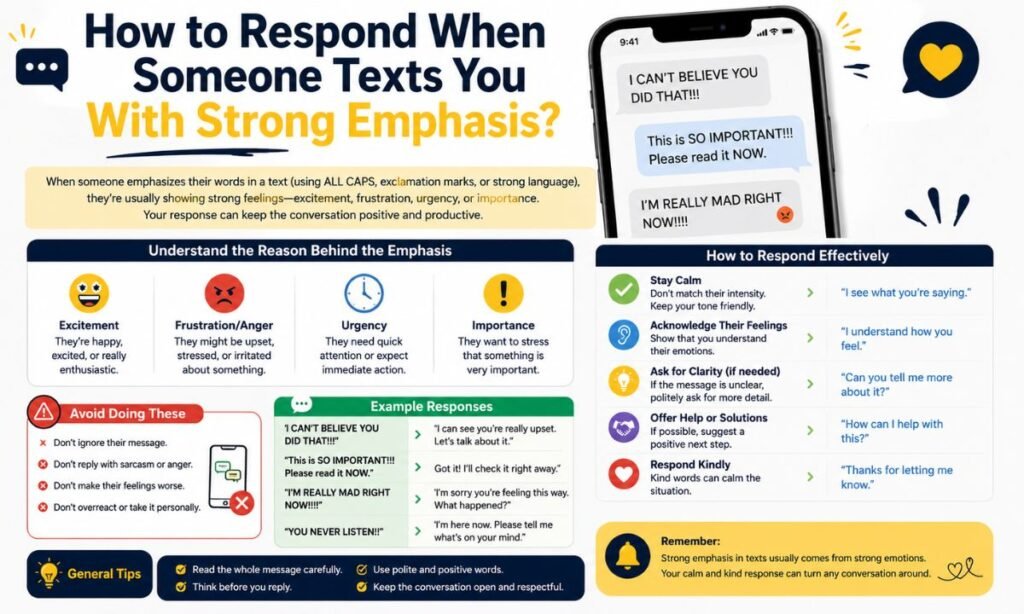
When someone sends a message using heavy emphasis, whether it’s ALL CAPS, “!!!” or a string of emojis, they are usually signaling that the emotional tone matters as much as the words. Responding well means matching that energy appropriately.
- If they text with excitement (“WE GOT THE HOUSE!!! 🎉”), match it back: “NO WAY!! Congrats, that’s huge!! 🎉”
- If they text with urgency (“call me NOW”), respond quickly and briefly rather than casually: “On it, calling in 2 min”
- If they text with sarcasm (“Sure, that’s totally fine”), acknowledge the tone rather than taking it literally: “Okay I clearly upset you, let’s talk”
- If they text with sadness or stress, avoid over the top emojis and reply with something grounded: “I’m here, want to talk about it?”
The main rule: read the emphasis as emotional context, not just decoration, before you decide how to reply.
When and Where You Should Avoid Using Emphasize Meaning Techniques
Emphasis tools are great for casual conversation, but they can easily backfire in the wrong setting. Here is where to dial it back.
- Professional emails: CAPS LOCK or excessive exclamation points can come across as unprofessional or even aggressive.
- Job interviews or client messages: Stick to clear, neutral language instead of emojis or stretched words.
- Serious or sensitive conversations: Overusing emphasis (like too many emojis) can undercut the seriousness of what you’re saying.
- Formal documents or reports: Emphasis should be limited to bold or italics used sparingly, not casual texting habits.
Rule of thumb: If you wouldn’t say it in that tone out loud in a meeting, don’t emphasize it that way in writing either.
Pro Tip I Learned
One trick that changed how I text: read your message back using a flat, monotone voice in your head before sending it. If it still sounds unclear or could be taken the wrong way without your intended emphasis, that’s your cue to add a caps word, an emoji, or restructure the sentence entirely. It catches almost every miscommunication before it happens.
Common Mistakes to Avoid When Using Emphasize Meaning
Even well-intentioned emphasis can go wrong. Watch out for these common slip-ups.
- Overusing CAPS LOCK, which can make even a friendly message feel like shouting.
- Stacking too many emojis, which dilutes the specific emotion you’re trying to show.
- Using sarcasm markers (like asterisks) with people who don’t know your texting style, leading to real confusion.
- Skipping emphasis entirely in emotionally important messages, which can make sincere texts feel cold or dismissive.
- Mixing formal and casual emphasis styles in the same conversation, which sends mixed signals about your tone.
Frequently Asked Questions
What does it mean to emphasize meaning in text?
It means using tools like capitalization, punctuation, emojis, or formatting to make your intended tone and emotion clear, since plain text alone cannot convey vocal tone.
Is using CAPS LOCK always considered shouting?
Not always. While CAPS often signals shouting or urgency, a single capitalized word inside a normal sentence is usually just emphasis on that specific word, not aggression.
How do I know if I’m using too much emphasis in a text?
If your message relies more on emojis, caps, or punctuation than actual words to get the point across, you’re likely overdoing it. Emphasis should support your message, not replace it.
Can emojis really change the meaning of a text?
Yes. The same sentence can read as sincere, sarcastic, or joking depending entirely on which emoji follows it, which is why emoji choice is a core part of learning to emphasize meaning in text.
Conclusion
Learning to emphasize meaning in text is really about restoring the tone that gets lost the moment we switch from talking to typing. Whether it’s a well placed emoji, a stretch of caps, or a single bolded word, these small choices carry a lot of emotional weight. Use them with intention, read the room before you send, and your texts will consistently say exactly what you mean, no misreads required.

Muhammad Shoaib is a content creator and SEO professional who enjoys making language and vocabulary easy to understand. He writes helpful content about word meanings, phrases, slang, abbreviations, spelling differences, and everyday expressions. nThrough WhizzMean, Shoaib focuses on creating clear, simple, and practical explanations that help readers quickly understand confusing words and language-related questions.