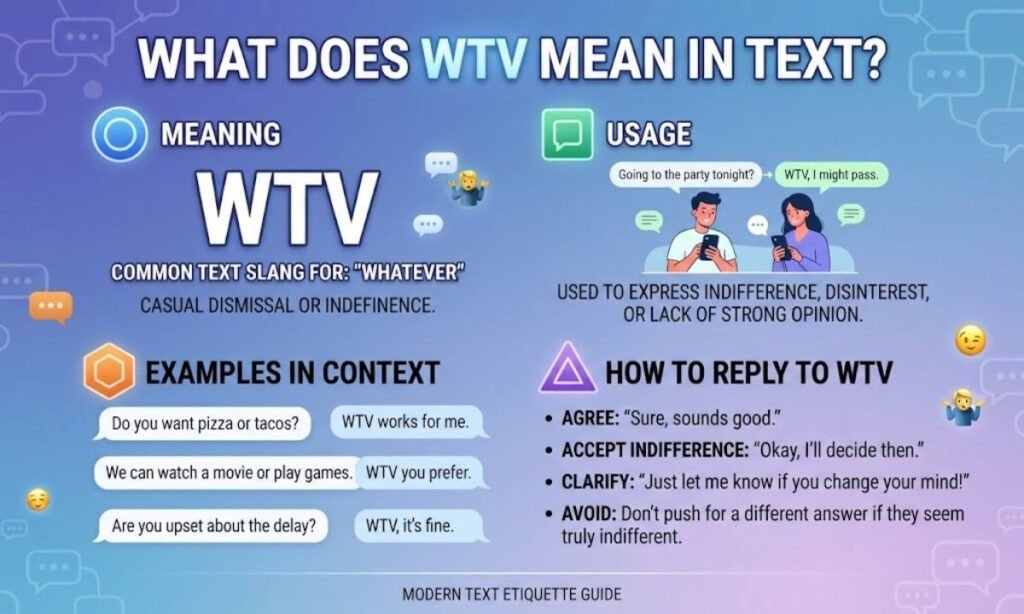
Have you ever got a message that just said “wtv”? It looks tiny, but it can leave you confused. Is the sender calm, bored, or upset?WTV is short for “whatever.” People use it in texts, DMs, and comments.
It can sound relaxed, playful, or cold. The meaning changes with the tone and the person.This guide explains what WTV means in simple words. You will see real chat examples, related forms, and smart ways to reply. Read on and never feel confused by “wtv” again.
What Does WTV Mean in Text? Quick Meaning
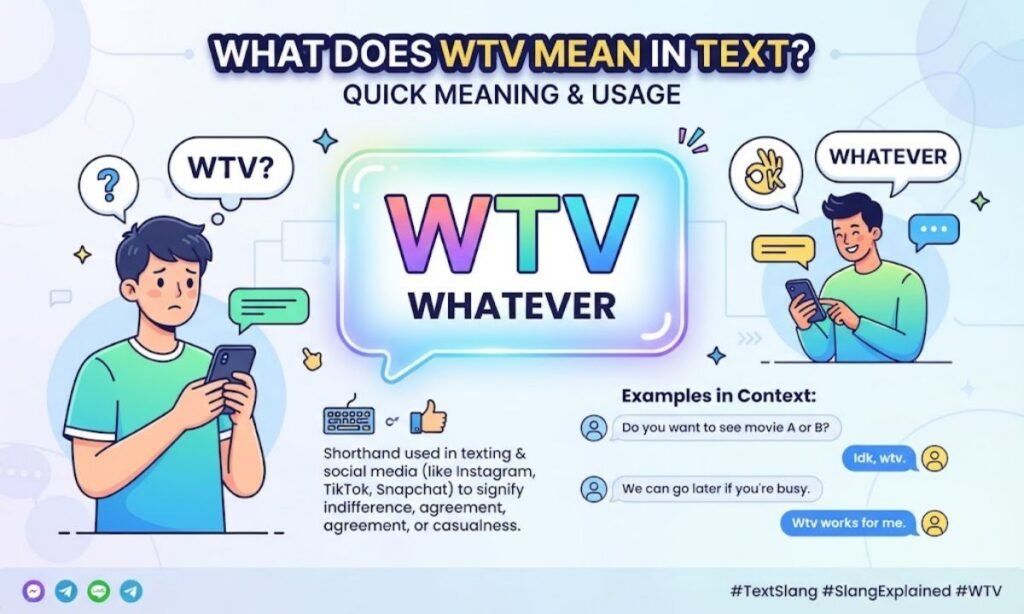
WTV is a texting abbreviation for the word “whatever.” People drop the vowels and some letters to type faster. That is why “whatever” becomes “wtv.”
The word itself is simple. The tone is what matters. Context tells you if the sender is calm, bored, or upset.
The simplest definition
WTV = whatever. It shows that the sender does not mind, does not care, or does not want to argue.
Here is a quick view of the main meanings.
| Meaning | What the Sender Feels | Example |
| I am fine with anything | Relaxed | “Pizza or burgers? Wtv you want.” |
| I do not care | Indifferent | “Wtv, it’s not a big deal.” |
| I give up | Tired or annoyed | “Wtv, do what you want.” |
| Playful shrug | Joking | “Wtv lol, you’re so dramatic.” |
Origin and Background of WTV
Text shorthand began with early mobile phones. Messages had a character limit, and typing on number keys was slow. People cut words short to save time and space.
“Whatever” was already a popular word in everyday speech. It became a common reply for showing indifference. When texting grew, people shortened it to “whatev,” “w/e,” and then “wtv.”
Social media made the term spread faster. Short forms feel natural in fast chats on WhatsApp, Instagram, Snapchat, and TikTok. Today, “wtv” is common among teens and young adults, and many older users now recognize it too.
| Stage | What Happened |
| Spoken English | “Whatever” used to show indifference |
| Early SMS era | Long words cut short to save space |
| Chat apps era | Forms like “w/e” and “wtv” became popular |
| Social media era | “Wtv” spread through DMs, comments, and captions |
Real-Life Conversations: How WTV Is Actually Used
Examples make the meaning clear. The same word can feel different in each chat. Watch the words around it.
Below are three common situations.
WhatsApp Conversation: Casual and Easygoing
Friend: Where should we eat tonight?
You: Wtv you like. I’m okay with anything.
Friend: Cool, let’s get pizza.
Here “wtv” is friendly. The sender is flexible and wants to keep things easy. There is no anger in it.
Instagram DM: Slightly Annoyed
Friend: You didn’t reply to my story again.
You: I was busy.
Friend: Wtv.
This “wtv” feels cold. The sender is hurt or irritated and ends the talk. The short reply and the missing emoji are clues.
TikTok Comment: Playful or Casual
Comment: This dance is so basic.
Reply: Wtv, you still watched it twice 😂
In public comments, “wtv” is often a joke. The emoji shows the playful mood. It works like a light shrug.
The Emotional and Psychological Meaning Behind WTV
“Wtv” can hide real feelings. Sometimes a person says “whatever” because they do not want to explain. It is a quick way to avoid conflict or end a topic.
It can also show emotional distance. If someone cares a lot but replies with “wtv,” they may feel unheard. They may feel too tired to keep arguing.
At other times it shows trust. Saying “wtv you want” tells a friend that you are flexible. You value peace more than the choice.
Look at these signals to read the mood:
- Punctuation: “Wtv.” with a full stop often feels sharper.
- Emojis: A smile or laugh usually means playful.
- Timing: A slow, short reply after a long chat can mean frustration.
- Relationship: Close friends joke more. Strangers may sound rude.
How WTV Is Used in Different Contexts
The meaning shifts with the place and the person. A word that is fine with a friend may sound rude to a boss. Let’s look at the main settings.
Social Media
On social media, “wtv” is quick and casual. People use it in comments, captions, stories, and replies. It often sounds like a shrug.
Creators also use it in posts such as “Wtv, I’m happy.” It shows confidence and a relaxed attitude.
Friends and Relationships
Among friends, “wtv” is usually light. It helps decide plans like food, movies, or timing. It means “I’m okay with your choice.”
In couples, it can be risky. If one partner says “wtv” after a disagreement, the other may feel dismissed. A clear sentence works better.
Work and Professional Settings
Avoid “wtv” at work. It can sound careless or disrespectful. A manager may read it as a lack of interest.
Use clear phrases instead, such as “I am flexible” or “Either option works for me.”
Casual vs. Serious Tone
Casual chats allow short forms. Serious talks need clear words. Use this table as a guide.
| Situation | Is WTV Okay? | Better Option |
| Choosing a restaurant with friends | Yes | “Wtv you like” |
| Joking in comments | Yes | “Wtv lol” |
| Arguing with a partner | Risky | “Let’s talk about it later” |
| Emailing a boss | No | “I am happy with either choice” |
| Talking to a client | No | “Both options work for me” |
Common Misunderstandings About WTV
Many people think “wtv” always means anger. That is not true. It can be friendly, calm, or funny.
Others think it always means “I don’t care about you.” Often it only means “I don’t mind the choice.” The topic is small, and the person is relaxed.
Another mistake is mixing “wtv” with “TV.” Some readers see the letters and think of television. In chat, it almost always means “whatever.”
Also, some think it is rude by default. Tone, emojis, and the relationship decide that.
When You Should Not Use WTV
There are times when a short reply can hurt. Skip “wtv” in these cases:
- When someone shares bad news or a personal problem
- During a serious argument
- In job emails or messages to teachers
- When you apologize
- When the other person asks for your real opinion
In these moments, people want care and clear words. A reply like “I hear you” or “I’m fine with either” feels kinder. It also avoids confusion.
WTV Compared With Similar Texting Terms
Many shortcuts sound alike. Their tone is a little different. This table shows how they compare.
| Term | Full Form | Tone | Usual Use |
| WTV | Whatever | Neutral to cold | Indifference or flexibility |
| W/E | Whatever | Neutral | Quick, casual reply |
| IDC | I don’t care | Strong, blunt | Shows clear lack of interest |
| IDK | I don’t know | Neutral | Shows uncertainty |
| NVM | Never mind | Soft or hurt | Drops a topic |
| K | Okay | Can feel cold | Short agreement |
| FR | For real | Friendly | Shows agreement |
Key Insight
“Wtv” sits in the middle. It is softer than “idc” but colder than “ok.” Because of this, the tone depends heavily on context.
Variations and Related Forms of WTV
People change the phrase to fit their mood. Here are common forms and what they usually mean.
1. WTV
The base form. It is short and flexible. Tone depends on the chat.
2. Wtv u want
Means “whatever you want.” It is usually friendly and shows you are open to their choice.
3. Wtv works
Means “whatever works for you.” It is common in plans and schedules.
4. Wtv happens
Means you accept any outcome. It can sound calm or fatalistic.
5. Wtv lol
A lighter version. The “lol” softens the tone and makes it playful.
6. Wtv
Written alone with a full stop, it can feel sharp. It often closes a conversation.
7. Wtv bro
Common among friends. It can be casual, teasing, or mildly annoyed.
8. Wtv then
This one can sound irritated. It often shows that the sender gave in.
9. Do wtv
Short for “do whatever.” It can be permission or a cold dismissal. Context decides.
10. Wtv makes you happy
A caring phrase. It shows support for the other person’s choice.
| Form | Likely Tone |
| Wtv u want | Friendly |
| Wtv works | Easygoing |
| Wtv lol | Playful |
| Wtv then | Annoyed |
| Do wtv | Mixed or cold |
| Wtv makes you happy | Caring |
How to Respond When Someone Uses WTV
Your reply depends on the mood you read. First check the tone. Then choose a response that fits.
Casual Replies
If the sender seems relaxed, keep it light.
- “Okay, let’s go with pizza then.”
- “Cool, I’ll pick a place.”
- “Sounds good!”
Funny Replies
If the chat is playful, match the energy.
- “Wtv? Say that again with a smile 😄”
- “Whatever is not on the menu!”
- “Okay boss, I’ll decide then.”
Mature and Confident Replies
If the sender seems upset, stay calm. Do not copy the cold tone.
- “I feel like something is off. Want to talk?”
- “I didn’t mean to upset you.”
- “Let’s sort this out when you’re ready.”
Private or Respectful Replies
If the topic is sensitive, move the talk to a call or a face to face chat. Text can hide tone.
- “I’ll call you later, okay?”
- “I’d like to hear your side. Can we talk?”
- “No pressure. I’m here when you want to share.”
Regional and Cultural Usage of WTV
Texting habits change from place to place. The word is widely understood, but the feeling can differ.
Western Culture
In the US, UK, Canada, and Australia, “wtv” is common among young people. It often shows a laid back or sarcastic vibe. Teens use it a lot in group chats.
Asian Culture
In many Asian countries, English shorthand mixes with local languages. People may write “wtv” inside Hindi, Urdu, or Filipino messages. It is usually seen as casual and friendly. In more respectful cultures, using it with elders can feel rude.
Middle Eastern Culture
In the Middle East, many young users mix Arabic and English online. “Wtv” appears in chats, often with emojis. Respect for elders matters, so it is used mostly among peers.
Global Internet Usage
Online, “wtv” has become a shared slang term. Gamers, creators, and students use it across borders. Even so, tone can be misread, so extra context helps.
| Region | Common Use | Tone |
| Western countries | Group chats, DMs | Casual or sarcastic |
| Asia | Mixed language chats | Casual, respectful with elders |
| Middle East | Peer chats with Arabic mix | Friendly |
| Global online spaces | Gaming, comments | Playful or neutral |
Frequently Asked Questions
What does WTV mean in text?
WTV means “whatever.” It shows you are flexible, indifferent, or ready to drop a topic.
Is WTV rude?
It can be, but not always. Tone, emojis, and your relationship with the sender decide.
Can I use WTV in a work chat?
It is best to avoid it. Use clear and polite words instead.
Is WTV the same as IDC?
Not exactly. IDC means “I don’t care” and is blunter. WTV is softer and more flexible.
What does “wtv u want” mean?
It means “whatever you want.” The sender is happy to follow your choice.
Is WTV used on TikTok and Instagram?
Yes. It is common in comments, DMs, and captions across these apps.
How do I reply to WTV?
Check the tone first. Reply lightly if it is playful, and calmly if it feels upset.
What does WTV stand for in text messages?
WTV stands for “whatever.” People use it as a quick way to show they do not mind or do not care.
What does WTV mean from a girl?
It usually means “whatever,” but the tone matters. It can be playful, relaxed, or a sign she feels upset.
Final Thoughts
WTV is a small word with a wide range of meanings. It can show ease, humor, or hurt. The best way to read it is to look at the full chat, the emojis, and the person behind the message. When in doubt, ask a gentle question instead of guessing.
Use “wtv” with care. It works well with friends and casual plans, but it can feel cold in serious talks or at work. Clear words build trust and avoid confusion. When you reply, match the mood, stay calm, and keep the conversation kind.

Muhammad Shoaib is a content creator and SEO professional who enjoys making language and vocabulary easy to understand. He writes helpful content about word meanings, phrases, slang, abbreviations, spelling differences, and everyday expressions. nThrough WhizzMean, Shoaib focuses on creating clear, simple, and practical explanations that help readers quickly understand confusing words and language-related questions.