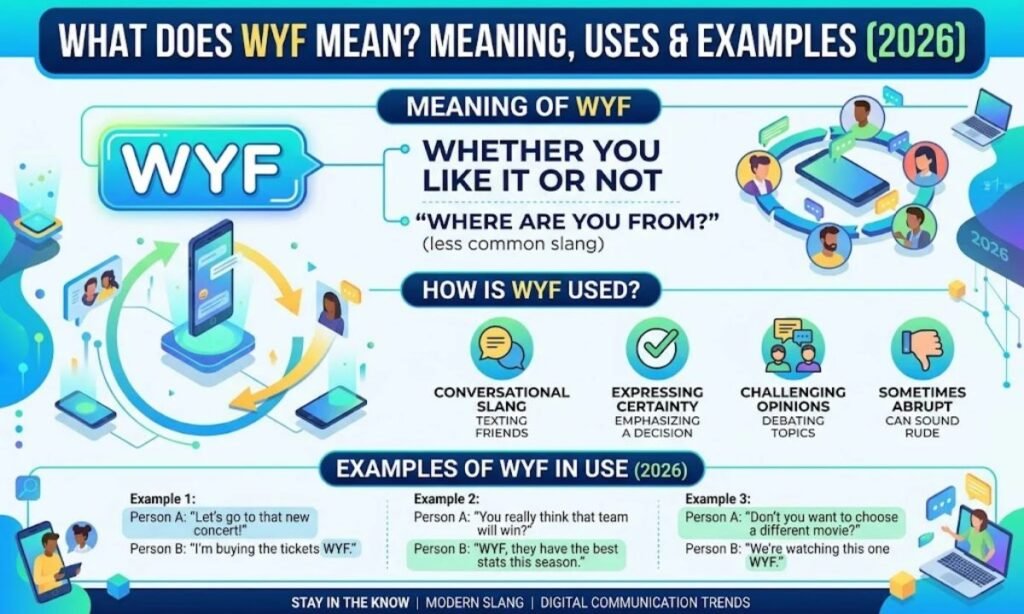
You may have seen “WYF” in a DM or a comment and wondered what it meant. It looks simple, but it can mean more than one thing. In most chats, WYF means “Where You From?” It is a quick way to ask where someone lives or grew up.
This guide explains the WYF meaning in simple words. You will see real chat examples, other meanings people use, and easy ways to reply. You will also learn common mistakes and how the term is used around the world.
WYF Meaning in Text: Quick Definition
WYF is a casual text abbreviation. The most common meaning is “Where You From?” People use it to ask about a hometown, a country, or a current city. It is short, friendly, and common on social apps.
Context matters a lot. Some people use WYF for “What’s Your Favorite?” or “What You Feeling?” A few use it as a spelling of “wife.” Always read the full message before you guess.
| Detail | What It Means |
| Abbreviation | WYF |
| Most common meaning | Where You From? |
| Other meanings | What’s Your Favorite? / What You Feeling? / What You Fixing? |
| Spelling variant | “Wife” (informal or old style spelling) |
| Tone | Casual, friendly, quick |
| Where you see it | Instagram, Snapchat, TikTok, WhatsApp, text messages |
| Best used with | Friends and people your age |
| Formal use | Not recommended |
Simple Examples
Short examples make the meaning clear. Here is how people use WYF:
- “Nice profile! WYF?” The person wants to know where you live.
- “WYF song right now?” This one asks for your favorite song.
- “Long day, huh? WYF?” The person checks how you are feeling.
- “WYF tonight?” In some regions, it asks what you are fixing or planning.
Notice the pattern. The words around WYF tell you which meaning fits.
Origin & Background
WYF grew out of early internet and SMS slang. Texts used to have tight character limits, so people cut phrases down to a few letters. “Where You From?” became WYF because it kept the key words and dropped the rest.
The habit of dropping small words is common in casual English. “Where are you from?” turns into “Where you from?” and then into three letters. This is the same path that gave us terms like WYM (“What You Mean?”) and HMU (“Hit Me Up”).
There is also an older link worth knowing. “Wyf” is a very old English spelling of the word “wife.” You can still see it in classic literature. Some online users play with this old spelling, so the same three letters can look very different depending on the chat.
Over time, the meaning stretched. People started using WYF to ask about interests, moods, and plans too. That is why one abbreviation now covers several questions.
How It Evolved
The path of WYF is easy to follow. It started as a shortcut and became a flexible chat term.
| Stage | How WYF Was Used |
| Early texting era | Short form for “Where You From?” to save characters |
| Social media rise | Common opener in DMs, comments, and profile chats |
| Meme and slang era | New readings like “What’s Your Favorite?” appear |
| Regional use | “What You Fixing?” used in some Southern U.S. style chats |
| Today | A flexible term where context decides the meaning |
Because slang changes fast, some meanings stay small and local. The “where you from” meaning remains the main one across most sources.
Real-Life Conversations (How People Actually Use WYF)
Most people meet WYF in quick chats with new contacts or friends. These short examples show how it sounds in real life.
1. WhatsApp Chat
Zara: Hey! Saw your story. Great photo. WYF?
Hamza: Thanks! I am from Lahore. You?
Zara: Karachi. Small world!
Here, WYF opens a friendly talk. The reply gives a city and returns the question.
2. Instagram DMs
Mia: Love your playlist. WYF song right now?
Leo: Anything by Arctic Monkeys. You?
Mia: Same! Great taste.
In this chat, the words after WYF show the meaning is “What’s Your Favorite?” The topic is a song, not a place.
3. Text Message
Sam: Long week. WYF?
Dan: Tired but okay. Weekend can’t come fast enough.
Sam: Same here.
This one is a check in. Sam is asking how Dan feels. The tone and the first sentence make that clear.
A good habit is to look at the sentence before and after WYF. If there is no clue, ask a short question like “WYF as in where you from?” It saves a lot of confusion.
Emotional & Psychological Meaning
WYF is small, but it carries a feeling. When someone asks “Where You From?”, they are showing interest in you. They want to find common ground.
People also use it to break the ice. A quick question feels lighter than a long intro. It lets two strangers start talking without pressure.
Some people feel proud when asked about their roots. Others feel shy or uneasy, especially if they move a lot or live far from home. How you feel can depend on who asks and how they ask.
What It Reflects
Using WYF often shows a few things about the sender:
- Curiosity: They want to know more about you.
- Friendliness: They are trying to start a casual talk.
- Connection: They hope to find a shared place or interest.
- Speed: They prefer short, easy messages.
- Low effort: Sometimes it is just a lazy opener, so do not read too much into it.
If a stranger asks WYF and you feel uncomfortable, you do not have to answer. Your location is private information. A polite reply or no reply is always fine.
Usage in Different Contexts
WYF changes a little based on where you see it. Here are the main settings.
1. Social Media
On Instagram, Snapchat, and TikTok, WYF often appears in DMs and comments. It is a common opener on new follows and live chats. Replies are usually one word, like a city or country.
On some posts, it also means “What’s Your Favorite?” For example, a creator may ask “WYF movie?” to spark comments.
2. Friends & Relationships
Among friends, WYF is relaxed. It can be a check in, a fun poll, or a way to learn more about a new friend.
In dating chats, WYF is a classic first question. Be careful, though. Some people use the letters in flirty or crude ways, so tone and context matter. If a message feels off, ask what they mean before you answer.
3. Work or Professional Settings
At work, WYF is not a good choice. Slang can look careless in emails, reports, or client chats. Use full words like “Where are you based?” instead.
In a very relaxed team chat, it may pass. Still, a clear sentence is always safer.
4. Casual vs Serious Tone
| Situation | Is WYF Okay? | Better Option If Not |
| Chat with a friend | Yes | None needed |
| Group chat or comments | Yes | None needed |
| Dating app opener | Sometimes | “Where are you from?” |
| Team chat at work | Rarely | “Where are you based?” |
| Email to a client | No | A full, polite sentence |
| Serious or sensitive talk | No | Use clear, caring words |
Match your words to the mood. A casual question needs a casual tone. A serious one needs full sentences.
Common Misunderstandings
Because WYF has several meanings, people mix it up. Here are the most common errors.
1. Thinking WYF Has Only One Meaning
Most sources agree that “Where You From?” is the top meaning. But it is not the only one. Always check the topic of the chat before you answer.
2. Assuming It Is Rude
Some pages claim WYF always means something harsh or crude. That is not true. In most chats, it is a harmless, friendly question. A crude reading only fits when the tone is clearly that way.
3. Mixing It Up With “Wife”
The old spelling “wyf” means wife. In a modern text, though, three capital letters with a question mark usually point to a question, not a person.
4. Using It in Formal Writing
WYF does not belong in school essays, job emails, or reports. It can look unclear or careless. Use full words in formal settings.
When NOT to Use WYF
- With people you do not know well: A full question feels safer and more polite.
- In serious talks: Slang can feel cold when someone is upset.
- At work or school: Clear words build trust.
- When the topic is sensitive: Asking about origin can feel personal to some people.
- When the meaning is unclear: Spell it out to avoid mix ups.
Comparison Table
This table compares WYF with similar chat abbreviations.
| Term | Meaning | Tone | Best Used For |
| WYF | Where You From? | Casual, friendly | Meeting new people |
| WYM | What You Mean? | Casual, curious | Asking for clarity |
| HMU | Hit Me Up | Casual | Inviting contact |
| WYD | What You Doing? | Casual | Checking plans |
| WBU | What About You? | Friendly | Returning a question |
| WYL | Where You Live? | Casual | Asking current location |
Key Insight
WYF is a flexible three letter question. The most common meaning is “Where You From?” The other readings depend on context, so always check the words around it. When in doubt, ask or spell it out.
Variations / Types of WYF Usage
People use WYF in a few main ways. Each one asks a different question.
- Where You From? The top meaning. It asks about a hometown or country.
- What’s Your Favorite? Used to ask about songs, foods, shows, or teams.
- What You Feeling? A friendly check in on someone’s mood.
- What You Fixing? A regional phrase that asks what someone is preparing or planning.
- Wyf (wife): An old or playful spelling of the word wife.
| Type | Example | How to Tell |
| Where You From? | “Cool profile! WYF?” | Chat with a new contact |
| What’s Your Favorite? | “WYF show right now?” | A topic or category follows |
| What You Feeling? | “Rough day. WYF?” | Chat about mood |
| What You Fixing? | “WYF for dinner?” | Plans or food in the message |
| Wyf (wife) | “Meet my wyf” | Lowercase word used as a noun |
The clearest clue is the sentence around it. If nothing helps, just ask.
How to Respond When Someone Uses WYF
When someone sends WYF, read the context first. Then pick a reply that fits the mood and the person.
Casual Replies
- “I am from Lahore. You?”
- “Born and raised in Toronto. WYF?”
- “Currently in Dubai, originally from Karachi.”
Funny Replies
- “From the land of great snacks.”
- “The internet. I live in the comments.”
- “Planet Earth, third rock from the sun.”
Keep jokes light. Skip them if the other person seems serious.
Mature / Confident Replies
- “I am from Islamabad. How about you?”
- “I grew up in London, and I live in Manchester now.”
- “Do you mean where I am from, or where I live now?”
Private / Respectful Replies
- “I would rather not share my exact location, but I am happy to chat.”
- “Let’s get to know each other a bit first.”
- “I keep my location private, but tell me about you.”
You never owe a stranger your exact location. Give a country or a region if you want to share a little. Keep your address and daily routine private.
Regional & Cultural Usage
WYF is understood in many English speaking chat spaces. How people use it can change by place and culture.
Western Culture
In the US, UK, and Canada, WYF is common on social media and in texts. Young users use it as a quick, friendly opener. In parts of the American South, “What You Fixing?” is also heard in casual speech.
Asian Culture
In many Asian countries, English slang spreads fast through social apps. Young users may mix WYF with local words in one message. Asking about someone’s city or country is a normal way to start a chat.
In respectful settings, such as talking to elders, a full polite sentence is better.
Middle Eastern Culture
In the Middle East, many young people chat in a mix of English and Arabic. WYF may be used among peers on Instagram or Snapchat. In family or formal settings, people prefer clear and respectful speech.
Privacy matters in many communities. A person may choose not to share a location with someone they do not know.
Global Internet Usage
Online, WYF works as a universal shortcut. It appears in gaming lobbies, comment sections, live streams, and DMs. Its short size suits fast typing.
Slang changes quickly. New meanings can appear in one community and fade in another. That is why context always matters more than the letters.
Frequently Asked Questions
What does WYF mean in text?
WYF most often means “Where You From?” It asks where someone lives or grew up.
What does WYF stand for?
It usually stands for “Where You From?” It can also mean “What’s Your Favorite?” or “What You Feeling?” depending on context.
How do you reply when someone asks WYF?
Share your city or country, then ask them back. For example, “I am from Lahore. You?”
Is WYF rude or inappropriate?
Not usually. It is normally a friendly question, but tone and context decide how it reads.
Can WYF mean something other than where you from?
Yes. It can mean “What’s Your Favorite?”, “What You Feeling?”, or “What You Fixing?” Check the words around it.
Is it safe to answer WYF from a stranger?
Share only a general answer, like a country or region. Keep your exact address private.
Is WYF okay to use at work?
No. Slang can look unprofessional, so use full words in work messages.
Final Thoughts
WYF is a small abbreviation with a flexible job. Most often it asks “Where You From?”, but it can also ask about favorites, feelings, or plans. The letters stay the same, while the meaning shifts with the chat. That is why reading the full message matters more than guessing.
Use WYF with friends and in casual chats. Spell out your words at work, in school, or with people you do not know well. If you are unsure what someone means, ask. A short question now can save an awkward moment later, and it keeps every chat friendly and clear.

Muhammad Shoaib is a content creator and SEO professional who enjoys making language and vocabulary easy to understand. He writes helpful content about word meanings, phrases, slang, abbreviations, spelling differences, and everyday expressions. nThrough WhizzMean, Shoaib focuses on creating clear, simple, and practical explanations that help readers quickly understand confusing words and language-related questions.