If you searched for the Javert meaning, you likely want a quick answer. Javert is a fictional police inspector from Victor Hugo’s novel Les Misérables. His name now stands for a person who follows rules so strictly that mercy has no room to grow.
This guide covers the character, the name, and the symbolism behind it. You will also see how the story changed on stage and screen. Let’s start with the simple answer.
What Does Javert Mean?
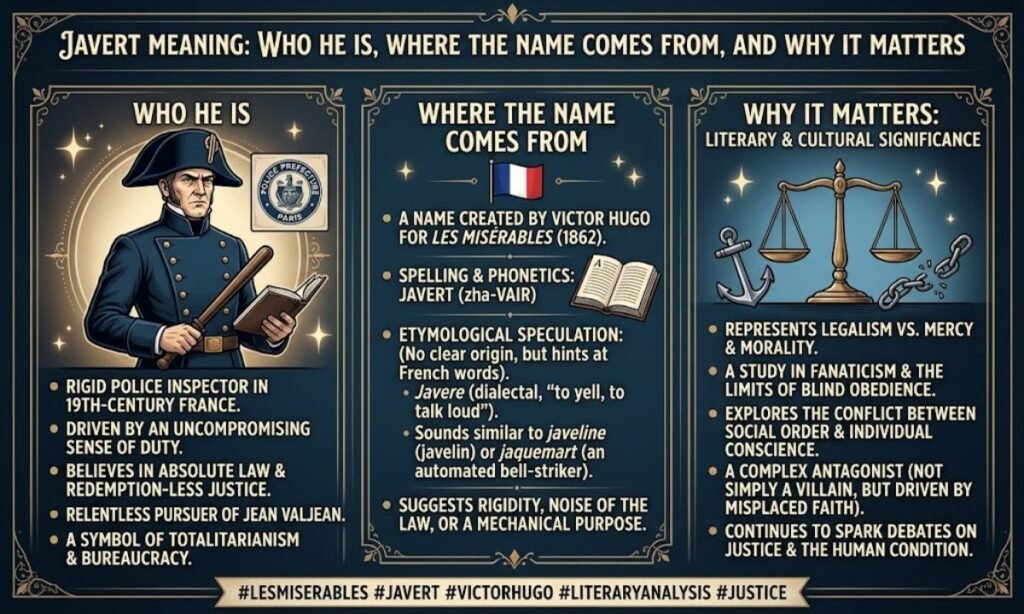
Javert is a proper name. It belongs to Inspector Javert, the lawman who hunts the former convict Jean Valjean across France. Hugo published the novel in 1862.
The name does not have a clear dictionary meaning. It is not a common French word. Hugo never explained it, so readers have studied the character rather than the word itself.
Today, the Javert meaning works on two levels:
- Literal: a police inspector in a classic French novel.
- Figurative: a rigid, unbending enforcer of rules who values law over compassion.
Many people use his name as shorthand for this kind of mindset. You will see it in book reviews, essays, and even office jokes.
Who Is Javert in Les Misérables?
Javert is a police inspector who believes in order above everything. He sees the law as a fixed line. People are either on the right side of it or the wrong side. There is no gray area for him.
His life story explains a lot. In the novel, he was born inside a prison. His mother was a fortune-teller, and his father was a convict. He grew up despising crime, partly because he wanted to prove he was different from the people who raised him.
He first meets Valjean when he works as a guard at the prison in Toulon. Years later, he finds Valjean living under a new name. Valjean has become a respected mayor and factory owner. Javert cannot accept that a man with a criminal record could change.
From that moment, Javert becomes the story’s relentless pursuer. He is not cruel for fun. He believes he is doing his duty, and that belief makes him both powerful and tragic.
The Origin of the Name Javert
Hugo gave no official explanation for the name. There is no proven root or hidden translation that scholars all agree on. Anyone who claims a firm origin is guessing.
What we do know is that Hugo drew on real life. Many readers connect Javert and Valjean to Eugène François Vidocq. Vidocq was a French criminal who later became a police chief and founded an early detective force. He lived on both sides of the law, and Hugo split that idea between two characters.
Another small fact is worth noting. Hugo never gives Javert a first name in the novel. That makes him feel more like a function than a person. He is “the inspector” first and a human being second.
The sound of the name also helps. It is short, hard, and sharp. It fits a man who sees the world in strict terms.
Javert as a Symbol of Law and Justice
Javert stands for the idea of law without mercy. He believes rules protect society, and he cannot imagine a case where breaking one might be right. This is the heart of the Javert meaning.
Hugo uses him to ask a hard question. Is justice only about following the law, or does it also need compassion? Valjean answers with kindness. Javert answers with strict duty.
Here is how the two ideas compare:
| Idea | Javert’s View | Hugo’s Question |
| Law | Fixed and final | Can a law be unfair? |
| Crime | A permanent label | Can a person change? |
| Duty | Above personal feeling | Is duty enough without love? |
| Mercy | A form of weakness | Is mercy a form of strength? |
Hugo does not make Javert a villain in a simple way. He treats him as a man who is honest, disciplined, and sincere. His flaw is that he cannot imagine a world bigger than his own rules.
Javert’s Main Character Traits
Javert is easy to describe but hard to dismiss. He has qualities that many people admire, and qualities that cause great harm. That mix is why he is still discussed today.
His key traits include:
- Disciplined: He follows his code every day without exception.
- Honest: He never takes bribes or bends the truth for personal gain.
- Rigid: He refuses to see exceptions or second chances.
- Self-denying: He holds himself to the same harsh standard he applies to others.
- Obsessive: He chases Valjean for decades.
Notice that honesty and rigidity live in the same person. That is the point. Hugo shows that a good trait, taken too far, can become a weakness.
Javert also has a strong sense of shame. He once reports himself to Valjean for a mistake, which shows he applies the rules to his own behavior. Few villains in fiction do that.
Javert vs Jean Valjean
The two men are mirrors of each other. Both come from hard backgrounds. Both are strong and serious. Yet they choose very different paths.
Valjean serves nineteen years in prison for stealing bread and later for escape attempts. A kind bishop shows him mercy, and the act changes his life. Javert, in contrast, is shaped by contempt for criminals and a fear of becoming one.
A quick comparison makes this clear:
| Feature | Jean Valjean | Javert |
| Starting point | Convict | Born in prison, becomes officer |
| Guiding force | Conscience and compassion | Law and duty |
| Attitude to change | Believes people can change | Believes people stay the same |
| Role in story | Hero and fugitive | Pursuer and rival |
| Final outcome | Finds peace | Cannot reconcile his beliefs |
This contrast gives the novel its emotional power. It is a battle between two moral systems, not only two men.
Javert’s Famous Turning Point and Ending
The turning point comes during the June 1832 uprising in Paris. Javert goes undercover among the rebels. He is discovered and captured. Valjean is then given the chance to deal with him.
Valjean could take revenge. Instead, he sets Javert free. This act of mercy breaks something inside Javert. He has always believed Valjean was just a criminal. Now he sees a man who is better than his own code allows.
Javert cannot live with that contradiction. He has two choices in his mind. He can break the law by letting Valjean go, or he can betray the truth he has just seen. Neither option fits his worldview. In the end, he takes his own life by leaping into the Seine River.
His death is not meant as a victory for anyone. It shows what can happen when a person’s whole identity rests on one rigid idea. When that idea falls, there is nothing left to hold him up.
Javert in the Musical and Film Adaptations
Javert has been played by many well-known actors. Each version brings a slightly different shade to the character. Some make him colder, while others make him more human.
| Adaptation | Year | Actor Who Played Javert |
| Film | 1935 | Charles Laughton |
| Film | 1998 | Geoffrey Rush |
| Stage musical (London) | 1985 | Roger Allam |
| Stage musical (Broadway) | 1987 | Terrence Mann |
| Film musical | 2012 | Russell Crowe |
| BBC series | 2018 | David Oyelowo |
The stage musical gives Javert two famous songs. “Stars” shows his belief in a fixed moral order. His final solo shows his inner collapse. Both songs help audiences understand his thinking, not only his actions.
Casting choices also affect how we see him. A stern, cold Javert feels like a threat. A thoughtful, conflicted Javert feels like a tragic figure.
Javert in Modern Language and Pop Culture
The name has moved beyond the book. People now say someone is “a Javert” when that person follows rules too closely. It often describes a boss, a rule enforcer, or anyone who refuses to see context.
You may also see the name used in these ways:
- In essays about law, ethics, and justice.
- In discussions of strict policing or bureaucracy.
- In jokes about people who correct every small mistake.
- In classroom debates about duty versus mercy.
The word is usually critical, but not always. Some people use it to mean a person with strong integrity. The meaning depends on the tone and the situation.
This flexible use shows how deeply the character has settled into culture. Few fictional names carry so much meaning in a single word.
Is Javert a Villain or a Hero?
Javert is best described as an antagonist, not a villain in the usual sense. He opposes the hero, but he does not act out of greed or hatred. He acts out of belief.
Many readers see him as a tragic figure. He does real harm, including the treatment of Fantine, a poor woman he arrests with little mercy. At the same time, he is sincere and often fair by his own standards.
Hugo seems to want us to feel both frustration and pity. Javert is not evil. He is trapped by an idea that cannot grow. That is what makes him memorable.
Lessons We Can Learn From Javert
Javert’s story offers a few simple lessons that still apply today. They are useful for students, teachers, and anyone who works with rules.
- Rules need judgment. Laws work best when people also use good sense.
- People can change. A past mistake does not have to define a whole life.
- Pride can blind us. Javert cannot admit he might be wrong.
- Identity should be flexible. If one belief is your whole self, losing it can be devastating.
These lessons explain why the character still feels relevant. We all meet “Javert moments” at work, at school, or in daily life.
Frequently Asked Questions
What does the name Javert mean?
Javert has no confirmed dictionary meaning. It is the name of the police inspector in Les Misérables, and it now symbolizes strict, unbending law enforcement.
Who created the character Javert?
French author Victor Hugo created Javert for his 1862 novel Les Misérables. Hugo likely drew on the real police chief Eugène François Vidocq.
Why does Javert chase Jean Valjean?
Javert believes Valjean is a convict who broke parole. To Javert, the law demands that Valjean be caught, no matter how much he has changed.
Is Javert a good or bad character?
He is both. Javert is honest and disciplined, but his lack of mercy causes harm. Most readers see him as a tragic antagonist.
What is Javert’s background?
Javert was born in a prison to a convict father and a fortune-teller mother. He later became a police officer to separate himself from that world.
How does Javert die?
Javert dies by jumping into the Seine River after Valjean spares his life. He cannot reconcile that mercy with his rigid beliefs.
Why is Javert still famous today?
He represents a timeless conflict between law and compassion. The stage musical and several films have also kept the character in the public eye.
Final Thoughts
The Javert meaning goes far beyond a name in a classic novel. It describes a way of thinking, where rules come first and mercy comes second. Victor Hugo built the character to show both the strength and the danger of that mindset.
Javert remains powerful because he feels real. He is not evil, and he is not simple. He is a man who believes in something so fully that he cannot bend. His story reminds us that justice works best when it carries both discipline and compassion.

Muhammad Shoaib is a content creator and SEO professional who enjoys making language and vocabulary easy to understand. He writes helpful content about word meanings, phrases, slang, abbreviations, spelling differences, and everyday expressions. nThrough WhizzMean, Shoaib focuses on creating clear, simple, and practical explanations that help readers quickly understand confusing words and language-related questions.