
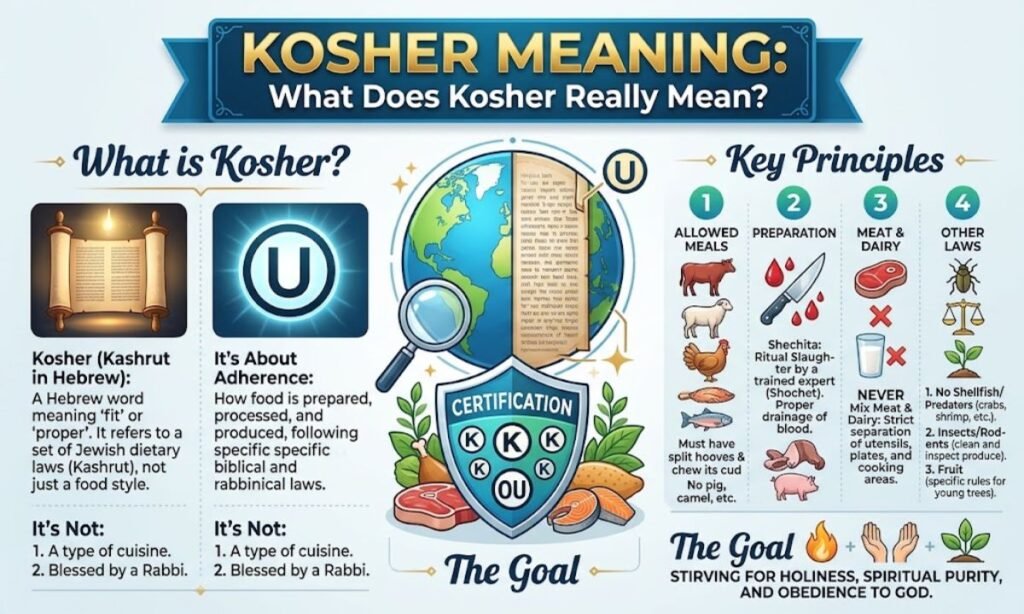
Kosher is a word you see on food labels, restaurant signs, and grocery shelves. Many people know it has something to do with Jewish food rules. Few know the full story.
The kosher meaning goes beyond a simple “approved food” tag. It covers what animals people can eat, how food is prepared, and even which dishes can touch each other. This guide explains it all in plain language, so you can understand kosher food with confidence.
What Is the Meaning of Kosher?
Kosher means “fit” or “proper” in Hebrew. In daily life, it describes food that follows Jewish dietary laws. These laws are called kashrut. Food that meets them is kosher. Food that does not is called treif, which means “torn” or “not fit.”
The word can also describe other things. A ritual object, such as a Torah scroll, can be kosher if it is made the right way. In casual English, people sometimes say “that doesn’t sound kosher” to mean something seems shady. That use is slang and has nothing to do with food.
Here is the short answer for quick readers:
- Kosher is a Hebrew word meaning fit or proper.
- It most often describes food that follows Jewish dietary law.
- The rules come from the Torah and later Jewish teachings.
- Kosher is about how food is sourced and made, not only what it is.
Origin and History of the Word Kosher
The word comes from the Hebrew root kasher. It appears in the Hebrew Bible in the sense of being right or suitable. Over time, it became the standard term for food that follows religious law.
The core food rules appear in the books of Leviticus and Deuteronomy. These books list which animals may be eaten and which may not. Rabbis in later centuries added detail. They wrote out how to slaughter animals, how to remove blood, and how to keep foods separate.
English speakers borrowed the word through Yiddish, the language many Jewish communities spoke in Europe. That is why the English spelling is “kosher” rather than a closer match to the Hebrew.
Basic Kosher Rules Explained
Kosher law can feel complex, but the main ideas are simple. Most rules fall into a few groups. Once you see the pattern, the rest makes sense.
The main rules include:
- Only certain animals, birds, and fish are allowed.
- Meat and dairy must never be cooked or eaten together.
- Animals must be slaughtered in a specific way.
- Blood must be removed from meat.
- Fruits, vegetables, grains, and eggs are generally fine, with some care needed.
- Insects are not allowed, so produce must be checked.
Utensils matter too. A pot used for meat cannot be used for dairy. Many kosher kitchens keep two full sets of dishes, pots, and tools. Some also keep a third set for Passover.
Kosher Animals: Which Are Allowed and Which Are Not
The Torah sets clear tests for each type of animal. These tests decide what counts as kosher. Here is a simple summary.
| Category | Kosher If | Common Kosher Examples | Common Non-Kosher Examples |
| Land animals | Chew cud and have split hooves | Cow, sheep, goat, deer | Pig, horse, camel, rabbit |
| Fish | Have fins and scales | Salmon, tuna, cod, trout | Catfish, eel, shark |
| Birds | Not birds of prey or scavengers | Chicken, turkey, duck, goose | Eagle, vulture, owl |
| Seafood | Must be a true fish | Fish only | Shrimp, crab, lobster, oysters |
| Insects | Not allowed in general | None | Most insects |
An animal must pass both land tests, not just one. A pig has split hooves but does not chew cud, so it is not kosher. A camel chews cud but lacks fully split hooves, so it fails too.
Even a kosher animal must be prepared the right way. A cow is kosher by species. Its meat is only kosher if it was slaughtered and processed by the rules.
Why Meat and Dairy Are Kept Apart
One of the best known kosher rules is the split between meat and dairy. The Torah says not to boil a young goat in its mother’s milk. Rabbis expanded this into a full rule. Meat and milk products are not cooked or eaten together.
This is why you will not find a kosher cheeseburger. It is also why a kosher restaurant is usually either a meat restaurant or a dairy restaurant, not both.
People also wait between eating meat and dairy. The wait time depends on family and community custom. Common practices include one hour, three hours, and six hours. Dairy followed by meat usually needs a shorter wait, though some people rinse their mouths first.
Fish is a special case. Fish is neither meat nor dairy under kosher law. Still, many communities avoid cooking fish and meat together as a custom, and some avoid eating them at the same plate.
Meaning of Pareve Foods
Pareve means neutral. These foods contain no meat and no dairy. They can be eaten with either one.
Common pareve foods include:
- Fruits and vegetables
- Grains, rice, and pasta
- Eggs
- Fish
- Nuts and seeds
- Many oils, sugar, and spices
Pareve is helpful for families who keep kosher. A pareve dessert can follow a meat dinner without breaking any rule. That is why many kosher bakeries use oil or margarine in place of butter.
Be careful, though. A pareve food loses that status if it is cooked in a meat pot or a dairy pot. The equipment can change the label. Packaged foods usually say “pareve” or “parve” on the kosher symbol.
How Kosher Slaughter (Shechita) Works
The kosher method of slaughter is called shechita. A trained person, called a shochet, carries it out. This person studies both the law and the technique for years.
The shochet uses a very sharp knife with no nicks. One quick, smooth cut is made across the throat. The goal is to be fast and to limit pain. The animal must be healthy at the time. After slaughter, the shochet checks the organs for signs of illness. If a problem is found, the meat is not kosher.
Blood is also a concern. The Torah forbids eating it. So the meat is soaked and salted, or broiled, to draw the blood out. Some parts, such as certain fats and the sciatic nerve, are removed. In practice, this makes many cuts from the hindquarters hard to prepare, so they are often sold outside kosher markets.
Kosher Certification and Symbols
Most people cannot check how a factory made a cookie. That is where kosher certification helps. A kosher certifying agency sends inspectors to review ingredients, equipment, and processes. If everything meets the rules, the product earns a symbol.
The symbol is often called a hechsher. You will see it on packaging as a small mark with letters or a design.
Common kosher symbols include:
- OU, from the Orthodox Union
- OK, from OK Kosher Certification
- Star-K
- Kof-K
- CRC, from the Chicago Rabbinical Council
A plain letter K is different. Anyone can print it, and it does not name a certifying agency. Look for a named symbol when you want reliable proof.
Some symbols add extra letters. D means the product has dairy or was made on dairy equipment. M means meat. Pareve is written out. The letter P near a symbol can mean kosher for Passover, though always check the full label.
Kosher vs Halal: Key Differences
People often mix up kosher and halal. Both are religious food laws, and both avoid pork. But they come from different traditions and have different details.
| Feature | Kosher | Halal |
| Faith | Judaism | Islam |
| Pork | Not allowed | Not allowed |
| Shellfish | Not allowed | Allowed in some schools of thought |
| Meat with dairy | Not allowed together | Allowed |
| Alcohol | Allowed, with some wine rules | Not allowed |
| Slaughter | By a shochet, with a blessing | By a Muslim, with God’s name spoken |
| Blood | Must be removed | Must drain out |
Some food can be both. A kosher chicken might meet halal rules in some cases. But you cannot assume one label covers the other. Each community decides based on its own standards.
Common Myths About Kosher Food
Many people have heard ideas about kosher that are not accurate. Clearing them up helps you understand the real meaning.
Here are a few popular myths:
- A rabbi blesses the food. Not true. A rabbi or inspector supervises the process. The goal is to check the rules, not to bless the product.
- Kosher food is always healthier. Not necessarily. A kosher cookie is still a cookie.
- Kosher means made in Israel. No. Kosher food is produced all over the world.
- Only Jewish people can eat it. Anyone can eat kosher food. Many people choose it for taste, trust, or dietary needs.
Kosher also does not mean clean in a hygiene sense. It is a religious standard. Food safety is handled by separate laws and inspections.
Kosher Salt: Why Is It Called Kosher?
Chefs love kosher salt for its coarse, flaky texture. The name often confuses people. Is the salt itself blessed? No.
It got its name because the large crystals are good at pulling blood out of meat. That step is part of the kosher preparation process. The salt was made for that job, and the name stuck.
Today, most home cooks use kosher salt because it is easy to pinch and sprinkle. It also dissolves cleanly and has a milder feel than fine table salt. Some brands carry a kosher certification. Others do not, even though the name says kosher.
Kosher for Passover
Passover adds another layer to the kosher meaning. During the holiday, Jewish families avoid chametz. This means any food made from wheat, barley, rye, oats, or spelt that has been allowed to rise or ferment.
Foods that are kosher all year may not be kosher for Passover. A bag of regular pasta is a good example. Many families also clean their homes before the holiday to remove all traces of chametz.
Products made for Passover usually carry a special label. It will say “Kosher for Passover” next to a trusted symbol. Some communities also have extra customs, such as avoiding rice or beans. These customs vary by family background.
Why People Choose Kosher Food Today
Many people who buy kosher are not Jewish. They like the added supervision. A kosher label tells them that someone has checked the ingredients and process.
Other reasons include:
- Dairy-free or vegetarian needs, since pareve foods have no milk or meat
- Trust in clear labeling
- Cultural and family tradition
- Interest in how food is made
For Jewish households, keeping kosher is also a way to stay connected to heritage and faith. Many see daily meals as a form of mindful practice. The rules make people pause and think about what they eat.
Frequently Asked Questions
What does kosher mean in simple words?
Kosher means fit or proper. It describes food that follows Jewish dietary laws.
Is kosher food blessed?
No. A rabbi or inspector supervises the process, but the food itself is not blessed.
Can non-Jewish people eat kosher food?
Yes. Anyone can eat kosher food, and many people do.
Is pork ever kosher?
No. Pigs do not chew cud, so pork is never kosher.
Why can’t you mix meat and dairy in kosher law?
The Torah forbids boiling a young goat in its mother’s milk. Rabbis expanded this into a full separation of meat and dairy.
Is kosher food cleaner or healthier?
Not by default. Kosher is a religious standard, not a health claim.
How can I tell if a product is kosher?
Look for a trusted symbol, such as OU, OK, Star-K, or Kof-K, on the package.
Final Thoughts
The kosher meaning is about more than a label. It is a system of laws that shapes what Jewish families eat, how they cook, and how they think about food. It covers animals, tools, timing, and care at every step. Once you understand the basic ideas, the details start to make sense.
Today, kosher food is part of everyday shopping for people of many backgrounds. Knowing how to read a symbol, what pareve means, and why meat and dairy stay apart can help you shop and talk about food with more confidence. Whether you follow kosher law or simply want to understand it, you now have a clear starting point.

Muhammad Shoaib is a content creator and SEO professional who enjoys making language and vocabulary easy to understand. He writes helpful content about word meanings, phrases, slang, abbreviations, spelling differences, and everyday expressions. nThrough WhizzMean, Shoaib focuses on creating clear, simple, and practical explanations that help readers quickly understand confusing words and language-related questions.