
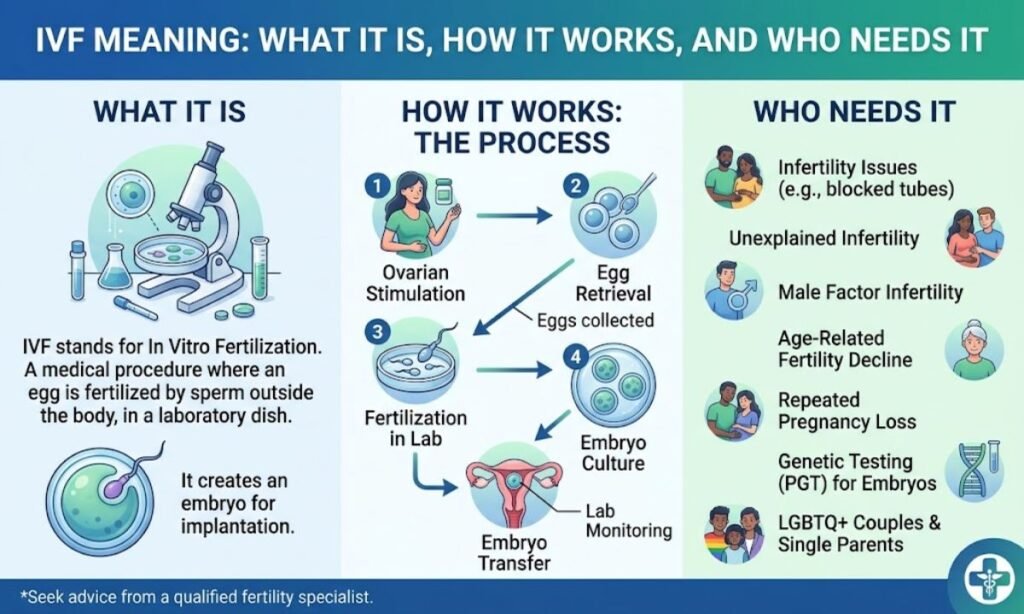
IVF stands for in vitro fertilization. It is a fertility treatment that helps people have a baby. Doctors collect eggs and mix them with sperm in a lab. The egg and sperm form an embryo. Then the doctor places the embryo in the uterus.
Many people turn to IVF when they cannot get pregnant on their own. It can help with blocked tubes, low sperm count, or age related fertility problems. In this guide, you will learn what IVF means and how each step works. You will also see who may need it and what to expect.
What Is the Meaning of IVF?
IVF means in vitro fertilization. “In vitro” is a Latin term that means “in glass.” It refers to the lab dish where fertilization happens. In natural conception, an egg and sperm meet inside the body. In IVF, they meet outside the body first.
IVF is one of the best known types of assisted reproductive technology, often shortened to ART. It helps people who struggle to get pregnant in the usual way. Doctors also use it for people who want to avoid passing on a genetic condition.
The first baby born through IVF was Louise Brown, in England in 1978. Since then, millions of babies have been born worldwide using this method. Dr. Robert Edwards, who helped develop the technique, won the Nobel Prize in Medicine in 2010.
How Does IVF Work?
IVF works by helping the egg and sperm meet under controlled conditions. A woman takes hormone medicines so her ovaries make several mature eggs in one cycle. Normally, the body releases only one egg a month.
Doctors then collect the eggs with a short procedure. In the lab, an embryologist mixes the eggs with sperm. If fertilization works, the eggs become embryos. The embryos grow in a special incubator for several days.
Finally, the doctor places one or more healthy embryos into the uterus. If an embryo attaches to the uterine lining, pregnancy begins. Any extra good embryos can be frozen for later use.
Here is a quick view of the main goals at each stage:
- Make more than one egg ready for collection
- Create embryos in a safe lab setting
- Choose the healthiest embryo
- Give that embryo the best chance to implant
Step by Step IVF Process
An IVF cycle usually takes about four to six weeks from the first medicine to the pregnancy test. Each clinic may follow a slightly different plan. Your doctor will build a schedule around your age, hormone levels, and health history.
The table below shows the typical steps.
| Step | What Happens | Usual Time |
| 1. Initial tests | Blood work, ultrasound, semen analysis | 1 to 4 weeks |
| 2. Ovarian stimulation | Daily hormone injections to grow follicles | 8 to 14 days |
| 3. Trigger shot | Final injection to mature the eggs | 1 dose, about 36 hours before retrieval |
| 4. Egg retrieval | Needle collects eggs under sedation | About 20 to 30 minutes |
| 5. Fertilization | Eggs and sperm combined in the lab | 1 day |
| 6. Embryo culture | Embryos grow and are monitored | 3 to 6 days |
| 7. Embryo transfer | Embryo placed in the uterus with a thin tube | 10 to 15 minutes |
| 8. Pregnancy test | Blood test to check hormone levels | About 9 to 14 days after transfer |
Egg retrieval is done under light sedation, so most people feel little pain. You may have cramps or bloating afterward. Embryo transfer is usually quick and feels like a routine pelvic exam.
Many clinics grow embryos to the blastocyst stage, which is around day five. Blastocysts have a better chance of showing which embryos are strong. Some clinics also test embryos for genetic problems before transfer. This is called preimplantation genetic testing, or PGT.
Who Needs IVF Treatment?
Doctors often suggest IVF when other treatments have not worked. They also suggest it when a medical issue makes natural pregnancy unlikely. Infertility is usually defined as not conceiving after 12 months of trying. For women over 35, doctors often step in after six months.
Common reasons people turn to IVF include:
- Blocked or damaged fallopian tubes
- Endometriosis
- Low sperm count or poor sperm movement
- Ovulation disorders such as PCOS, when simpler treatments fail
- Low egg reserve or advanced maternal age
- Unexplained infertility
- A risk of passing on an inherited condition
- Previous failed IUI cycles
IVF is also used by single parents and same sex couples. Egg donors, sperm donors, and gestational carriers can be part of the process. Cancer patients sometimes freeze eggs, sperm, or embryos before treatment. This is called fertility preservation.
Types of IVF Procedures
Not every IVF cycle looks the same. Doctors can adjust the method to match your needs. Knowing the main types helps you ask better questions during a consultation.
| Type | Meaning | Best For |
| Conventional IVF | Eggs and sperm are placed together in a dish | Most couples with normal sperm quality |
| ICSI | A single sperm is injected into each egg | Male factor infertility |
| Frozen embryo transfer (FET) | Previously frozen embryos are thawed and transferred | Extra embryos, genetic testing, or a delayed transfer |
| Natural cycle IVF | Only the one egg your body makes is collected | People who cannot or prefer not to take strong hormones |
| Mini IVF | Lower doses of fertility drugs are used | Some people at risk of overstimulation |
| Donor egg or sperm IVF | Donated cells are used to create embryos | Low egg reserve or severe sperm problems |
ICSI stands for intracytoplasmic sperm injection. It is now very common, even in some cases without male factor problems. Frozen embryo transfers are also on the rise. They give the body time to recover from hormone medicines before pregnancy.
IVF Success Rates
IVF success depends mostly on the age of the woman whose eggs are used. Younger eggs are more likely to form healthy embryos. Success rates also depend on embryo quality, uterine health, sperm quality, and clinic expertise.
These ranges are broad estimates. Actual numbers vary by clinic and by country, so always ask for the clinic’s own data.
| Age Group | Approximate Live Birth Chance per Embryo Transfer |
| Under 35 | About 40 to 50 percent |
| 35 to 37 | About 30 to 40 percent |
| 38 to 40 | About 20 to 30 percent |
| 41 to 42 | About 10 to 15 percent |
| Over 42 | Often under 10 percent with own eggs |
Many people need more than one cycle. Cumulative success rises with each try. Using donor eggs from a younger donor can raise the odds for older women.
Do not judge a clinic only by a headline success rate. Ask how it counts success. A live birth rate is more meaningful than a positive pregnancy test rate. Also ask whether the numbers include all patients or only a favorable group.
IVF Cost
IVF cost varies widely by country, clinic, and treatment plan. In the United States, one cycle often costs between 12,000 and 25,000 dollars. This is before medicines, which can add several thousand more. In some other countries, the price is lower.
The base fee may not include everything. Extra charges can come from several places.
- Fertility medicines
- ICSI
- Genetic testing of embryos
- Embryo freezing and yearly storage
- Frozen embryo transfer cycles
- Donor eggs, donor sperm, or a gestational carrier
- Consultations, scans, and blood tests
Some insurance plans and public health systems cover part of the cost. Others cover none. Ask the clinic for a written, itemized quote. Also ask about package deals and refund programs, and read the terms carefully.
Risks and Side Effects of IVF
IVF is generally safe, but like any medical treatment, it has risks. Most side effects are mild and short term. Knowing them in advance helps you stay calm and prepared.
Common side effects include:
- Bloating and mild pelvic pain
- Mood swings from hormone drugs
- Headaches and tiredness
- Breast tenderness
- Spotting after egg retrieval
More serious but less common risks include ovarian hyperstimulation syndrome, or OHSS. This happens when the ovaries react too strongly to fertility drugs. Signs include rapid weight gain, severe belly pain, and trouble breathing. Call your clinic right away if you notice them.
Other risks include multiple pregnancy, ectopic pregnancy, and miscarriage. Transferring a single embryo lowers the chance of twins or triplets. The emotional side matters too. Waiting, cost, and uncertainty can be stressful, so consider counseling or a support group.
How to Prepare for IVF
Good preparation can make the process smoother. Start by choosing a clinic with strong lab standards and clear communication. Ask about its experience with patients like you. Book a consultation and write down your questions.
Healthy habits help too. Small steps add up over a few months.
- Take folic acid as your doctor advises
- Aim for a balanced diet and regular, gentle exercise
- Stop smoking and limit alcohol
- Cut back on caffeine
- Manage stress through rest, walking, or talking with someone you trust
- Review all medicines and supplements with your doctor
Partners can prepare as well. Sperm quality can improve with better sleep, less heat exposure, and no smoking. Plan your calendar too. Injections, scans, and appointments take time, so talk to your employer early if you need flexibility.
IVF vs IUI: What Is the Difference?
Many people compare IVF with IUI, or intrauterine insemination. Both help with conception, but they work very differently. IUI places washed sperm directly into the uterus around ovulation. Fertilization still happens inside the body.
IVF is more involved. Fertilization happens in the lab, and doctors can see and choose embryos. That is why IVF often has higher success rates per cycle. It is also more costly and takes more time.
| Feature | IUI | IVF |
| Where fertilization happens | Inside the body | In the lab |
| Medication | Mild or none | Stronger hormone injections |
| Procedure | Simple, no sedation | Egg retrieval and embryo transfer |
| Cost | Lower | Higher |
| Best for | Mild infertility, cervical issues, some sperm issues | Blocked tubes, severe male factor, older age, repeated IUI failure |
Doctors often try IUI first for milder cases. If it fails after a few cycles, they usually move to IVF. Your age and diagnosis will guide that choice.
Frequently Asked Questions
What does IVF stand for?
IVF stands for in vitro fertilization. It is a treatment where an egg and sperm are joined in a lab.
How does IVF work in simple words?
Doctors collect eggs, fertilize them with sperm in a lab, and grow embryos. Then they place a healthy embryo in the uterus.
How long does one IVF cycle take?
One IVF cycle usually takes about four to six weeks from the first medicine to the pregnancy test.
Is IVF painful?
Most people feel mild discomfort, such as bloating or cramps. Egg retrieval is done under sedation, so you should not feel pain during it.
What is the success rate of IVF?
It depends mostly on age. For women under 35, the live birth chance per transfer is often around 40 to 50 percent.
Who should consider IVF?
People with blocked tubes, low sperm count, endometriosis, age related fertility decline, or unexplained infertility may consider IVF. Doctors also suggest it for genetic screening needs.
Is an IVF baby different from a naturally conceived baby?
No. Babies born through IVF are healthy and develop like any other child. The only difference is how fertilization happened.
Final Thoughts
The IVF meaning is simple, but the journey can feel complex. IVF is a medical process that helps an egg and sperm meet in a lab so an embryo can grow and be placed in the uterus. It has helped millions of families, and technology keeps improving. Knowing the steps, costs, and risks lets you approach it with clear expectations.
Every person’s fertility story is different. Age, health, and the cause of infertility all shape the outcome. This article is for general education and is not medical advice. Talk with a qualified fertility specialist who can review your tests and guide you toward the plan that suits you best.

Muhammad Shoaib is a content creator and SEO professional who enjoys making language and vocabulary easy to understand. He writes helpful content about word meanings, phrases, slang, abbreviations, spelling differences, and everyday expressions. nThrough WhizzMean, Shoaib focuses on creating clear, simple, and practical explanations that help readers quickly understand confusing words and language-related questions.