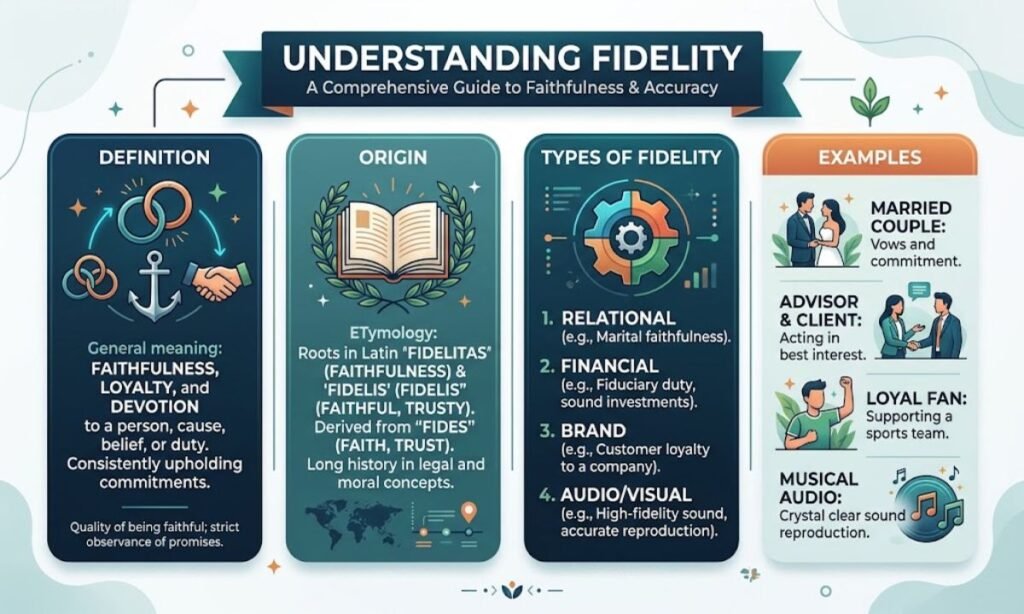
Fidelity means faithfulness. It describes loyalty to a person, a promise, a duty, or a standard. It also means accuracy, as in how closely a copy matches the original.
The word shows up in many places. You will see it in relationships, music, business, research, and finance. This guide explains the fidelity meaning in plain words, with examples and tables to make each use clear.
What Is the Meaning of Fidelity?
Fidelity is a noun. It has two main senses.
The first sense is loyalty. A person shows fidelity when they stay true to a partner, a friend, a cause, or a promise. This is the most common use in daily life.
The second sense is accuracy. Here, fidelity tells you how exactly something is copied or reproduced. A recording with high fidelity sounds very close to the live performance. A translation with high fidelity stays close to the original text.
Here is a quick summary of both senses:
| Sense | Simple Definition | Example |
| Loyalty | Faithful support or commitment | Fidelity to a spouse |
| Accuracy | How closely a copy matches the original | A high fidelity sound system |
| Adherence | Following a rule or plan exactly | Fidelity to a treatment plan |
Where Does the Word Fidelity Come From?
The word comes from the Latin term fidelitas. That term comes from fidelis, which means faithful or trusty. Both link back to fides, the Latin word for faith or trust.
English borrowed the word through Old French. It entered common use in the 1400s. Back then, it mostly described loyalty to a lord, a king, or a religious faith.
Over time, the meaning grew. By the 1900s, engineers used it to describe how well a machine reproduced sound. That is how “hi-fi” was born. It is short for high fidelity.
Related words share the same root. Think of fidelity, confide, confidence, and infidelity. All of them connect to trust.
Fidelity Meaning in Everyday Language
In daily speech, fidelity usually points to loyalty in a relationship. When someone speaks of marital fidelity, they mean staying faithful to a spouse. The opposite is infidelity, which means breaking that trust.
Fidelity also applies outside romance. You can show fidelity to a friend by keeping a secret. You can show it to a team by supporting it in hard times. You can show it to your values by acting on what you believe.
Here are some simple examples of the word in a sentence:
- She kept her fidelity to the family business for thirty years.
- The soldier swore fidelity to his country.
- The film showed great fidelity to the original novel.
- The speakers deliver impressive sound fidelity.
Notice how the same word fits very different situations. The core idea stays the same: being true to something.
Types of Fidelity
Fidelity has several forms. Each one fits a different field. The table below gives a quick view of the most common types.
| Type | What It Means | Where It Is Used |
| Marital fidelity | Loyalty to a spouse or partner | Relationships |
| Audio fidelity | Accuracy of sound reproduction | Music and electronics |
| Visual fidelity | Accuracy of images and graphics | Gaming, video, design |
| Translation fidelity | Closeness to the source text | Language and literature |
| Treatment fidelity | Following a plan or protocol as designed | Healthcare and research |
| Simulation fidelity | How real a training model feels | Aviation and medicine |
| Financial fidelity | Duty to act in a client’s best interest | Finance and law |
Each type measures one thing: how closely something stays true to a standard. That standard can be a promise, a sound, a text, or a plan.
Fidelity in Relationships and Personal Life
In relationships, fidelity is about trust. It goes beyond physical loyalty. It also covers honesty, respect, and emotional commitment.
Many couples talk about emotional fidelity too. This means keeping your deepest thoughts and closeness for your partner, not sharing them in ways that hurt trust. Each couple sets its own boundaries, so open talk matters.
Fidelity also builds strong friendships and families. When people keep their word, others feel safe. That safety lets bonds grow over time.
Some signs of fidelity in a relationship include:
- Keeping promises, even small ones
- Being honest when the truth is hard
- Supporting your partner in public and in private
- Respecting agreed boundaries
High Fidelity in Music and Technology
In audio, fidelity describes how true a sound is to its source. A system with high fidelity plays music the way the artist created it. It keeps the tone, depth, and detail intact.
The term “hi-fi” became popular in the mid 1900s. Home audio fans used it to describe quality record players and speakers. Today, it still guides how people choose headphones, amplifiers, and streaming services.
Several factors affect sound fidelity:
- Frequency response: how well a device handles low, mid, and high tones
- Distortion: unwanted changes to the original sound
- Bit rate and file format: how much detail a file keeps
- Speaker and headphone quality: how well hardware turns signals into sound
Lossless formats such as FLAC keep more detail than compressed formats such as low bit rate MP3. That is why audiophiles often prefer them.
Fidelity in Research and Healthcare
Researchers use the term fidelity to describe how closely a study or program follows its plan. This is often called implementation fidelity or treatment fidelity.
Imagine a school tests a new reading program. If teachers change the steps or skip lessons, the results become hard to trust. High fidelity means the program ran as designed. That makes the findings more reliable.
In healthcare, fidelity matters for the same reason. Clinicians follow set protocols so that patients get the intended care. It also helps other teams repeat the method and compare outcomes.
Simulation fidelity is another related idea. A flight simulator with high fidelity feels like a real cockpit. Medical training models work the same way. The more realistic the setup, the better the practice.
Fidelity in Finance and Business
In finance, the word has two common meanings. The first is a legal duty. A fiduciary must act faithfully in the best interest of a client. The word “fiduciary” shares the same Latin root as fidelity.
The second meaning is a brand name. Fidelity Investments is a well known financial services company based in Boston, Massachusetts. Edward C. Johnson II founded it in 1946. It offers retirement accounts, brokerage services, and mutual funds.
Many people search for “fidelity” while looking for this company. If that is your goal, visit the official company website. This article covers the word itself, not investment advice.
Businesses also use the word in other ways. A fidelity bond is a type of insurance. It protects an employer from losses caused by employee dishonesty, such as theft or fraud.
Fidelity vs Loyalty vs Faithfulness
These words sound alike. They overlap, but they are not always the same. Knowing the small differences helps you choose the right one.
| Word | Core Idea | Best Used For |
| Fidelity | Faithfulness to a duty, person, or standard, plus accuracy | Relationships, audio, research |
| Loyalty | Steady support and allegiance | Friends, teams, brands |
| Faithfulness | Being true and reliable | Partners, promises, faith |
| Accuracy | Closeness to the truth or original | Data, copies, measurements |
Only fidelity covers both loyalty and accuracy. That makes it a flexible word. Loyalty and faithfulness lean toward people. Accuracy leans toward facts and data.
Synonyms and Antonyms of Fidelity
Knowing related words helps you write better. It also helps you understand the word in context.
Synonyms:
- Loyalty
- Faithfulness
- Allegiance
- Devotion
- Constancy
- Accuracy
- Precision
- Exactness
Antonyms:
- Infidelity
- Disloyalty
- Betrayal
- Treachery
- Inaccuracy
- Unfaithfulness
Choose the synonym that matches your meaning. Use “loyalty” for people. Use “accuracy” for copies and data.
Frequently Asked Questions
What does fidelity mean in simple words?
Fidelity means being faithful or true. It can also mean how accurately something is copied.
What is an example of fidelity?
Staying loyal to your partner is a common example. A speaker that plays music exactly as recorded is another.
What is the opposite of fidelity?
The main opposite is infidelity, which means disloyalty or betrayal. Inaccuracy is the opposite in the sense of accuracy.
What does high fidelity mean?
High fidelity means a very accurate copy or reproduction. It is often used for sound and images.
Is fidelity only about marriage?
No. It also covers loyalty to friends, duties, values, and standards. It applies to accuracy in technology too.
What is fidelity in research?
It is how closely a study or program follows its original plan. High fidelity makes results more reliable.
What language does the word fidelity come from?
It comes from the Latin word fidelitas, which comes from fidelis, meaning faithful.
Final Thoughts
The fidelity meaning comes down to one idea: staying true. In people, that means loyalty and honesty. In technology and research, it means accuracy and close adherence to a standard. Once you see this single thread, the many uses of the word make sense.
Next time you see the word, check the context. It may describe a promise between two people, a high quality speaker, a research method, or a financial duty. Each use points to trust, and that trust is what gives the word its lasting power.

Muhammad Shoaib is a content creator and SEO professional who enjoys making language and vocabulary easy to understand. He writes helpful content about word meanings, phrases, slang, abbreviations, spelling differences, and everyday expressions. nThrough WhizzMean, Shoaib focuses on creating clear, simple, and practical explanations that help readers quickly understand confusing words and language-related questions.