I didn’t get a heading structure with your message, so I built one around the primary keyword “fwiw meaning.” If you have a specific outline, send it and I will rework the article to match.
You see “FWIW” in texts, work chats, and online comments. It looks small, but many people are not sure what it says. This guide explains the FWIW meaning in plain words.
You will learn what the term stands for, where it came from, and how to use it. You will also see how it differs from similar slang, and when to skip it.
What Does FWIW Mean?
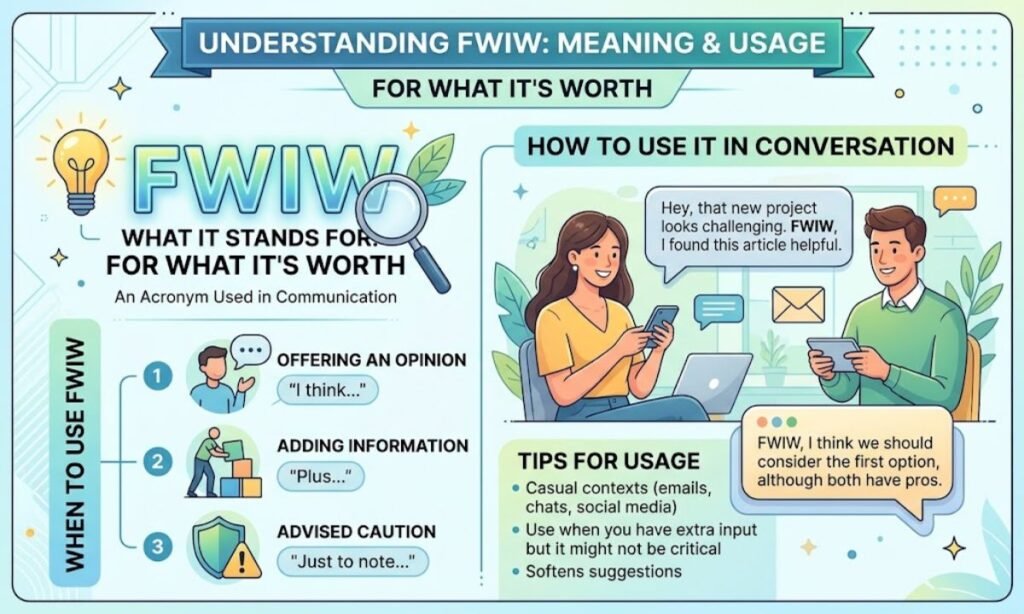
FWIW stands for “for what it’s worth.” People use it to share an opinion, a tip, or a fact in a gentle way. It tells the reader, “This may or may not help, but here it is.”
The phrase works like a soft opener. It lowers the pressure. The speaker does not claim to be an expert or to have the final say.
In short, FWIW means “take this for what it is.” You can use it, ignore it, or think it over.
Here is a quick snapshot:
| Item | Detail |
| Full form | For what it’s worth |
| Type | Abbreviation, internet slang, text acronym |
| Simple meaning | “Here is my view, use it if it helps” |
| Common places | Texts, chats, emails, social media, forums |
| Tone | Casual, humble, sometimes neutral |
FWIW Full Form and Origin
The full form is “for what it’s worth.” The spoken phrase is much older than the abbreviation. English speakers have used it for a long time to offer a small piece of advice or information.
The short form grew with early online chat, forums, and text messages. Typing was slow, so people cut common phrases into letters. Acronyms like BTW, IMO, and FWIW became normal.
The phrase also reached pop culture. A well known 1960s protest song uses “For What It’s Worth” as its title. That helped keep the words familiar to many people.
Today, FWIW is used by all ages. Younger users meet it in chat apps. Older users know the long form from everyday speech.
How to Use FWIW in Text and Chat
You can place FWIW at the start or the end of a message. It sets the tone for what comes next, or it softens what came before. Both work well.
Use it when you want to share something without pushing it. It fits best when you are not fully sure, or when no one asked for your view.
Here are common ways people use it:
- To give a gentle opinion
- To add a helpful fact
- To offer a small tip
- To share a personal experience
- To comfort someone in a light way
You can write it in capitals, as “FWIW,” or in lowercase, as “fwiw.” Both are fine in casual chat. Capitals look a bit clearer in work messages.
Examples of FWIW in Sentences
Seeing real lines makes the meaning easier to grasp. Here are some simple examples for different settings.
In a text with a friend:
“FWIW, I think the second apartment is a better deal.”
In a work chat:
“FWIW, the client replied faster last time when we sent a short summary.”
On social media:
“The movie was slow at first. FWIW, the ending made it worth it.”
As support:
“I know the exam was hard. FWIW, you studied harder than anyone I know.”
Notice the pattern. Each line adds something useful, but none of them forces the reader to agree. That is the whole point of the term.
Is FWIW Polite, Rude, or Passive Aggressive?
Most of the time, FWIW is polite and neutral. It signals humility. The writer is saying, “I am offering this, not demanding it.”
Still, tone depends on context. In a heated argument, FWIW can sound cold. It may read as, “Here is my point, and I don’t care if you listen.”
Here is how the tone can shift:
| Situation | How FWIW Can Sound |
| Friendly advice | Kind and humble |
| Sharing a fact | Neutral and helpful |
| During a disagreement | Dismissive or sharp |
| After a long debate | Tired or slightly sarcastic |
Because text has no voice or face, readers fill in the mood themselves. When the topic is sensitive, add a warm word or an emoji to keep the tone clear.
FWIW vs IMO vs IMHO vs FYI
People often mix up these text acronyms. They look alike but do different jobs. Knowing the gap helps you write with more care.
| Acronym | Full Form | Best Use |
| FWIW | For what it’s worth | Offer a light, optional input |
| IMO | In my opinion | State a clear personal view |
| IMHO | In my humble opinion | State a view with extra modesty |
| FYI | For your information | Share a fact the reader should know |
| BTW | By the way | Add a side note |
FWIW is softer than IMO. IMO says, “This is what I think.” FWIW says, “This might help, but you decide.”
FYI is more direct. It tells the reader something they likely need to know. FWIW is more optional and leaves more room for the reader.
Where to Use FWIW and Where to Avoid It
FWIW works best in relaxed or semi-formal settings. It fits well when the stakes are low and the tone is friendly.
Good places to use it:
- Text messages and group chats
- Slack, Teams, and other work chat tools
- Social media replies and comments
- Informal emails to people you know well
Places to avoid it:
- Legal documents and contracts
- Formal reports and academic papers
- Job applications and cover letters
- Official letters to senior leaders
In formal writing, spell out the idea instead. For example, write “For your consideration, here is another point.” That keeps the message clear and professional.
Common Mistakes with FWIW
Many people use FWIW in a way that weakens their message. A few small habits can fix that.
Here are the most common mistakes:
- Overusing it. If every line starts with FWIW, you sound unsure.
- Using it to hide a harsh point. Adding FWIW to a rude comment does not make it kind.
- Mixing it up with FYI. They are not the same, so pick the right one.
- Using it in formal settings. It can look casual or careless.
- Writing it with odd punctuation. Keep it simple, like “FWIW,” followed by your point.
One more tip. If your point is important, say it plainly. A strong fact does not need a soft opener. Save FWIW for views and ideas that are truly optional.
Related Searches: FWIW in Texting, Slang and Emails
Many readers search for more than the basic FWIW meaning. They want to know how it fits into daily writing. Here are the most common related topics.
FWIW in texting. In a text, it acts as a friendly nudge. It often comes before advice, a recommendation, or a kind word.
FWIW slang meaning. As slang, it simply means “just so you know, here is my take.” It carries no strong emotion on its own.
FWIW in email. It is fine in casual work emails. Think of notes to teammates. For clients or leaders, a full sentence is safer.
FWIW meaning in chat apps. On WhatsApp, Instagram, or Discord, people use it freely. Most readers know it well, so you rarely need to explain it.
Frequently Asked Questions
What does FWIW stand for?
FWIW stands for “for what it’s worth.” It introduces an opinion or fact in a gentle, optional way.
Is FWIW formal or informal?
It is informal. Use it in texts and chats, and avoid it in formal reports or legal writing.
Can FWIW sound rude?
Yes, in some cases. During an argument, it can come across as cold or dismissive.
Is FWIW the same as IMO?
No. IMO states your own opinion, while FWIW offers a softer, optional thought.
Should I use capital letters for FWIW?
Either style works. Capitals look cleaner in work chats, and lowercase suits casual texts.
Can I use FWIW at the end of a sentence?
Yes. You can place it at the start or the end, and the meaning stays the same.
Is FWIW appropriate in a work email?
It is fine for casual emails with teammates. For clients or senior staff, write the full phrase or rephrase.
Final Thoughts
FWIW is a small phrase with a useful job. It lets you share a view, a tip, or a bit of comfort without pressure. The reader can take it or leave it, and that makes conversations feel lighter and kinder.
Use it with care. Keep it for casual and low stakes moments, and skip it in formal writing. When your point matters, say it clearly. When it is just a thought worth sharing, FWIW is the right tool.

Muhammad Shoaib is a content creator and SEO professional who enjoys making language and vocabulary easy to understand. He writes helpful content about word meanings, phrases, slang, abbreviations, spelling differences, and everyday expressions. nThrough WhizzMean, Shoaib focuses on creating clear, simple, and practical explanations that help readers quickly understand confusing words and language-related questions.