
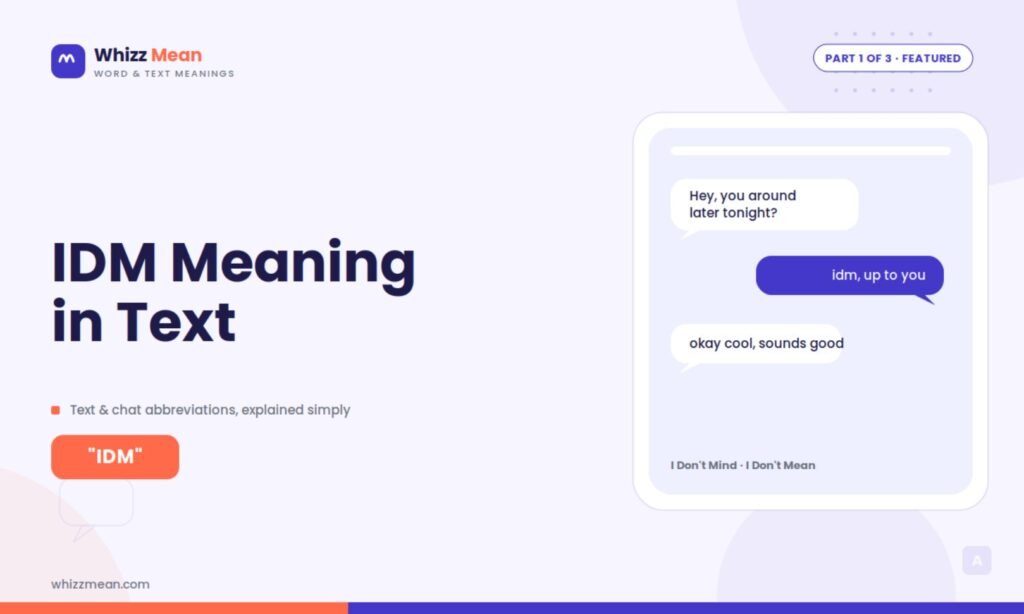
Ever gotten a text that just says “idm” and had absolutely no idea what your friend meant? You’re not alone. Texting abbreviations move fast, and IDM meaning in text is one of those short forms that trips up even people who consider themselves fluent in internet slang.
Part of the confusion comes from the fact that IDM isn’t a one-trick term. Depending on who sent it, the platform they’re using, and the context of the conversation, IDM meaning in text can shift from “I don’t mind” to something entirely different like a technical term or a niche music genre. That kind of ambiguity is exactly why people freeze up mid conversation, unsure whether to respond casually or ask for clarification.
Getting the IDM meaning in text right matters more than it seems. Misreading a casual “idm” as indifference, or worse, as dismissiveness, can create awkward misunderstandings between friends, partners, or coworkers. This guide breaks down every common meaning, shows you how to use it naturally, and helps you avoid the mistakes that make people look out of touch.
IDM Meaning in Text: Quick Answer 🔍
IDM most commonly stands for “I Don’t Mind” in texting and casual chat. It’s used to show easy going agreement or indifference when someone asks for your preference. 💬✅
Primary Meanings and Full Forms of IDM
IDM carries a handful of widely recognized full forms depending on tone and context. Here are the most common ones you’ll actually run into.
- I Don’t Mind – the most popular meaning, used to express flexibility or lack of preference.
- I Didn’t Mean (that) – used when someone wants to walk back something they said.
- In Da Morning – a casual, phonetic shorthand for “in the morning,” popular in scheduling texts.
- Instant Direct Message – occasionally used in tech or app-related contexts to describe a quick private message.
Key takeaway: The safest default interpretation of IDM meaning in text is “I don’t mind,” unless the sentence structure clearly points to another meaning.
Origin and History of IDM in Online Slang
Like most texting abbreviations, IDM grew out of the need for speed. As SMS character limits and early chat rooms pushed people toward shorthand, common phrases got trimmed down to their initials.
“I don’t mind” was a natural candidate for abbreviation because it’s a phrase used constantly in casual planning conversations. Think group chats deciding on dinner spots or movie times, where nobody wants to type out a full sentence just to say they’re easygoing.
The term picked up steam through instant messaging platforms in the 2000s (AIM, MSN Messenger) and carried over into modern texting and social media DMs. Its flexibility, working as both a shrug emoji in text form and a polite deferral, kept it relevant well into the smartphone era.
How to Use IDM in Daily Chats (With Examples)
Using IDM naturally comes down to matching it with the right tone: casual, low effort, and non committal. Here are real world examples of how people drop it into conversation.
Friend 1: Pizza or sushi tonight?
Friend 2: idm, you pick 🍕🍣
Partner 1: Should we watch a movie or just chill?
Partner 2: idm honestly, whatever you’re feeling
Coworker 1: Can we push the meeting to 3pm?
Coworker 2: idm, works for me
Group chat: Where should we meet up? Park or the mall?
Reply: idm either is fine, just tell me the time
Notice the pattern: IDM always appears when someone is being asked to weigh in, and it signals they’re happy to go along with whatever’s decided.
Popular Platforms Where IDM Is Commonly Used
IDM meaning in text shows up most frequently on platforms built around fast, casual conversation rather than formal communication.
- WhatsApp: heavily used in group planning chats among friends and family.
- Instagram DMs: common in quick back and forth replies to stories or plans.
- Snapchat: used in fast paced chats where brevity matters most.
- Reddit: appears in comment threads when users express indifference to a suggestion or option.
- iMessage/SMS: a texting staple, especially in scheduling and decision making conversations.
TikTok comments also feature IDM occasionally, though it’s less dominant there compared to WhatsApp and iMessage conversations.
Other Meanings of IDM in Different Contexts
Outside of texting, IDM takes on entirely different definitions depending on the industry or community.
- Intelligent Document Management: a term used in enterprise software and business tech.
- Idiopathic Dilated Cardiomyopathy: a medical abbreviation referring to a type of heart condition.
- Intelligent Dance Music: a genre of electronic music known for its complex, experimental style, often just called “IDM” by music fans.
- Identity Management: used in IT and cybersecurity circles to refer to systems that manage user identities and access.
If IDM appears in a professional email, tech forum, or medical document, it almost certainly isn’t the “I don’t mind” texting slang version.
IDM vs Similar Texting Abbreviations
Here’s how IDM meaning in text stacks up against other common indifference or clarification abbreviations.
| Abbreviation | Full Meaning | Tone | Best Use Case |
| IDM | I Don’t Mind | Casual, agreeable | Responding to a choice with no preference |
| IDC | I Don’t Care | Blunt, sometimes dismissive | Expressing true indifference, can sound harsh |
| IDK | I Don’t Know | Neutral, uncertain | Answering when you genuinely lack information |
| NVM | Never Mind | Dismissive, closing a topic | Ending a conversation thread or retracting a question |
| WTV | Whatever | Casual, sometimes passive aggressive | Signaling indifference, occasionally with attitude |
IDM stands out because it’s the friendliest of this group. Unlike IDC or WTV, it doesn’t risk sounding cold or annoyed.
How to Respond When Someone Texts You IDM?
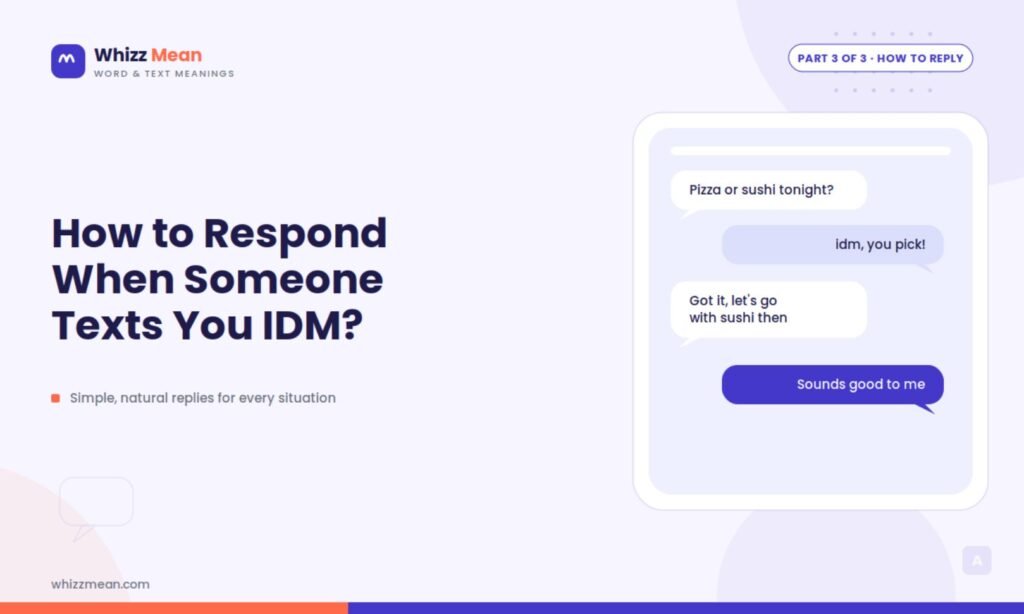
When someone sends IDM, they’re handing the decision back to you. The best response depends on the situation, but here’s how to handle it smoothly.
- If it’s about plans: Just pick an option and confirm it. Example: “Cool, let’s do sushi then 🍣”
- If it feels vague: Ask a quick follow up. Example: “idm too lol, you choose then?”
- If it’s about feelings or opinions: Give them space to be honest. Example: “You sure? No pressure either way”
Pro tip: Don’t read IDM as disinterest in the conversation itself. It usually just means they’re flexible, not that they don’t care about talking to you.
When and Where You Should Avoid Using IDM
Despite its popularity, IDM meaning in text doesn’t belong everywhere. Skip it in these situations.
- Professional emails: abbreviations like IDM read as unpolished in workplace communication.
- Formal client messages: clarity matters more than speed when representing a business.
- Sensitive conversations: topics involving emotions, conflict, or important decisions deserve full sentences.
- First time conversations: using slang too early with someone new can come across as overly casual.
In these contexts, swap IDM for a full phrase like “I’m happy with either option” to maintain professionalism.
Pro Tip I Learned
When you see “IDM” in a text or chat, don’t assume it always has the same meaning. In most casual conversations, IDM means “I Don’t Mind,” which is used to show that you are okay with a suggestion, choice, or situation. For example, if someone asks, “Do you want pizza or burgers?” replying “IDM” means you are fine with either option. Always consider the context because abbreviations can have different meanings in different conversations.
Common Mistakes to Avoid When Using IDM
A few small missteps can make IDM land wrong, even when your intentions are good.
- Using it after asking a serious question. IDM can seem dismissive if the topic clearly needed real thought.
- Capitalizing it unnecessarily. “IDM” in all caps can read as shouting; lowercase “idm” feels more natural in casual texts.
- Confusing it with IDC. Swapping IDM for IDC changes the tone from agreeable to indifferent or even rude.
- Using it in professional settings. As covered above, this instantly undercuts a polished tone.
Quick fix: When in doubt, add a follow up word or emoji, like “idm 🙂” or “idm, either works,” to soften the tone and avoid sounding flat.
Frequently Asked Questions
What does IDM mean in a text message?
IDM most commonly means “I don’t mind,” used to express flexibility or agreement with a suggestion.
Is IDM the same as IDC?
No. IDM (“I don’t mind”) is friendlier and more agreeable, while IDC (“I don’t care”) can sound blunt or dismissive.
Can IDM mean something other than “I don’t mind”?
Yes. Depending on context, IDM can also stand for “I didn’t mean,” “in da morning,” or industry terms like Identity Management.
Is it okay to use IDM in professional messages?
It’s best avoided. IDM is a casual texting abbreviation and can come across as unprofessional in formal emails or workplace chats.
Conclusion
At its core, the IDM meaning in text boils down to easygoing flexibility, most often “I don’t mind.” It’s a small abbreviation that carries a lot of social nuance, from casual group chats to the rare technical or medical context where it means something completely different.
Understanding when and how to use IDM, and recognizing when to avoid it, helps you communicate clearly across every platform and every kind of conversation. Once you’ve got the context sorted, you’ll never second guess that quick “idm” text again.

Muhammad Shoaib is a content creator and SEO professional who enjoys making language and vocabulary easy to understand. He writes helpful content about word meanings, phrases, slang, abbreviations, spelling differences, and everyday expressions. nThrough WhizzMean, Shoaib focuses on creating clear, simple, and practical explanations that help readers quickly understand confusing words and language-related questions.


1 thought on “IDM Meaning in Text: What It Stands for & How to Use It”