“Imminent” is a word you see in news alerts, weather warnings, and movie trailers. It sounds serious, and it is. In short, imminent means something is about to happen very soon.
This guide explains the imminent meaning in plain English. You will see how to say it, where it comes from, and how to use it in a sentence. You will also learn how it differs from look-alike words such as eminent and immanent.
What Does Imminent Mean?
Imminent is an adjective. It describes an event that is close in time and ready to happen at any moment. The event has not happened yet, but it is right around the corner.
Think of dark clouds and a rumble of thunder. You could say, “Rain is imminent.” That tells people to grab an umbrella now, not later.
Here are the key points to remember:
- It talks about the near future, not the past.
- It suggests the event is almost certain.
- It often carries a feeling of urgency.
The word is often used for storms, deadlines, danger, and big announcements. But it can also describe good news, such as an imminent birth or an imminent trip.
Imminent Definition and Pronunciation
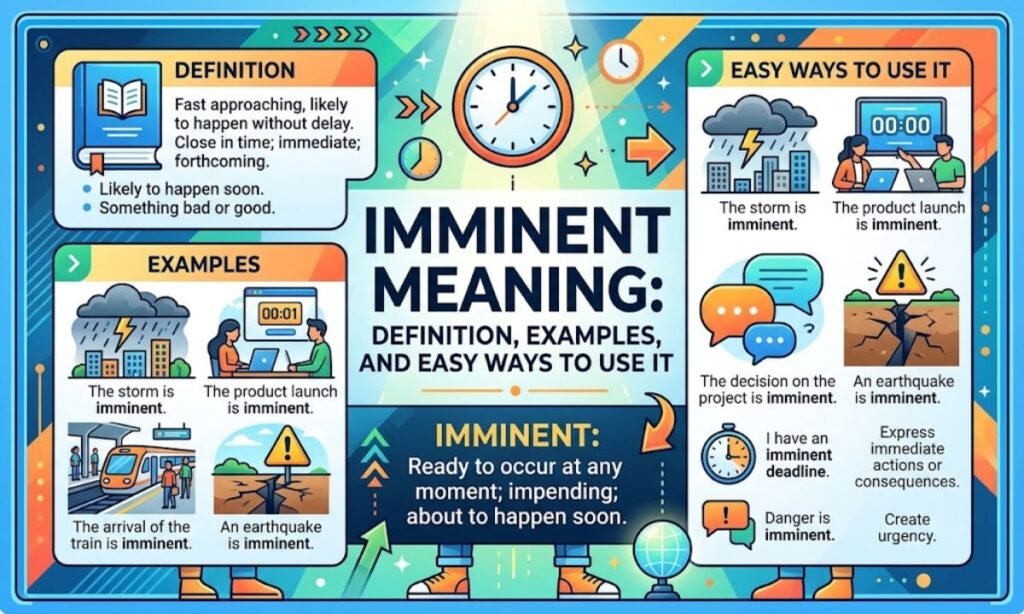
The standard imminent definition is “about to occur” or “likely to happen without delay.” Dictionaries use slightly different wording, but the idea stays the same. Time is short, and the event is near.
People often ask how to say it. The word is pronounced IM-uh-nunt. The stress falls on the first syllable. It has three syllables: im, mi, nent.
Here is a quick reference:
| Detail | Answer |
| Part of speech | Adjective |
| Pronunciation | IM-uh-nunt |
| Adverb form | Imminently |
| Noun form | Imminence |
| Basic meaning | About to happen soon |
Spelling trips up many writers. Remember the double “m” at the start and the single “n” in the middle. The word ends in “-ent,” not “-ant.”
Origin and Word History
Imminent comes from the Latin word imminere. That verb meant to hang over, to lean toward, or to threaten. The picture is a rock ledge hanging over your head. It has not fallen, but it could drop any second.
This history explains why the word feels tense. Even today, imminent often hints at a threat or a big change that you cannot easily stop. The sense of something “hanging over” you has stayed in the word for centuries.
English borrowed the word from Latin through the usual route of scholarly and legal writing. Over time, it moved into everyday speech. Now it appears in headlines, reports, and daily conversation.
How to Use Imminent in a Sentence
Using the word is easy once you see a few examples. Put it before a noun, or use it after a linking verb such as “is” or “seems.”
Here are some simple examples:
- The weather service warned that a storm was imminent.
- The company said a product launch is imminent.
- With the exam date so close, her stress felt imminent and heavy.
- Doctors told the family that the baby’s arrival was imminent.
- The old bridge looked weak, and a collapse seemed imminent.
You can also use the adverb form. For example: “The train will imminently arrive at platform two.” This sounds formal, so most people prefer “is about to arrive” in casual speech.
A good tip is to check the timing. Use imminent only when the event is truly close. If something will happen next year, a better choice is “upcoming” or “future.”
Imminent Synonyms and Antonyms
Knowing similar words helps you write with more variety. It also helps you pick the right shade of meaning. Some synonyms are close to imminent, while others are softer.
| Synonyms (similar meaning) | Antonyms (opposite meaning) |
| Impending | Distant |
| Looming | Remote |
| Approaching | Far off |
| Forthcoming | Unlikely |
| Near | Improbable |
| On the horizon | Past |
| Close at hand | Delayed |
Not every synonym fits every sentence. “Looming” often sounds threatening. “Forthcoming” sounds neutral and is common in announcements, such as a forthcoming book.
“Imminent” sits in the middle. It is strong, direct, and focused on timing. When you want to say that something is truly about to happen, it is hard to beat.
Imminent vs Eminent vs Immanent
These three words look and sound alike. Many people mix them up. Each one has a different meaning, so it helps to learn them side by side.
| Word | Meaning | Example |
| Imminent | About to happen | A storm is imminent. |
| Eminent | Famous, respected, high in rank | She is an eminent scientist. |
| Immanent | Existing within something, inherent | Many faiths speak of an immanent spirit. |
Imminent is about time. Eminent is about status. Immanent is about something that lives inside a thing, and it is rare in daily writing.
A simple memory trick can help. Imminent starts with “imm,” like “immediately.” Eminent has “em,” like “emperor,” a person of high rank. That small link can save you from an awkward typo.
Imminent vs Impending
Many readers ask whether imminent and impending are the same. They are close, but not identical. Both describe something that is coming, yet they feel a little different.
Impending usually points to something unpleasant or serious, such as impending doom or an impending storm. It also does not always tell you the exact timing. Imminent puts more weight on how soon the event will occur.
Compare these two lines:
- “An impending change worried the staff.” The change is coming, but the timing may be loose.
- “An imminent change worried the staff.” The change is about to happen very soon.
If you want to stress speed, choose imminent. If you want to stress a looming, heavy feeling, impending may fit better.
Common Phrases With Imminent
Some word pairs appear again and again. Learning them helps you sound natural. They also show how the word works in real life.
Here are common phrases:
- Imminent danger: a threat that is about to cause harm
- Imminent threat: a risk that could strike at once
- Imminent arrival: someone or something is almost here
- Imminent collapse: a structure or system is about to fail
- Imminent departure: a person or vehicle is about to leave
- Imminent release: a product, film, or update is coming very soon
Notice that many of these phrases involve risk. That is why the word often appears in safety notices and emergency reports. Still, phrases like “imminent arrival” and “imminent release” show it can be neutral or even happy.
Imminent in Legal, News, and Everyday Contexts
In news writing, imminent helps reporters show urgency. A headline might say that a decision is imminent, which tells readers to expect an answer shortly. It adds weight without using many words.
In law, the word has a more careful meaning. Phrases like “imminent danger” often refer to a threat that is about to happen, not one that might happen someday. This idea matters in topics such as self-defense and workplace safety. Rules and definitions differ by place, so always check local law for exact terms.
In daily life, people use it more loosely. A friend might say, “My sleep is imminent,” when they are very tired. That is playful, and it works because everyone understands the core meaning.
Easy Tips to Remember the Meaning
Memory tricks make new words stick. Try one of these ideas the next time you see imminent.
- Picture the ledge: Imagine a rock hanging over your head. It is about to fall.
- Link it to “immediate”: Both words start with “imm” and both are about time.
- Use a countdown: If you can picture a clock ticking down, the event is imminent.
- Write your own example: A sentence from your own life is easier to remember than a dictionary line.
Practice also helps. Try using the word in a message or a short note this week. After two or three uses, it will feel natural.
Frequently Asked Questions
What is the simple meaning of imminent?
Imminent means something is about to happen very soon. It points to the near future.
Is imminent a positive or negative word?
It can be either. It often describes danger, but it can also describe good events like an imminent birth.
What part of speech is imminent?
Imminent is an adjective. Its adverb form is imminently, and its noun form is imminence.
What is the difference between imminent and eminent?
Imminent means about to happen. Eminent means famous or highly respected.
Can you give an example of imminent in a sentence?
Yes. “Heavy rain is imminent, so please bring your umbrella.”
What are the best synonyms for imminent?
Good options include impending, looming, approaching, and forthcoming.
How soon is “imminent”?
There is no fixed time. It usually means minutes, hours, or a few days, depending on the situation.
Final Thoughts
The imminent meaning is simple at its core. It describes something that is about to happen very soon. The word carries a sense of urgency, and its Latin roots give it the feeling of something hanging overhead. Once you know that picture, the meaning is hard to forget.
Use imminent when timing truly matters, and double check that you have not mixed it up with eminent or immanent. Pick synonyms like impending or looming when you want a different tone. With a few examples and a clear memory trick, you can use this word with confidence in writing and in speech.

Muhammad Shoaib is a content creator and SEO professional who enjoys making language and vocabulary easy to understand. He writes helpful content about word meanings, phrases, slang, abbreviations, spelling differences, and everyday expressions. nThrough WhizzMean, Shoaib focuses on creating clear, simple, and practical explanations that help readers quickly understand confusing words and language-related questions.