
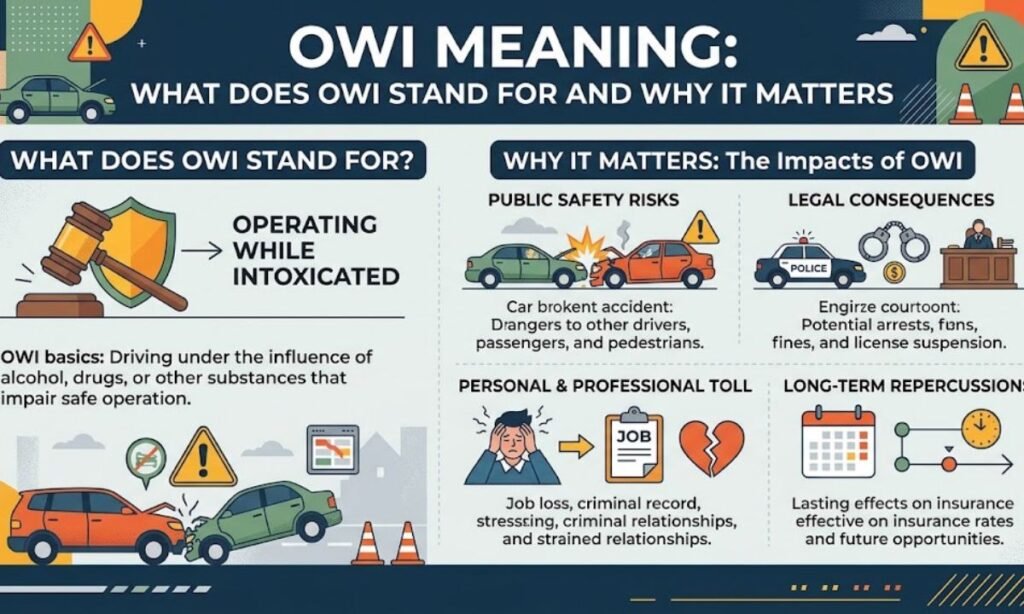
OWI stands for Operating While Intoxicated. It is a legal term for driving or running a vehicle while under the influence of alcohol or drugs. You will see it most often in traffic law, police reports, and court records.
If you searched for the OWI meaning, you likely saw it on a ticket, in the news, or in a legal document. This guide explains what the term means, where it is used, and how it differs from DUI and DWI. You will also learn what penalties can follow and what to do if you face a charge.
What Does OWI Stand For?
OWI is short for Operating While Intoxicated. In some places, people also read it as Operating While Impaired. Both versions describe the same core idea. A person controls a motor vehicle when drugs or alcohol affect their ability to do it safely.
The word “intoxicated” is not limited to alcohol. It can cover illegal drugs, prescription medicine, and other substances that affect your judgment, reaction time, or coordination. A legal drug can still lead to a charge if it impairs your driving.
Here is a quick summary:
- O stands for Operating
- W stands for While
- I stands for Intoxicated
Why the Word “Operating” Matters
Many people ask why the law says “operating” and not “driving.” The difference is small in daily speech but big in court. Driving means the vehicle is moving. Operating is wider. It can include sitting in the driver’s seat with the keys and being able to start the car.
This means a person might face an OWI charge even while parked. Think of someone who falls asleep in a parked car with the engine running. A police officer could still decide they were in control of the vehicle.
Each state sets its own rules, so the exact test can vary. In general, the word “operating” gives the law more reach than the word “driving.”
Where Is the Term OWI Used?
OWI is a state-level term in the United States. Wisconsin and Iowa use it in their laws. Indiana and Michigan also use OWI in their legal language. Other states use different labels for the same kind of offense.
That is why the same act can have a different name depending on the map. A person arrested in one state might be charged with OWI. A person arrested in a neighboring state might face a DUI or DWI charge instead.
Here is how the common terms compare:
| Term | Full Form | Where You Often See It |
| OWI | Operating While Intoxicated | Wisconsin, Iowa, Indiana, Michigan |
| DUI | Driving Under the Influence | Many states, including California and Texas |
| DWI | Driving While Intoxicated | New York, Texas, North Carolina, and others |
| OUI | Operating Under the Influence | Maine, Massachusetts, Rhode Island |
| OVI | Operating a Vehicle Impaired | Ohio |
OWI vs DUI vs DWI: Are They the Same?
In everyday talk, these terms mean almost the same thing. All of them describe impaired driving. The legal label simply depends on the state where the arrest happens.
Still, there can be real differences in how each state defines the offense. Some states treat a DUI as an alcohol offense and a DWI as a drug offense. Others use one term for every case. Some states set separate rules for being impaired and for having a blood alcohol level above the legal limit.
The safest way to understand a charge is to read the law of the state where it happened. Do not assume that a DUI in one place works the same way as an OWI in another.
How Is OWI Measured? BAC and Impairment
Police often use blood alcohol concentration, or BAC, to decide if a driver is over the legal limit. For most adult drivers in the United States, the standard limit is 0.08 percent. The limit is lower for commercial drivers and for drivers under 21.
BAC is not the only factor. An officer can also look at how you drive, how you speak, and how you perform on field sobriety tests. A driver can be charged even with a BAC below the limit if the officer believes alcohol or drugs affected their driving.
Common ways to check for intoxication include:
- A breath test at the roadside or at the station
- A blood test or urine test
- Field sobriety tests, such as walking in a straight line
- The officer’s notes on behavior, smell, and speech
What Is Implied Consent?
Most states have implied consent laws. These laws say that by driving on public roads, you agree to take a chemical test if an officer lawfully asks. The test is usually a breath, blood, or urine test.
If you refuse, you may face a separate penalty. In Wisconsin, for example, a first refusal can lead to a one-year license suspension. That penalty can apply even if you are never convicted of the main offense.
Because the rules are strict, it helps to know your state’s law before you ever need it. A lawyer can explain what applies to you.
OWI Penalties: What Can Happen After a Charge?
Penalties depend on the state, your record, your BAC, and whether anyone was hurt. A first offense usually brings lighter penalties than a second or third. Serious harm to another person can lead to felony charges.
Common penalties across states include:
- Fines and court costs
- License suspension or revocation
- Jail time, depending on the offense
- An ignition interlock device in your car
- Mandatory alcohol education or treatment
- Higher car insurance costs
Even a first offense can affect your job, your insurance, and your travel plans. Some employers run background checks. Some countries may also restrict entry for people with certain driving convictions.
Wisconsin vs Iowa: A Quick Look at First Offense OWI
Wisconsin and Iowa both use the OWI label, but they treat a first offense very differently. In Wisconsin, a standard first offense is a civil matter that carries a forfeiture, not a criminal charge. It can become criminal if aggravating factors exist, such as a child under 16 in the vehicle.
In Iowa, a first OWI is a serious misdemeanor. That can mean a minimum of 48 hours in jail, up to a maximum of one year, along with fines and a license revocation. Iowa also bans drivers under 21 from driving with a BAC of 0.02 percent or higher.
| Factor | Wisconsin | Iowa |
| First offense type | Civil forfeiture in most cases | Serious misdemeanor |
| Jail for a standard first offense | No | Yes, minimum 48 hours |
| License action | Revocation | Revocation |
| Ignition interlock | Often required | Possible |
Laws change often, so check current rules with your state’s transportation department or a licensed attorney.
What Should You Do If You Are Charged With OWI?
Stay calm and be polite with the officer. Do not argue at the roadside. Know that you can ask to speak to a lawyer. Do not sign or say anything you do not understand.
After the arrest, act quickly. Many states give you only a short window to challenge a license suspension. Missing that deadline can cost you your driving privileges.
Helpful steps include:
- Write down everything you remember about the stop
- Save all paperwork you receive
- Contact a criminal defense or traffic attorney
- Ask about the deadline for a license hearing
- Follow every court and treatment order
How to Avoid an OWI Charge
The best way to avoid an OWI is to never drive after drinking or using drugs that affect you. Plan your ride before you go out. Even one drink can affect some people more than they expect.
Smart options include:
- Naming a sober driver before the night begins
- Using a taxi or a ride-share app
- Staying overnight where you are
- Taking public transport
- Waiting until you are fully sober, not just “feeling fine”
Remember that coffee, a cold shower, or fresh air will not lower your BAC. Only time does that.
Frequently Asked Questions
What does OWI mean in law?
OWI means Operating While Intoxicated. It is a charge for controlling a vehicle while impaired by alcohol or drugs.
Is OWI the same as DUI?
They are very close. The name depends on the state, and the exact rules can differ.
Is a first OWI a crime?
It depends on the state. In Wisconsin it is usually a civil matter, while in Iowa it is a misdemeanor.
Can you get an OWI while parked?
Yes, in some cases. If you are in control of the vehicle and able to start it, the law may call that operating.
Does OWI only apply to alcohol?
No. It can also apply to illegal drugs and some prescription or over-the-counter medicines.
What is the legal BAC limit for OWI?
For most adult drivers in the United States, it is 0.08 percent. Lower limits apply to commercial and underage drivers.
Will an OWI affect my car insurance?
Usually yes. Many insurers raise rates or ask for special coverage after a conviction.
Final Thoughts
The OWI meaning is simple at its core. It stands for Operating While Intoxicated, and it describes controlling a vehicle while drugs or alcohol affect your ability to do so safely. Words like DUI, DWI, and OUI point to the same kind of offense, but the label and the penalties change from state to state.
Knowing the term helps you read legal papers, follow the news, and make better choices. If you ever face a charge, act fast and get proper legal advice. This article is for general information only and is not legal advice. Laws change, so always confirm the current rules in your state.

Muhammad Shoaib is a content creator and SEO professional who enjoys making language and vocabulary easy to understand. He writes helpful content about word meanings, phrases, slang, abbreviations, spelling differences, and everyday expressions. nThrough WhizzMean, Shoaib focuses on creating clear, simple, and practical explanations that help readers quickly understand confusing words and language-related questions.