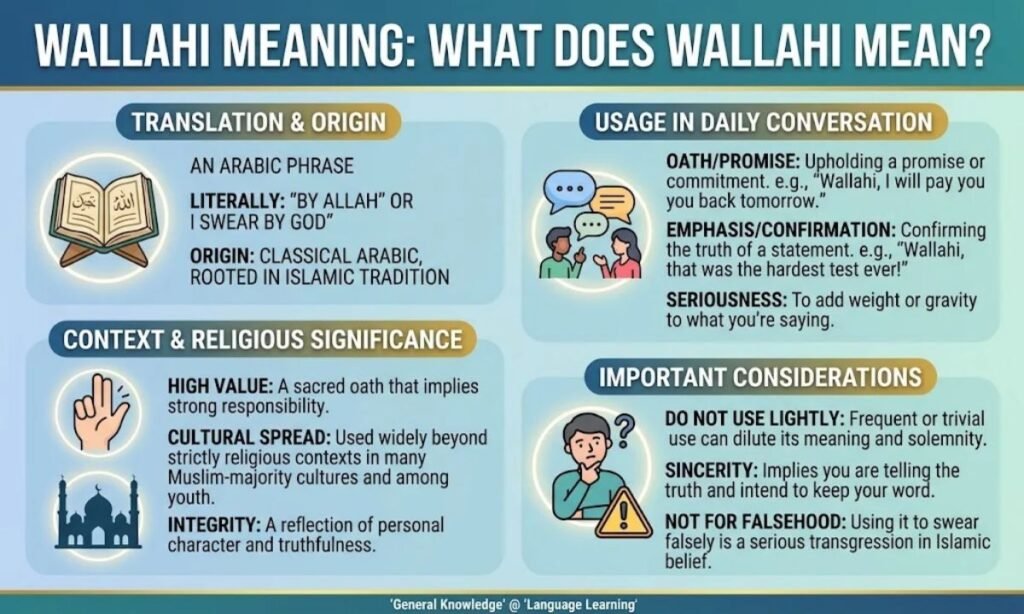
Wallahi means “I swear by God.” It is an Arabic word used to show honesty. People say it when they want others to believe them. It can also add strong emphasis to a statement.
You will hear Wallahi in daily talk, songs, videos, and online chats. Arabic speakers and Muslims use it the most. Many other people have picked it up as slang too. In this guide, you will learn the meaning, origin, and proper use of Wallahi in simple words.
What Does Wallahi Mean?
Wallahi is an oath. It comes from Arabic. It means “by God” or “I swear to God.”
Speakers use it to back up a claim. It tells the listener, “I am being honest.” It adds weight to a statement.
The phrase has two uses today:
- A serious oath: a promise or a strong claim made before God.
- A casual emphasis: a quick way to say “really” or “for real.”
The setting and the speaker decide which use applies. A court oath is serious. A joke between friends is not.
Where Does Wallahi Come From?
The word is built from Arabic parts. “Wa” means “by.” “Allah” means God. Put together, they form “Wallahi,” or “by God.”
The phrase has been in use for centuries. It appears in classic Arabic speech and writing. It spread with the Arabic language across many regions.
Today, it is also found in other languages. Turkish speakers say “vallahi.” French speakers in some communities say “wallah.” Urdu and Persian speakers use close forms too.
How Do You Spell Wallahi?
There is no single English spelling. Arabic uses a different script. People write the sound in Latin letters, so forms vary.
| Spelling | Where You See It |
| Wallahi | Most common in English texts |
| Wallah | Short and casual form |
| Walahi | Quick typing in chats |
| Vallahi | Turkish and some European use |
| Wallahi billahi | Stronger, more serious oath |
All of these point to the same idea. They all mean a sworn promise.
Wallahi Meaning in Everyday Use
In daily life, Wallahi is a strong word. People use it to prove they are honest. It can come with surprise, anger, joy, or doubt.
Young people also use it as slang. In some cities, it has moved into local street talk. There, it often works as a simple “for real.”
| Situation | Example | Meaning |
| Proving honesty | “Wallahi, I did not take it.” | I swear I am telling the truth |
| Showing surprise | “Wallahi? That is crazy!” | Really? Is that true? |
| Making a promise | “Wallahi, I will be there.” | I swear I will come |
| Casual slang | “That movie was good, wallahi.” | It was truly good |
Is Wallahi a Serious Oath?
Yes, in its true sense, it is. Islamic teaching treats an oath in God’s name with great respect. The name of God is not meant to be used lightly.
Many scholars advise people to avoid swearing too often. Some also warn against swearing about small things. A false oath is considered a serious wrong.
In Islamic law, breaking a sworn oath can require an act of expiation. This is called kaffarah. Details vary, so people ask a trusted scholar for guidance.
This is why many Muslims use the word with care. Some feel uneasy when others use it as a joke. Others see casual use as harmless. Views differ, so it helps to be respectful.
Common Variations of Wallahi
The oath has several longer forms. Each adds more weight to the claim.
| Phrase | Meaning |
| Wallah | By God (short form) |
| Wallahi al azim | By God the Almighty |
| Wallahi billahi | By God, truly by God |
| Billahi | By God |
| Wallahi ya akhi | I swear, brother |
How to Use Wallahi the Right Way
Use the word with thought. Keep these tips in mind.
- Use it only when you are truly honest.
- Avoid it for small or silly claims.
- Do not use it to joke if the listener may feel hurt.
- Know your audience before using it.
- Choose “really” or “I promise” if you are unsure.
These steps show respect for the word and the people who hold it dear.
How to Reply to Wallahi
Your reply depends on how much you trust the speaker. You can accept it, question it, or stay neutral.
| Your Feeling | Sample Reply |
| You believe them | “Okay, I trust you.” |
| You are surprised | “Really? I did not know that.” |
| You doubt it | “Are you sure about that?” |
| You want to calm things | “No need to swear. I believe you.” |
Stay calm and kind. A gentle reply keeps the talk smooth.
Wallahi in Other Languages and Cultures
The phrase has travelled far. It is part of many daily speech patterns.
- Arabic: the original home of the phrase.
- Turkish: spelled “vallahi” and used often in casual talk.
- Urdu and Persian: used in similar forms in some areas.
- French and English slang: heard in multicultural city communities.
In Pakistan and nearby regions, people may also say “Khuda ki qasam.” It carries a similar sense of swearing by God.
Frequently Asked Questions
What does Wallahi mean?
Wallahi means “I swear by God.” It is an Arabic oath used to show honesty.
Is Wallahi a bad word?
No, it is not a bad word. It is a religious oath, so it should be used with respect.
What does Wallahi mean in slang?
In slang, it means “for real” or “I promise.” It adds emphasis to a statement.
Can non-Muslims say Wallahi?
Yes, many Arabic speakers of all faiths use it. Others may use it, but should know its religious weight.
What is the difference between Wallah and Wallahi?
Both mean “by God.” Wallah is the short, casual form. Wallahi is the fuller form.
Is it a sin to say Wallahi falsely?
Islamic teaching treats a false oath in God’s name as a serious wrong. For details, ask a trusted scholar.
What can I say instead of Wallahi?
Try “I promise,” “honestly,” or “for real.” These carry the same feel without the religious weight.
Final Thoughts
Wallahi means “I swear by God.” It is an Arabic oath with deep religious roots. People use it to show truth, promise something, or add strong emphasis. Today it also lives in everyday slang across many cultures.
Use the word with care. Think about who is listening and why you are saying it. When in doubt, choose a simple phrase like “I promise.” That way, you stay clear, honest, and respectful.

Muhammad Shoaib is a content creator and SEO professional who enjoys making language and vocabulary easy to understand. He writes helpful content about word meanings, phrases, slang, abbreviations, spelling differences, and everyday expressions. nThrough WhizzMean, Shoaib focuses on creating clear, simple, and practical explanations that help readers quickly understand confusing words and language-related questions.