
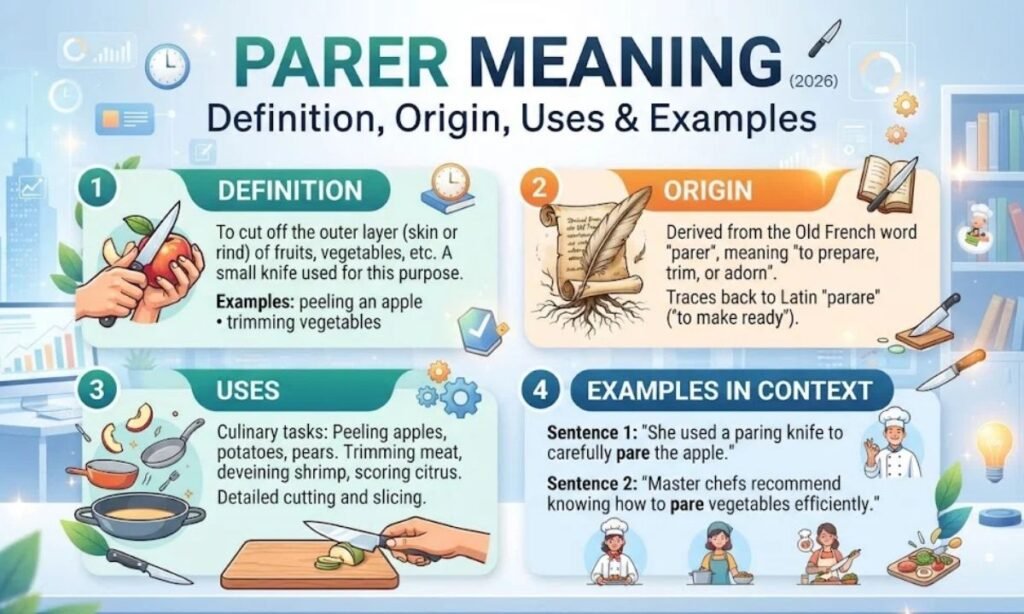
Have you seen the word “parer” and wondered what it means? A parer is a person or tool that pares. To pare means to trim, peel, or cut away the outer layer of something. An apple parer is the most common example.
This guide explains the meaning of parer, where the word comes from, and how people use it today. You will see real chat examples, easy tables, and simple replies. You will also learn how it differs from “pairer” and how it can describe smart habits like trimming a budget. Let’s get started.
Parer Meaning: Quick Definition
A parer is someone or something that pares. To pare means to trim away the edge or skin of an object. It can also mean to reduce something step by step, like costs or words.
The word is a noun. It names the doer of the action. You will most often see it in the kitchen, in crafts, and in phrases about cutting back.
Simple Meaning
Think of a parer as a “trimmer” or “peeler.” The word works in two ways:
- Literal meaning: a tool or person that peels or trims, such as an apple parer.
- Figurative meaning: a person who cuts down or simplifies something, such as expenses or a long speech.
Quick Examples
- “She used an apple parer to peel ten apples in minutes.”
- “He is a careful parer of his monthly budget.”
- “The editor was a sharp parer of long sentences.”
- “This cheese parer makes thin, even slices.”
Quick Reference Table
| Feature | Details |
| Word | Parer |
| Part of speech | Noun |
| Core meaning | One who pares, trims, or peels |
| Common forms | Apple parer, cheese parer, fruit parer |
| Figurative use | Someone who cuts back or simplifies |
| Tone | Neutral and standard English |
| Related verb | Pare |
Origin & Background
The word “parer” is built from the verb pare and the ending er. In English, the ending “er” often names the person or thing doing an action. A baker bakes, a painter paints, and a parer pares.
The verb itself has a long history. It travelled from Latin into French and then into English. Over time, its meaning shifted from “prepare” to “trim” and “peel.”
Linguistic Roots
The verb “pare” comes from the Old French word parer, which meant to prepare, trim, or decorate. That word came from the Latin parare, meaning “to make ready.” Cooks and craftspeople once “prepared” fruit by trimming it, and the meaning narrowed from there.
The same root appears in other languages. In modern French, parer can mean to adorn or to ward off a blow. The English word “parry” comes from a related Italian form. Spanish and Portuguese use parar, which means to stop.
Cultural & Internet Influence
Kitchen tools made the word famous in homes. The old hand crank apple parer is a classic item in many kitchens and antique shops. Today, videos about vintage tools and cooking hacks bring the word back to a new audience.
Online, people also use it in a playful, figurative way. You may see jokes about being a “budget parer” or a “word parer.” Also note that Parer is a family name too, so it can appear as a surname in news and history.
Timeline Table
| Stage | What Happened |
| Latin era | Parare meant to make ready |
| Old French | Parer meant to trim or prepare |
| Middle English | “Pare” entered English with the meaning to trim |
| Later English | “Parer” became the name for a person or tool that pares |
| Today | Used for kitchen tools and figurative trimming |
Real-Life Conversations (Mandatory Examples)
Examples make a word easier to remember. Below are four short chats that show how “parer” appears in daily talk. Each one uses a different tone.
WhatsApp Chat
Nina: Do you have something to peel apples fast?
Omar: Yes, I have an old apple parer from my grandma.
Nina: Perfect. Can I borrow it for the pie?
Omar: Sure, I’ll bring it over.
Here, “parer” is a kitchen tool. The meaning is literal.
Instagram DM
Lea: Your story about saving money was great.
Chris: Thanks! I became a serious budget parer this year.
Lea: Same. I cut three subscriptions.
Chris: Small trims add up fast.
In this chat, “budget parer” is a figurative use. It means someone who cuts costs.
TikTok Comments
User 1: What is that gadget in the video?
User 2: It’s a vintage apple parer. It peels, cores, and slices.
User 1: I need one right now.
User 2: They sell them online and in thrift shops.
Short comments like these help the word spread to new viewers.
Text Message
Sam: Can you look at my essay?
Tia: Sure. I’m a good parer of extra words.
Sam: Great, it’s too long.
Tia: Send it over and I’ll trim it.
The word here means a person who edits and shortens text.
Emotional & Psychological Meaning
“Parer” is a neutral word. It does not carry a strong feeling by itself. Still, the idea behind it often feels calm, careful, and practical.
Paring is about removing what you do not need. People like that idea because it brings clarity and order. It can feel satisfying to simplify a busy plan or a messy list.
Why People Connect With It
Many people enjoy the feeling of a fresh start. Peeling fruit, trimming a draft, or cutting extra costs gives a sense of control. The word also reminds people of home, family kitchens, and old traditions.
For some, it brings warm memories. A grandparent’s hand crank parer can feel like a small family treasure.
Mindset It Reflects
A parer thinks in terms of essentials. The mindset sounds like this:
- Keep what matters.
- Remove what weighs you down.
- Work slowly and carefully.
- Make small, smart cuts.
This mindset fits minimalism, budgeting, and clear writing. It values quality over quantity.
Mindset Table
| Trait | What It Looks Like |
| Careful | Trims with care, not force |
| Practical | Focuses on what is useful |
| Patient | Works in small steps |
| Minimalist | Prefers simple over cluttered |
Usage in Different Contexts
The meaning stays steady, but the setting changes how the word feels. Here is how people use it in common places.
1. Social Media
On social media, “parer” shows up in cooking videos, vintage tool posts, and life hacks. Creators also use it as a playful label, like “I’m a budget parer now.” It is usually friendly and light.
2. Friends & Relationships
Among friends, the word is mostly used for kitchen tools or jokes about trimming habits. You might say, “You are a real expense parer.” It usually sounds teasing, not rude.
In relationships, couples may talk about paring down shared costs or schedules. The word then suggests teamwork and planning.
3. Work / Professional Settings
At work, “parer” is not very common, but the verb “pare” is. People say “pare down the budget” or “pare back the list.” A manager might call a colleague a careful parer of project scope. The tone is professional and clear.
4. Casual vs Serious Tone
In casual talk, it can be playful. In serious talk, it is direct and precise. It works well in business writing when you explain how to reduce waste. Just make sure the reader knows what you mean.
Context Table
| Setting | Typical Use | Tone |
| Social media | Kitchen tools, hacks, jokes | Light |
| Friends | Teasing about saving or trimming | Friendly |
| Relationships | Simplifying plans and costs | Supportive |
| Work | Cutting scope or budgets | Professional |
| Serious talk | Reducing risk or waste | Clear and direct |
Common Misunderstandings
Because “parer” is not a daily word, people sometimes get it wrong. Here are the most common mix-ups.
1. Thinking It Means “Pairer”
“Parer” and “pairer” sound similar, but they are different. A pairer matches or joins two things together. A parer trims or peels. Spelling matters here.
2. Assuming It’s Slang
Some people think “parer” is new internet slang. It is not. It is a standard English word with a long history. Only the playful, figurative uses online feel informal.
3. Using It for People Only
You can use “parer” for a person, but it also names a tool. An apple parer is a device, not a person. Both uses are correct.
4. Using It Negatively
The word is not an insult. Calling someone a parer does not mean they are cheap or harsh. It usually means they are careful and efficient. Still, tone and context can change how it feels.
Comparison Table
“Parer” is often confused with similar words. This table shows the differences.
| Word | Meaning | Example |
| Parer | One who trims or peels | “An apple parer saves time.” |
| Pairer | One who matches or pairs | “She is a good pairer of socks.” |
| Peeler | Tool that removes skin | “Use a peeler for carrots.” |
| Trimmer | One who cuts edges | “The hedge trimmer is loud.” |
| Parry | To block or ward off | “He parried the question.” |
| Pear | A fruit | “I ate a pear.” |
A parer and a peeler are close in meaning. The main difference is that “parer” can also describe trimming more broadly, not only removing skin.
Variations / Types of “Parer” (10 Examples)
The word works well as a label for different habits. Note that these are creative, figurative uses and not formal dictionary terms. They are helpful for understanding the idea.
1. Content Parer
A person who cuts extra words from writing. Example: “She is a content parer who turns long drafts into clear posts.”
2. Budget Parer
Someone who reduces spending. Example: “As a budget parer, he cancelled unused apps.”
3. Word Parer
A person who prefers short, simple language. Example: “A word parer removes filler from every sentence.”
4. Lifestyle Parer
Someone who simplifies daily life. Example: “She became a lifestyle parer and owns fewer things.”
5. Emotional Parer
A person who lets go of stress or unhealthy habits. Example: “Becoming an emotional parer helped him feel lighter.”
6. Social Circle Parer
Someone who trims their circle to focus on close friends. Example: “He is a social circle parer who values quality time.”
7. Time Parer
A person who cuts wasted hours. Example: “A time parer plans the day to avoid distractions.”
8. Digital Parer
Someone who cleans up apps, files, and notifications. Example: “The digital parer deleted old photos and emails.”
9. Process Parer
A person who removes extra steps from a workflow. Example: “Our process parer cut the approval time in half.”
10. Decision Parer
Someone who narrows options to make choices easier. Example: “A decision parer picks two choices instead of ten.”
Variations Summary Table
| Type | What They Trim | Benefit |
| Content parer | Extra words | Clear writing |
| Budget parer | Spending | Savings |
| Word parer | Filler language | Better speech |
| Lifestyle parer | Clutter | Simpler life |
| Emotional parer | Stress | Calm mind |
| Social circle parer | Draining ties | Better bonds |
| Time parer | Wasted hours | More focus |
| Digital parer | Files and apps | Clean devices |
| Process parer | Extra steps | Faster work |
| Decision parer | Too many options | Easier choices |
How to Respond When Someone Uses “Parer”
Your reply depends on the setting and the person. Here are easy options for every mood.
Casual Replies
- “Oh nice, where did you find it?”
- “That sounds handy.”
- “I need one of those too.”
Funny Replies
- “Please pare my to do list next.”
- “Can your parer fix my bank account?”
- “Careful, I might hire you to trim my emails.”
Mature / Confident Replies
- “That is a smart way to simplify things.”
- “Good point. Cutting extras can improve the result.”
- “I agree. Let’s focus on what matters most.”
Private / Respectful Replies
- “Thanks for sharing that with me.”
- “If you want help trimming things down, I’m here.”
- “Let’s talk about it when you’re ready.”
Reply Guide Table
| Situation | Best Reply Style |
| Kitchen or hobby chat | Casual and curious |
| Joking with friends | Funny |
| Work or planning talk | Mature and confident |
| Personal topic | Private and respectful |
Regional & Cultural Usage
Words travel across borders, but their popularity changes from place to place. “Parer” is a standard English word, yet how often people use it varies.
Western Culture
In the United States, the United Kingdom, Canada, and Australia, “parer” is mostly linked to kitchen tools. The apple parer is a well known antique item. People also see “pare down” in business and lifestyle writing. As a surname, Parer is known in Australia.
Asian Culture
In many Asian countries, English learners meet the verb “pare” in school or business reading. The noun “parer” is less common in daily speech. People often use local words for peeling and trimming, but they understand the idea easily.
Middle Eastern Culture
In the Middle East, English is common in business and education. People may know “pare down” from workplace English. The word “parer” is rare in casual talk, though kitchen tool names are understood through online shopping and videos.
Global Internet Usage
Online, the word spreads through cooking videos, vintage tool posts, and minimalism content. Its figurative uses are growing in lifestyle and productivity talk. Because it is not very common, a short explanation helps global readers.
Regional Usage Table
| Region | Level of Use | Notes |
| Western countries | Medium | Mostly kitchen tools and “pare down” |
| Asia | Low to medium | Known through learning and online content |
| Middle East | Low to medium | Seen in business English and shopping |
| Global internet | Medium | Grows through cooking and minimalism trends |
Frequently Asked Questions
What does parer mean?
A parer is a person or tool that pares, which means trims or peels. An apple parer is a common example.
Is parer a real English word?
Yes. It is a standard noun formed from the verb “pare” plus the ending “er.”
Is parer slang?
No. It is a traditional English word. Only some playful online uses feel informal.
What is the difference between a parer and a peeler?
A peeler removes skin from food. A parer can also mean someone or something that trims more broadly.
Is parer the same as pairer?
No. A parer trims or peels, while a pairer matches or joins things together.
Where does the word parer come from?
It comes from the verb “pare,” which traces back to Old French parer and Latin parare.
What does it mean to pare down?
To pare down means to reduce something by cutting away the extras. People use it for budgets, lists, and plans.
Final Thoughts
“Parer” is a simple but useful word. It names a person or tool that trims, peels, or cuts away what is not needed. It began in kitchens and craft work, and it now also describes smart habits like saving money, editing text, and simplifying life.
Use it when you want to describe careful, practical trimming. Keep the spelling clear so it is not mixed up with “pairer,” and add a short explanation if your audience may not know it. When you use the word with the right context and tone, your message stays clear, friendly, and easy to understand.

Muhammad Shoaib is a content creator and SEO professional who enjoys making language and vocabulary easy to understand. He writes helpful content about word meanings, phrases, slang, abbreviations, spelling differences, and everyday expressions. nThrough WhizzMean, Shoaib focuses on creating clear, simple, and practical explanations that help readers quickly understand confusing words and language-related questions.