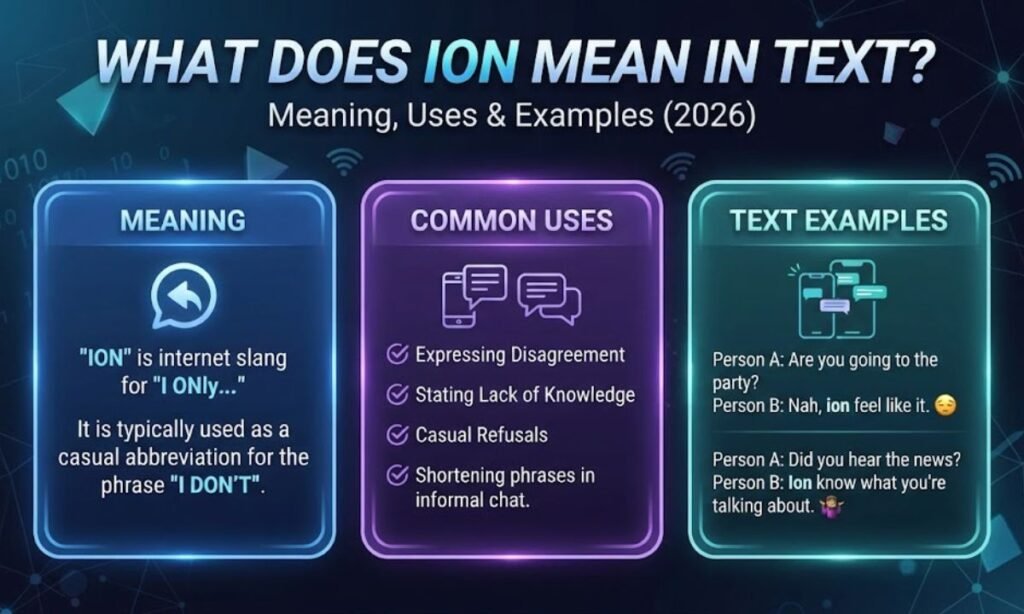
Have you ever seen “ion” in a text and wondered what it means? You are not alone. This short slang term shows up in chats, comments, and captions all the time. In most cases, ION means “I don’t.” It is a quick way to write “I don’t” without typing the extra letters.
This guide explains the meaning of ION in text, where it came from, and how people use it. You will see real chat examples, similar slang terms, and easy ways to reply. Everything is written in simple words, so you can use it with confidence.
What Does ION Mean in Text? Quick Meaning
ION is a text slang term that stands for “I don’t.” It is a shortened, informal way of writing the phrase. People use it to save time and to sound relaxed in casual chats.
It is almost always followed by a verb. For example, “ion know” means “I don’t know.” “Ion care” means “I don’t care.” The word on its own rarely makes sense, so the next word gives you the full meaning.
Quick examples
Here are a few simple examples to help you see how it works.
- “Ion know what to eat.” (I don’t know what to eat.)
- “Ion like that song.” (I don’t like that song.)
- “Ion wanna go out today.” (I don’t want to go out today.)
- “Ion think so.” (I don’t think so.)
Quick Reference Table
| Feature | Details |
| Slang term | ION |
| Full form | I don’t |
| Type | Text and social media slang |
| Tone | Casual and informal |
| Common platforms | WhatsApp, Instagram, TikTok, Snapchat, X |
| Best used with | Friends, family, online chats |
| Avoid in | Formal emails and professional writing |
Origin and Background of ION Slang
ION grew out of everyday speech. In casual spoken English, many people say “I don’t” so fast that it sounds like “ion.” Writers then began typing it the way it sounds. This style is common in informal and regional speech, especially in African American Vernacular English (AAVE), where it has been used for a long time.
Social media helped it spread. Short posts, quick replies, and fast typing made shortened words very popular. Platforms like TikTok and Instagram pushed slang like this to a global audience. Today, people from many backgrounds use it.
The trend is part of a bigger pattern. Internet users often shorten phrases to save time and add personality. Think of “idk,” “tbh,” and “gonna.” ION fits right into that group.
Quick Timeline Table
| Stage | What Happened |
| Spoken use | People say “I don’t” fast, and it sounds like “ion” |
| Early texting | Short spelling saves time on small keyboards |
| Social media boom | Slang spreads through captions and comments |
| Today | ION is widely understood in casual online chats |
Real-Life Conversations Using ION
Seeing slang in real chats makes it much easier to understand. Below are three simple examples from popular apps. Each one shows how ION fits into a normal conversation.
WhatsApp Conversation
Sara: Are you coming to the party tonight?
Mia: Ion know yet. I might be tired.
Sara: Okay, just tell me later.
Mia: Will do!
Here, “ion know” means “I don’t know.” The tone is relaxed and friendly.
Instagram DM Conversation
Jay: Did you like that new movie?
Dan: Ion think it was that good.
Jay: Really? I loved it.
Dan: Haha, to each their own.
In this chat, “ion think” means “I don’t think.” It shows a simple opinion without sounding harsh.
TikTok Comments Conversation
User 1: This trend is everywhere now.
User 2: Ion get the hype, honestly.
User 1: Same, but it’s fun to watch.
Here, “ion get” means “I don’t get.” Short comments like this are very common on TikTok.
The Emotional and Psychological Meaning Behind ION
ION often carries a relaxed and confident feel. People use it to sound natural and not too serious. It can make a sentence feel more personal, like you are talking to a close friend.
Sometimes ION shows honesty without drama. Saying “ion care” can sound casual, while “I do not care” can sound stronger or colder. The slang softens the message in many cases.
It can also show identity and belonging. Using slang helps people connect with their group. It tells others, “I speak your language.” That is why ION feels friendly in casual spaces.
However, tone matters. In some situations, “ion care” can sound rude or dismissive. The words around it and the relationship between people decide how it lands.
Emotional Tone Table
| Phrase | Possible Feeling |
| Ion know | Unsure, relaxed |
| Ion care | Casual, or sometimes dismissive |
| Ion like | Honest opinion |
| Ion want | Clear preference |
| Ion think | Gentle disagreement |
How Is ION Used in Different Contexts?
ION changes slightly depending on where and with whom you use it. Knowing the right setting keeps you from sounding out of place.
Social Media
On social media, ION is everywhere. People use it in captions, comments, replies, and short videos. It keeps posts short and gives them a natural voice.
For example, a caption might say, “Ion do mornings.” A comment might say, “Ion agree with that.” Both feel light and real.
Friends and Relationships
Among friends, ION feels easy and comfortable. It is part of everyday talk. Close friends rarely misread it.
In relationships, use it with care. “Ion want to fight” sounds calm. “Ion care” during an argument can sound hurtful. Think about how your partner will feel.
Work and Professional Settings
ION does not belong in formal work writing. Emails, reports, and client messages need full, clear words. Write “I do not” or “I don’t” instead.
In a casual team chat with close coworkers, it may be fine. Still, it is safer to avoid it unless the group already uses slang.
Casual vs. Serious Tone
ION works best in casual tone. It does not fit serious talks, such as discussing health, money, or major decisions. In those cases, clear language shows respect.
Context Guide Table
| Setting | Is ION Okay? | Better Choice |
| Group chat with friends | Yes | ION is fine |
| Social media comments | Yes | ION is fine |
| Dating or relationship chat | Sometimes | Watch your tone |
| Work email | No | “I do not” or “I don’t” |
| School essay | No | Full formal sentence |
| Serious talk | No | Clear and complete words |
Common Misunderstandings About ION
Because ION is short and informal, people sometimes misread it. Here are the most common mix-ups.
1. It can mean the scientific term
In science, an ion is an atom or molecule with an electric charge. That has nothing to do with the slang. Context tells you which meaning is used. A chat about homework differs from a chat about plans.
2. Context may change the interpretation
The same words can feel different in different chats. “Ion know” might show real confusion or simple playfulness. Look at the full conversation before you decide.
3. It is not standard English
ION is slang, not formal grammar. Teachers and employers expect full words. Use it only where casual language is welcome.
4. Tone can be misunderstood
Text has no voice or face. A phrase like “ion care” can sound rude even when you mean it lightly. Add an emoji or a friendly word if you want to keep the mood soft.
5. It should not be used to judge someone’s intelligence
Some people think slang means poor grammar or low skill. That is not true. Slang is a style choice. Many smart, skilled people use it when they chat.
ION Compared With Similar Slang Terms
ION belongs to a large family of short, casual terms. Here is how it compares with others.
| Slang | Meaning | Example |
| ION | I don’t | “Ion know.” |
| IDK | I don’t know | “Idk what to wear.” |
| IDC | I don’t care | “Idc where we eat.” |
| IDT | I don’t think | “Idt it will work.” |
| Gonna | Going to | “I’m gonna leave soon.” |
| Wanna | Want to | “I wanna sleep.” |
| Ain’t | Am not, is not, are not | “It ain’t ready.” |
The main difference is that ION covers many phrases, while IDK or IDC cover only one. That makes ION more flexible. You can place it before almost any verb.
Variations and Related Forms of ION
ION is almost always paired with another word. Here are the most common forms you will see.
1. Ion Know
It means “I don’t know.” This is the most popular form. People use it when they feel unsure.
2. Ion Care
It means “I don’t care.” Use it carefully, since it can sound dismissive.
3. Ion Want
It means “I don’t want.” It states a clear preference. Example: “Ion want pizza tonight.”
4. Ion Like
It means “I don’t like.” It shares an honest opinion. Example: “Ion like cold weather.”
5. Ion Think
It means “I don’t think.” It adds gentle doubt. Example: “Ion think he’s coming.”
6. Ion Believe
It means “I don’t believe.” It shows disbelief. Example: “Ion believe that story.”
7. Ion Understand
It means “I don’t understand.” People use it when something is confusing.
8. Ion Wanna
It means “I don’t want to.” It is a very casual refusal. Example: “Ion wanna wake up early.”
9. Ion Even
It means “I don’t even.” People often use it for strong reactions, such as shock or humor. Example: “Ion even know how that happened.”
10. Ion Mess With That
It means “I don’t mess with that.” It shows that someone avoids a person, habit, or thing. Example: “Ion mess with fast food.”
Variations Summary Table
| Form | Meaning | Tone |
| Ion know | I don’t know | Unsure |
| Ion care | I don’t care | Casual or blunt |
| Ion want | I don’t want | Clear |
| Ion like | I don’t like | Honest |
| Ion think | I don’t think | Gentle |
| Ion believe | I don’t believe | Doubtful |
| Ion understand | I don’t understand | Confused |
| Ion wanna | I don’t want to | Relaxed |
| Ion even | I don’t even | Dramatic or funny |
| Ion mess with that | I don’t mess with that | Firm |
How to Respond When Someone Uses ION
Your reply depends on the mood and the person. Here are simple options for every situation.
Casual Replies
Keep it light and short.
- “Haha, same.”
- “That’s fair.”
- “No worries, we can decide later.”
Funny Replies
Humor works well with friends.
- “Ion know either, let’s figure it out together.”
- “Well, that makes two of us.”
- “Ion blame you, honestly.”
Mature and Confident Replies
Use calm and clear words when the topic matters.
- “I understand. Let’s talk about it more.”
- “Thanks for being honest.”
- “Okay, what would work better for you?”
Private or Respectful Replies
If the topic feels personal, respond with care.
- “No pressure. Take your time.”
- “I’m here if you want to talk.”
- “Let’s chat privately about this.”
Reply Guide Table
| Situation | Best Reply Style |
| Friendly chat | Casual and short |
| Joking with friends | Funny |
| Disagreement | Mature and calm |
| Sensitive topic | Private and respectful |
Regional and Cultural Usage
Slang changes from place to place. ION has spread widely, yet its use still varies by region and culture.
Western Culture
In the United States and other Western countries, ION is common in texts and social media. It is closely linked to casual youth speech and has roots in AAVE. Many young people use it daily. Older groups may find it less familiar.
Asian Culture
In many parts of Asia, people learn English as a second language. Some pick up ION from social media, music, and videos. Younger users often know it, but they may use it less than native speakers. Some may confuse it with the science term.
Middle Eastern Culture
In the Middle East, English slang spreads mostly through TikTok, Instagram, and gaming. Young users may understand ION but use it only with friends online. In formal or family settings, people prefer full and polite language.
Global Internet Usage
Online, slang crosses borders quickly. ION now appears in chats, memes, and comments worldwide. Still, it may feel unfamiliar to people who are new to English slang. If you chat with a global audience, a short explanation can help.
Regional Usage Table
| Region | Level of Use | Notes |
| Western countries | High | Common among young people |
| Asia | Medium | Learned through social media |
| Middle East | Medium | Mostly used online with friends |
| Global internet | High | Understood in casual online spaces |
Frequently Asked Questions
What does ION mean in text?
ION means “I don’t.” It is a casual slang form used in texts and social media.
Is ION the same as IDK?
No. IDK means “I don’t know,” while ION covers many phrases like “I don’t care” or “I don’t like.”
Where does the slang ION come from?
It comes from the way people say “I don’t” in fast speech. It also has roots in AAVE and grew through social media.
Can I use ION in a work email?
No. Use full words like “I do not” or “I don’t” in professional writing.
Is ION rude?
Not by itself. Phrases like “ion care” can sound rude depending on tone and context.
Does ION also mean something in science?
Yes. In science, an ion is a charged atom or molecule. Context shows which meaning is used.
How do you reply to “ion know”?
Reply with something friendly, like “No worries, we can figure it out.” Keep it light and kind.
Final Thoughts
ION is a simple and popular slang term that means “I don’t.” It makes texting faster and gives your words a relaxed, natural feel. Once you know the common forms, like ion know, ion care, and ion want, you can read most chats with ease.
Use ION with friends, in social media comments, and in casual talks. Skip it in formal writing, and watch your tone in serious moments. When you match your words to the setting, your messages stay clear, friendly, and respectful.

Muhammad Shoaib is a content creator and SEO professional who enjoys making language and vocabulary easy to understand. He writes helpful content about word meanings, phrases, slang, abbreviations, spelling differences, and everyday expressions. nThrough WhizzMean, Shoaib focuses on creating clear, simple, and practical explanations that help readers quickly understand confusing words and language-related questions.