
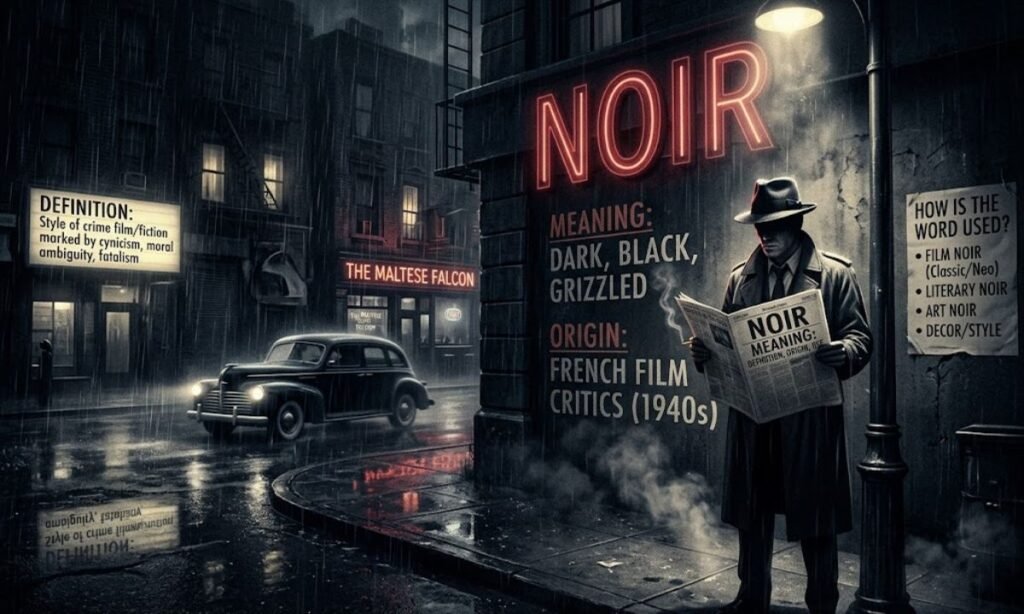
Noir is a French word that means black. In English, people use it for a dark and moody style. You see it in crime films, detective books, and shadowy art. The word often hints at danger, secrets, and a gloomy mood.
In this guide, you will learn the simple meaning of noir. You will see where the word came from and how it grew in film and books. You will also find out how people use it today in wine, coffee, fashion, and more.
What Does Noir Mean?
Noir means black in French. English speakers borrowed the word and gave it a wider job. Today it often stands for a mood. That mood is dark, tense, and cynical.
When someone says a story is “noir,” they usually mean it has a gloomy tone. The world feels unfair. Characters are flawed. Crime, greed, and betrayal sit at the center.
The word can also be a plain color name in French. It appears in menus, perfume labels, and wine bottles. So the meaning depends on the setting.
Noir Meaning in French
In everyday French, noir is an adjective. It means black, dark, or gloomy. French speakers say “un chat noir” for a black cat. They say “une nuit noire” for a pitch-dark night.
The word also carries a darker sense. A “roman noir” is a dark novel. A “humour noir” is black humor. The word hints at fear, grief, and the unknown.
Here are a few common French uses:
- Café noir: black coffee, served without milk
- Chocolat noir: dark chocolate
- Liste noire: blacklist
- Marché noir: black market
Where the Word Noir Comes From
The word traces back to the Latin “niger,” which also meant black. It passed through Old French and became “noir.” English later borrowed it, mainly through film talk.
The phrase “film noir” first took off in France. After World War II, American movies reached French theaters in large numbers. Many were dark crime stories. French critics noticed the shared mood and gave it a name.
Critic Nino Frank is often credited with using “film noir” in 1946 for this group of films. Hollywood did not use the label at the time. Filmmakers back then thought they were just making crime pictures.
Noir Meaning in Film
Film noir is a style of crime drama. It became popular in the United States during the 1940s and 1950s. Many film historians treat this as the classic noir era.
These films often follow a tired detective, a desperate man, or a person caught in a bad plan. Things rarely end well. The tone is bleak, and trust is hard to find.
Noir is usually called a style or mood, not a strict genre. Some experts argue about the exact definition. Still, most agree on the core ideas: moral gray areas, danger, and fate.
Key Features of Noir Style
Noir stories share a set of familiar ingredients. Some come from the writing. Others come from the camera work. Together they build the dark mood viewers remember.
| Feature | What It Looks Like |
| Lighting | Strong contrast between light and deep shadow, often called low-key lighting or chiaroscuro |
| Setting | Rainy streets, dim offices, smoky bars, big cities at night |
| Main character | A private detective, a cynical loner, or an ordinary person who makes a bad choice |
| Femme fatale | A charming, dangerous woman who pulls the hero toward trouble |
| Narration | A voice-over that explains events in a weary, sharp tone |
| Camera angles | Tilted shots, odd framing, and shadows from window blinds |
| Theme | Corruption, guilt, fate, and the loss of hope |
Several forces shaped this look. German Expressionist cinema inspired the bold shadows. Many European filmmakers who fled to the United States brought that style with them. Wartime anxiety and a more suspicious public mood also played a part.
The film industry’s strict moral rules, known as the Hays Code, shaped the stories too. Crime had to be punished. So many noir plots end with the wrongdoer paying a price.
Noir Meaning in Literature
Noir began on the page before it reached the screen. In the 1920s and 1930s, American writers produced tough crime stories known as hardboiled fiction. Dashiell Hammett, Raymond Chandler, and James M. Cain are the best-known names.
These books used short, sharp sentences. Their heroes were not clean-cut. They lived in a corrupt world and tried to survive it.
France helped spread the label. In 1945, publisher Gallimard launched a crime series called “Série noire.” It brought translated American and British crime novels to French readers. The name helped link “noir” with crime fiction.
Today, crime writers around the world use the term. You may see “Nordic noir” for dark Scandinavian crime stories. You may also see “tartan noir” for gritty Scottish crime fiction.
What Is Neo-Noir?
Neo-noir means “new noir.” It describes modern works that borrow the mood and themes of classic noir. They often add updated settings, color film, and fresh social topics.
Classic noir was mostly black and white. Neo-noir uses color, but it still plays with shadows and moody lighting. It may also tackle themes that older films avoided.
Some well-known neo-noir titles include:
- Chinatown (1974)
- Blade Runner (1982)
- Blood Simple (1984)
- L.A. Confidential (1997)
- Drive (2011)
Some neo-noir stories even blend noir with science fiction. Blade Runner is a famous case. It mixes a detective plot with a rainy, neon-lit future.
Noir Meaning in Other Contexts
The word noir shows up outside film and books too. Often it simply means black or dark. Here are the most common cases.
| Context | Meaning of Noir |
| Wine | “Pinot Noir” is a red wine grape. The name points to the dark color of the fruit |
| Coffee | “Café noir” means black coffee in French |
| Fashion | Brands use “noir” to signal black, sleek, or mysterious designs |
| Photography | Noir-style photos use harsh shadows and high contrast |
| Video games | Games with detective plots and dark city settings are called noir games |
| Music | Some artists use the term for moody, slow, jazzy sounds |
Marketers like the word because it feels stylish. A perfume called “Noir” suggests mystery. A restaurant named “Noir” suggests an upscale, dim, intimate setting.
Noir Famous Examples You Should Know
If you want to understand noir, watching or reading a few classics helps a lot. These titles are often listed among the most important works in the style.
| Title | Year | Type | Why It Matters |
| The Maltese Falcon | 1941 | Film | Often named an early classic of the noir style |
| Double Indemnity | 1944 | Film | Shows a murder plot, a femme fatale, and sharp narration |
| The Big Sleep | 1946 | Film | Based on a Raymond Chandler novel |
| Sunset Boulevard | 1950 | Film | A dark story about fame and ruin in Hollywood |
| Touch of Evil | 1958 | Film | Often seen as a late landmark of classic noir |
| The Postman Always Rings Twice | 1934 | Novel | A bleak tale by James M. Cain |
Start with one film and one novel. You will quickly notice the shared mood. The shadows, the tired heroes, and the sense of doom repeat across them.
Noir vs Thriller: What Is the Difference?
Many people ask how noir differs from a regular thriller. The two overlap, but they are not the same. A thriller focuses on suspense and action. Noir focuses on mood and moral struggle.
In a thriller, the hero often fights to stop a threat. In noir, the hero may be part of the problem. The line between right and wrong is blurry.
Here is a simple comparison:
- Thriller: fast pace, clear danger, a goal to stop a threat
- Noir: slower pace, moral doubt, a feeling that fate is against the hero
- Thriller ending: often hopeful or resolved
- Noir ending: often bitter, tragic, or unclear
Frequently Asked Questions
What does noir mean in English?
Noir means “black” in French. In English, it describes a dark, moody crime style.
Is noir a genre or a style?
Most experts call it a style or mood. It cuts across genres like crime, drama, and even science fiction.
What does film noir mean?
Film noir means “black film” or “dark film.” It names dark crime movies from the 1940s and 1950s.
What is a femme fatale in noir?
She is a seductive, dangerous woman who leads the hero into trouble. She is a classic noir character.
What does neo-noir mean?
Neo-noir means “new noir.” It is a modern work that uses classic noir themes and visuals.
Why is noir always dark?
The darkness reflects the themes. Noir deals with crime, guilt, and moral decay, so the visuals match.
Is noir only used for movies?
No. The term also applies to books, games, music, photography, and even wine and coffee.
Final Thoughts
The noir meaning starts with a simple idea: black. Over time, that idea grew into a full style of storytelling. It now covers films, novels, games, and even products that want to feel mysterious and bold. Once you know the key signs, such as deep shadows, flawed heroes, and a sense of doom, you can spot noir almost anywhere.
Understanding noir also helps you enjoy it more. You can watch a classic film and notice why the lighting looks so sharp. You can read a hardboiled novel and see how the short sentences build tension. Whether you are a student, a writer, or just a curious viewer, knowing the word gives you a better view of a style that is still popular today.

Muhammad Shoaib is a content creator and SEO professional who enjoys making language and vocabulary easy to understand. He writes helpful content about word meanings, phrases, slang, abbreviations, spelling differences, and everyday expressions. nThrough WhizzMean, Shoaib focuses on creating clear, simple, and practical explanations that help readers quickly understand confusing words and language-related questions.