You may have heard someone say “mashallah” and wondered what it means. It sounds soft and kind. People say it in happy moments, and it feels warm every time.
Mashallah means “God has willed it.” It is a short phrase from Arabic. People use it to show praise, joy, and thanks. It also reminds them that every blessing comes from God.
In this guide, you will learn the meaning in simple words. You will see when to say it and how to say it. You will also learn how to reply when someone says it to you.
What Does Mashallah Mean?
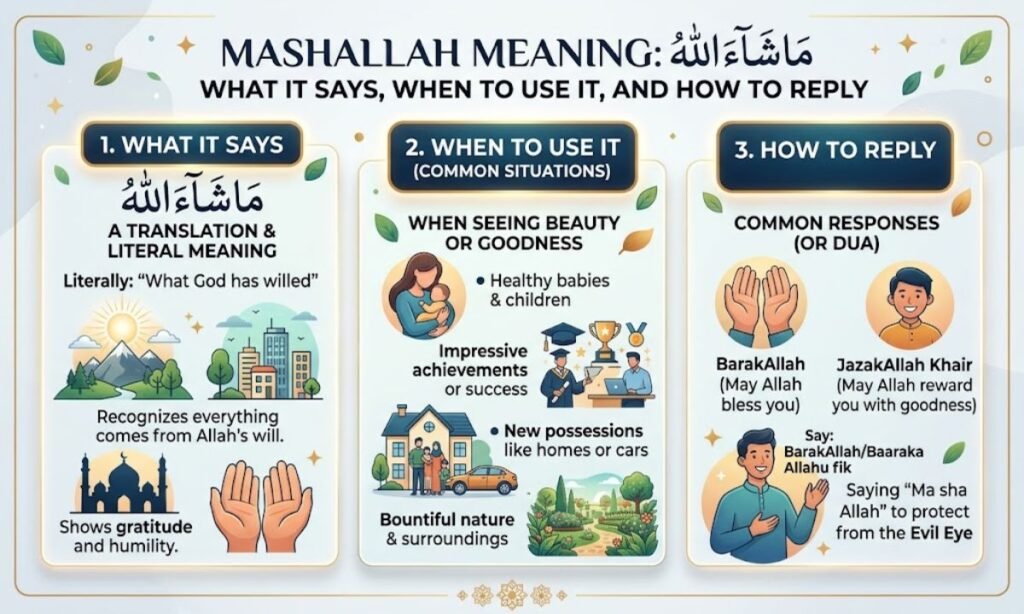
Mashallah means “God has willed it.” Another common way to put it is “what God wills has happened.” People say it when they see something good and want to give credit to God.
It works like a polite “wow.” But it adds something extra. The speaker admires the thing and also reminds themselves that every blessing comes from God.
Think of it as praise with humility. Instead of saying “You did this all by yourself,” the phrase says “This is a gift, and I am glad to see it.”
Here are the key points in one place:
- Core meaning: God has willed it.
- Feeling behind it: admiration, joy, gratitude, and respect.
- Common use: praising a person, a success, or a blessing.
- Spoken in: Arabic, Urdu, Turkish, Persian, Malay, Bengali, and many other languages.
Mashallah in Arabic and Pronunciation
In Arabic, the phrase is written ما شاء الله. It has three parts. “Ma” means “what.” “Sha’a” means “willed.” “Allah” means “God.”
Put together, it reads as “what God has willed.” The phrase talks about something that has already happened. That small detail matters, and it is the main reason people confuse it with “inshallah.”
You will see many spellings online. All of these are the same phrase:
- Mashallah
- MashaAllah
- Masha’Allah
- MashAllah
- Masha Allah
To say it, try “mah-shah-ALL-ah.” Stress the last part a little. Say it slowly at first. Speed will come with practice.
Origin and Quranic Roots
The phrase appears in the Quran in Surah Al-Kahf, verse 39. In the story, a man looks at his rich garden and feels proud. His companion reminds him to say “ma sha’a Allah, la quwwata illa billah.” This means “What God willed has happened. There is no power except with God.”
The lesson is simple. When you see a blessing, remember who gave it. Do not let pride grow in your heart.
Over time, Muslims shortened this longer line into the single word “mashallah.” Today it is part of daily speech in Muslim communities around the world.
Because of this origin, the phrase carries a gentle warning too. It teaches people to enjoy good things without boasting.
When Do People Say Mashallah?
People use mashallah in many happy moments. It is not limited to big events. A small compliment can carry it too.
Here are common situations:
- Seeing a newborn baby
- Hearing about a graduation or a new job
- Admiring a child’s good manners
- Watching a wedding or a family gathering
- Looking at a beautiful home, garden, or view
- Hearing about someone’s recovery from illness
- Complimenting someone’s cooking, art, or talent
Short examples:
- “Your daughter recited so well, mashallah.”
- “Mashallah, what a lovely house.”
- “He passed his exam with top marks, mashallah.”
You can say it before or after a sentence. You can also say it alone, with a smile.
Mashallah and the Evil Eye
Many people link mashallah with protection from the evil eye. The evil eye, often called “nazar,” is a belief that a harmful look can come from envy, even when the person means no harm. Islamic teachings describe the evil eye as real.
Saying mashallah is seen as a way to keep admiration clean. It shows that the speaker wishes only good for the other person. It also reminds everyone that the blessing belongs to God.
That is why parents often hear it around new babies. Friends and relatives say it as a sign of love and care.
A related practice is to add a short prayer for blessing, such as “barakallahu fik” (may God bless you). Together they make a kind and complete compliment.
Mashallah vs Inshallah vs Alhamdulillah vs Subhanallah
These four phrases sound alike, and learners often mix them up. Each one fits a different moment. The table below makes the difference clear.
| Phrase | Meaning | When to use it | Time focus |
| Mashallah | God has willed it | Admiring something good | Present or past |
| Inshallah | If God wills | Talking about future plans | Future |
| Alhamdulillah | Praise be to God | Giving thanks for a blessing | Present or past |
| Subhanallah | Glory be to God | Feeling amazed by creation | Any time |
A quick example will help. If a friend shows you her new home, you say “mashallah.” If she asks whether you will visit next week, you say “inshallah.” Once you arrive and feel grateful for the day, you say “alhamdulillah.”
The rule is easy to remember. Mashallah looks at what already exists. Inshallah looks ahead.
How to Reply When Someone Says Mashallah
Many people are unsure how to answer. The good news is that replies are simple and warm. You do not need a long speech.
Popular replies:
- Jazakallahu khairan: May God reward you with good.
- Barakallahu feek: May God bless you.
- Ameen: So be it, if the person also made a prayer.
- Thank you, mashallah to you too: A friendly, everyday answer.
- Alhamdulillah: Praise be to God, to share the credit.
Pick the one that feels natural. In casual talk, a simple “thank you” is perfectly fine.
If you are the one giving a compliment, you do not need to wait for a reply. Say it with kindness and move on.
Common Mistakes to Avoid
Mashallah is a respectful phrase, so the tone matters. Using it the wrong way can confuse people or sound odd.
Watch out for these mistakes:
- Using it for the future. Say “inshallah” for plans that have not happened yet.
- Using it as sarcasm. The phrase is sincere. Mocking tone can offend people.
- Using it for bad news. Do not say it after a loss or an accident. Choose a phrase of comfort or patience instead.
- Saying it without meaning it. People can tell when a word is empty.
- Mixing up the spelling in formal writing. Pick one version and keep it the same.
If you are unsure, listen first. Hear how friends or family use it, then copy the tone.
Can Non-Muslims Say Mashallah?
Yes, many non-Muslims use it. In Arabic-speaking regions, people of different faiths often say it as a warm, cultural expression. Colleagues, neighbors, and friends use it to share a happy moment.
If you are not Muslim, the main thing is respect. Say it for a good reason, with a kind voice. Most people will take it as a sweet gesture.
Keep in mind that the phrase has religious roots. Use it with care, and avoid joking about it. A sincere “mashallah” is almost always welcomed.
Frequently Asked Questions
What is the simple meaning of mashallah?
It means “God has willed it.” People use it to show praise, joy, or admiration for something good.
Is mashallah the same as inshallah?
No. Mashallah is about something that already exists, while inshallah means “if God wills” and talks about the future.
Can I say mashallah to my own success?
Yes. Many people say it to stay humble and to thank God for their own blessings.
Why do people say mashallah around babies?
It shows love and gives credit to God. Many also see it as protection from the evil eye.
Is mashallah only for Muslims?
No. Muslims use it most, but many Arabic speakers and respectful non-Muslims use it too.
How do you spell mashallah correctly?
There is no single fixed English spelling. Mashallah, MashaAllah, and Masha’Allah are all common.
Does mashallah appear in the Quran?
Yes. A form of it appears in Surah Al-Kahf, verse 39, in the story of the garden owner.
Final Thoughts
The mashallah meaning is simple, yet it holds a lot of heart. It says “God has willed it,” and it turns praise into gratitude. It helps people share joy without pride and admire without envy.
Now you know how to say it, when to use it, and how to answer it. Use it kindly and sincerely. A small phrase, said with care, can make someone’s day brighter and bring people closer.

Muhammad Shoaib is a content creator and SEO professional who enjoys making language and vocabulary easy to understand. He writes helpful content about word meanings, phrases, slang, abbreviations, spelling differences, and everyday expressions. nThrough WhizzMean, Shoaib focuses on creating clear, simple, and practical explanations that help readers quickly understand confusing words and language-related questions.