You see the word “holistic” on health labels, school websites, and business blogs. Many people use it. Few explain it. So what does it actually mean?
In short, holistic means looking at the whole instead of only the parts. This guide explains the holistic meaning in plain words. You will learn where the term comes from, how people use it in health, education, and work, and how it differs from other approaches.
What Is the Holistic Meaning?
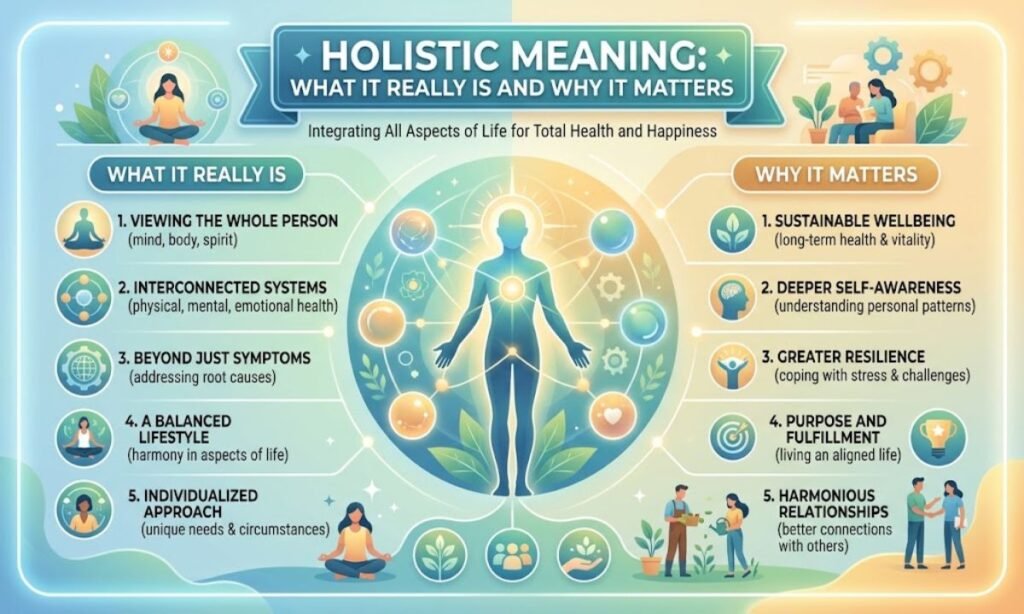
The holistic meaning is simple. Something is holistic when you treat it as a complete system. You do not split it into small pieces and study each one alone. You look at how all the pieces connect.
Think of a car. A mechanic can check the engine, the tires, and the brakes one by one. A holistic view asks a bigger question. How do all these parts work together to make the car run well?
The same idea applies to people, schools, companies, and nature. The whole is more than a pile of parts. The links between the parts matter just as much as the parts themselves.
Where the Word Holistic Comes From
The word comes from the Greek word “holos.” It means whole, entire, or complete. The related noun is “holism.”
The South African thinker Jan Smuts popularized holism in the 1920s. He used it in his book about evolution. His point was that living things act as unified wholes. You cannot explain them by listing their pieces.
Since then, the idea has spread into many fields. Doctors, teachers, psychologists, and designers all use it today. The wording changes, but the core belief stays the same.
| Term | Origin | Basic Meaning |
| Holistic | Greek “holos” | Focused on the whole |
| Holism | Coined in the 1920s | The idea that wholes matter more than parts |
| Whole system | Modern usage | A group of parts that work as one |
Holistic Meaning in Simple Words
If you want the easiest definition, try this. Holistic means “the big picture.” It is a way of thinking that connects causes, effects, and context.
Here is a quick example. A student starts failing math. A narrow view blames the math skills only. A holistic view also checks sleep, stress, home life, friendships, and teaching style.
Holistic thinking usually has these traits:
- It looks at the full situation, not one piece.
- It values connections between parts.
- It considers body, mind, and environment together.
- It seeks root causes instead of quick fixes.
- It treats each person or system as unique.
Holistic Meaning in Health and Wellness
Health is where most people meet this word. Holistic health looks at physical, mental, emotional, and social well-being together. It does not focus only on a disease or a symptom.
This idea is not far from mainstream medicine. In 1948, the World Health Organization described health as a state of complete physical, mental, and social well-being. It is more than the absence of illness. That definition is holistic at its core.
A holistic health plan often includes:
- Balanced nutrition
- Regular exercise
- Quality sleep
- Stress management
- Mental health support
- Healthy relationships
Some practitioners also add yoga, meditation, or acupuncture. These can support well-being for many people. But they do not replace proper medical care for serious conditions. A good holistic approach works alongside doctors, not against them.
Holistic Approach in Education
Schools use the term too. Holistic education aims to develop the whole child. That means academics, emotions, social skills, physical health, creativity, and character.
Test scores still matter in this model. But they are not the only goal. A teacher with this mindset asks whether a child feels safe, curious, and supported.
Here is how a holistic classroom may look:
- Students learn through projects, not only memorization.
- Teachers teach emotional skills like empathy and self-control.
- Physical activity and arts get real time in the day.
- Parents and teachers share information openly.
- Progress is judged with more than one kind of measure.
Holistic Thinking in Business and Daily Life
Companies also use holistic thinking. A holistic business leader sees how teams, customers, products, and finances affect one another. Cutting a budget in one area may hurt service in another. A wider view helps avoid that trap.
Take customer service as an example. A narrow fix might be hiring more agents. A holistic fix looks at the product, the website, the training, and the support process. The root problem may sit somewhere else entirely.
In daily life, the idea helps with personal goals too. If you want more energy, you could look at sleep, food, movement, work stress, and screen time together. Small changes in several areas often beat one big change in only one.
Holistic vs Reductionist Approach
The opposite of holistic thinking is reductionism. A reductionist breaks a problem into small parts. Each part is studied alone. This method has given us huge scientific progress.
Neither approach is wrong. They serve different goals. The best results often come from using both. Zoom in to understand the details. Zoom out to see how the details fit.
| Feature | Holistic Approach | Reductionist Approach |
| Focus | The whole system | Individual parts |
| Main question | How do parts connect? | What is each part doing? |
| Strength | Shows context and links | Gives precise detail |
| Weakness | Can feel broad or vague | Can miss the big picture |
| Example in health | Treats lifestyle and symptoms | Targets a single cause |
Common Examples of Holistic Practices
Many everyday habits fit the holistic meaning. You may already use some of them. Here are examples across different areas.
Health: A person with back pain sees a doctor. They also check posture, desk setup, sleep, and stress.
Mental wellness: Someone feeling anxious adds therapy, regular walks, and better sleep. They do not rely on one tool only.
Environment: Farmers who use crop rotation and natural pest control treat the farm as one living system.
Workplace: A manager improves team results by fixing workload, communication, and culture together.
Design: A city planner thinks about housing, transport, parks, and jobs in one plan.
Benefits and Limits of a Holistic Approach
This way of thinking offers real benefits. It helps you find root causes. It treats people as individuals. It encourages prevention, not just repair.
Still, it has limits. The word can be misused. Some sellers stick “holistic” on products without proof. Always check claims. Ask for evidence and talk to a qualified professional before making health choices.
| Benefits | Limits |
| Sees the full picture | Can become too broad |
| Targets root causes | Some claims lack scientific proof |
| Supports prevention | May take more time and effort |
| Respects individual needs | The word is often used as a marketing tag |
Holistic Meaning vs Alternative Medicine
Many people search for this comparison. The two terms overlap, but they are not the same. Holistic is a mindset about the whole person. Alternative medicine is a group of treatments used instead of standard care.
Doctors often use the word “integrative” for a blend. Integrative care combines proven standard treatment with supportive practices like nutrition, exercise, or mindfulness. This is a safe way to apply holistic ideas.
Frequently Asked Questions
What does holistic mean?
Holistic means focusing on the whole instead of only the parts. It looks at how everything connects.
What is an example of a holistic approach?
Treating a headache by checking sleep, stress, food, and screen time, not only taking a painkiller.
Is holistic the same as natural?
No. Holistic describes a whole-person mindset. Natural only describes the source of a product or method.
Is holistic medicine safe?
It can be safe when used with proper medical care. Avoid any method that replaces treatment for serious illness.
What is holistic education?
It is teaching that develops a child’s mind, body, emotions, and social skills together.
What is the opposite of holistic?
The opposite is reductionist, which breaks things into small parts and studies each alone.
Can holistic thinking help at work?
Yes. It helps teams spot how processes, people, and goals affect each other.
Final Thoughts
The holistic meaning comes down to one clear idea. Everything is connected, and the whole matters more than any single piece. This view helps in health, school, work, and daily life. It pushes you to ask better questions and look beyond the surface.
Use the idea with care. Pair it with facts, expert advice, and common sense. When you do, holistic thinking becomes a practical tool. It helps you see the full picture and choose the next step with confidence.

Muhammad Shoaib is a content creator and SEO professional who enjoys making language and vocabulary easy to understand. He writes helpful content about word meanings, phrases, slang, abbreviations, spelling differences, and everyday expressions. nThrough WhizzMean, Shoaib focuses on creating clear, simple, and practical explanations that help readers quickly understand confusing words and language-related questions.