You are scrolling through a group chat and someone drops a link followed by three letters: NSFW. Maybe you know exactly what it means. Maybe you have a rough idea but you are not 100% sure, and you have quietly hoped nobody notices your hesitation before clicking.
You are not alone. NSFW is one of those internet abbreviations that almost everyone has seen, but not everyone can define with confidence. It gets mixed up with similar warning tags, misused in the wrong setting, or typed out casually without anyone stopping to think about what it actually implies.
Getting the NSFW meaning in text right matters more than people assume. Use it correctly and you protect your reputation, your job, and your relationships with the people you text. Use it wrong (or skip it entirely) and you risk an awkward, even career-damaging moment. This guide breaks it all down in plain, simple language.
NSFW: Quick Answer 🔍
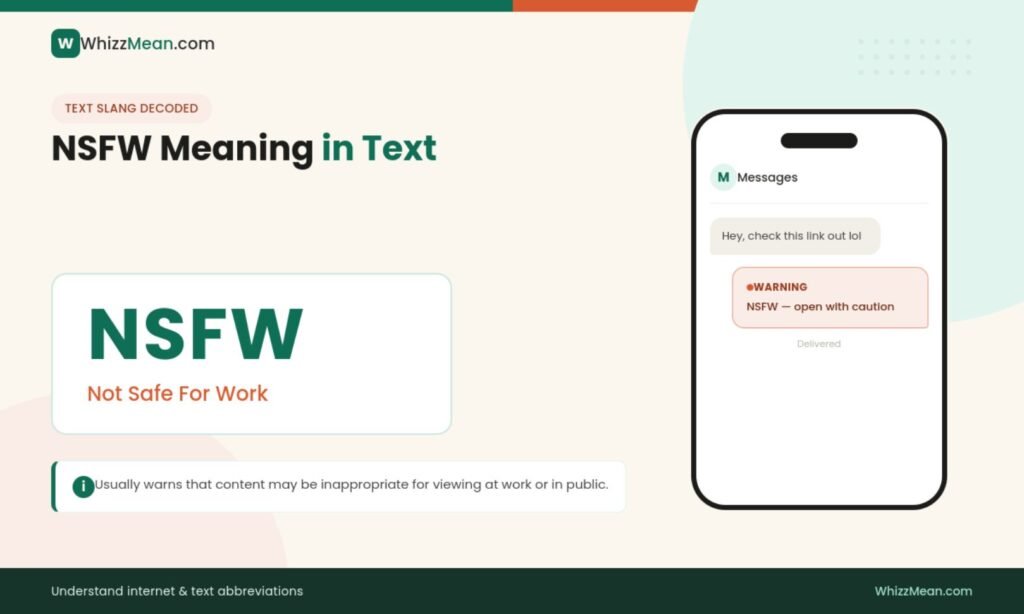
NSFW stands for “Not Safe For Work.” 🚫💼 It is a warning label used before sharing content (links, images, videos, or text) that is inappropriate, explicit, or unprofessional to view in a school, office, or public setting.
Primary Meanings and Full Forms of NSFW
At its core, NSFW has one dominant meaning, but it carries a few nuanced interpretations depending on context.
- Not Safe For Work: the original and most widely accepted full form. It warns that content is unsuitable for a professional environment.
- Not Suitable For Work: a slight variation of the same idea, used interchangeably by some communities.
- Not Safe For Wife/Family: a lighthearted, informal twist some people use in personal group chats to mean “don’t open this around your partner or kids.”
- Content Warning Label: functionally, NSFW acts less like a phrase and more like a digital caution sign, similar to a rating system on a movie or video game.
Key takeaway: No matter which full form you use, the intention stays the same. NSFW tells the reader “pause before you open this.”
Origin and History of NSFW in Online Slang
The NSFW meaning in text traces back to early internet forums and message boards in the late 1990s and early 2000s. Back then, workplace internet access was common, but employers monitored what employees viewed on company computers.
Users on forums like Something Awful and early Usenet groups started tagging explicit or questionable links with “NSFW” as a courtesy warning. It let readers decide whether to click while sitting at a work desk.
Reddit adopted the tag heavily in the 2010s, turning it into a formal content flair that users could filter in their settings. From there, NSFW spread into everyday texting slang, moving from a niche forum warning into mainstream digital vocabulary used by millions of people daily.
How to Use NSFW in Daily Chats (With Examples)?
Using NSFW naturally in texting is simple once you understand its purpose: warn first, share second. It typically appears right before a link, image, or description of something explicit or unprofessional.
Here are a few realistic examples of how people use it in daily conversations.
Example 1
Sarah: Found this hilarious but kinda wild video 😂 NSFW btw
Jake: Perfect, opening it after work lol
Example 2
Mike: NSFW warning, don’t open this at the office
Dana: Noted, saving it for later
Example 3
Group chat: 🚨NSFW🚨 do not scroll if your boss is nearby
Chris: lol thanks for the heads up
Example 4
Anonymous forum
post: NSFW – explicit language and imagery ahead
In every case, the tag is placed before the content, giving the reader a chance to prepare or wait until they’re somewhere private.
Explore more Meanings Guides
Popular Platforms Where NSFW Is Commonly Used
The NSFW meaning in text shows up across nearly every major platform, though some use it more heavily than others.
- Reddit: NSFW is a built in content tag and filtering system, one of the most formalized uses of the term online.
- Twitter/X: widely used as a manual warning before explicit images or sensitive threads.
- Discord: servers often have dedicated “NSFW channels” that require age verification to access.
- TikTok and Instagram: used informally in captions or comments, though actual explicit content usually violates platform guidelines.
- WhatsApp and Snapchat:common in private group chats between friends sharing questionable memes or videos.
Quick tip: Platforms with public content (Reddit, Twitter/X) treat NSFW as a formal moderation tool. Private messaging apps treat it more like social etiquette between friends.
Other Meanings of NSFW in Different Contexts
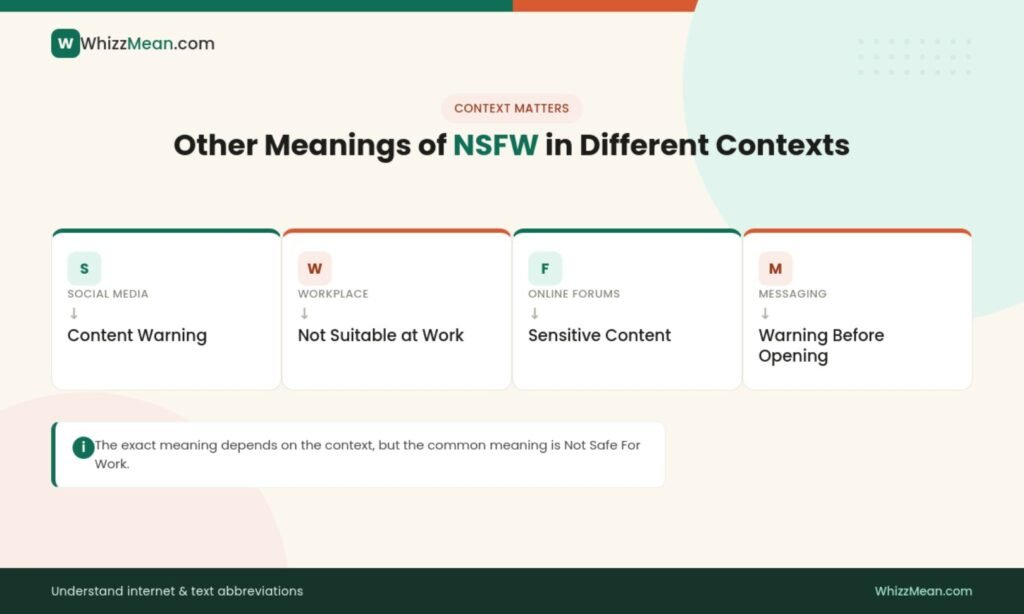
While “Not Safe For Work” dominates, NSFW occasionally pops up with different meanings depending on the community or niche.
- In gaming communities, NSFW sometimes labels fan art or mods with explicit themes.
- In marketing and content moderation, NSFW is used as a technical classification tag for automated filtering systems and AI content moderation tools.
- In casual slang, some younger users jokingly apply NSFW to content that’s simply embarrassing or cringeworthy, not necessarily explicit.
- In workplace Slack channels, NSFW can humorously refer to content that’s unprofessional in tone (like a meme) rather than sexually explicit.
The common thread across all these variations is the same: NSFW always signals “proceed with caution.”
NSFW vs Similar Texting Abbreviations
It helps to see how NSFW compares to other common content warning abbreviations people mix it up with.
| Abbreviation | Full Meaning | Tone | Best Use Case |
| NSFW | Not Safe For Work | Cautionary, explicit warning | Sharing adult, graphic, or unprofessional content |
| SFW | Safe For Work | Reassuring, neutral | Confirming content is appropriate to view anywhere |
| NSFL | Not Safe For Life | Serious, disturbing warning | Extremely graphic or disturbing content (violence, gore) |
| TW | Trigger Warning | Sensitive, protective | Content involving trauma, mental health, or sensitive topics |
Key distinction: NSFW warns about explicit or unprofessional content. NSFL warns about deeply disturbing content. TW warns about emotionally triggering content. They are related but not interchangeable.
How to Respond When Someone Texts You NSFW?
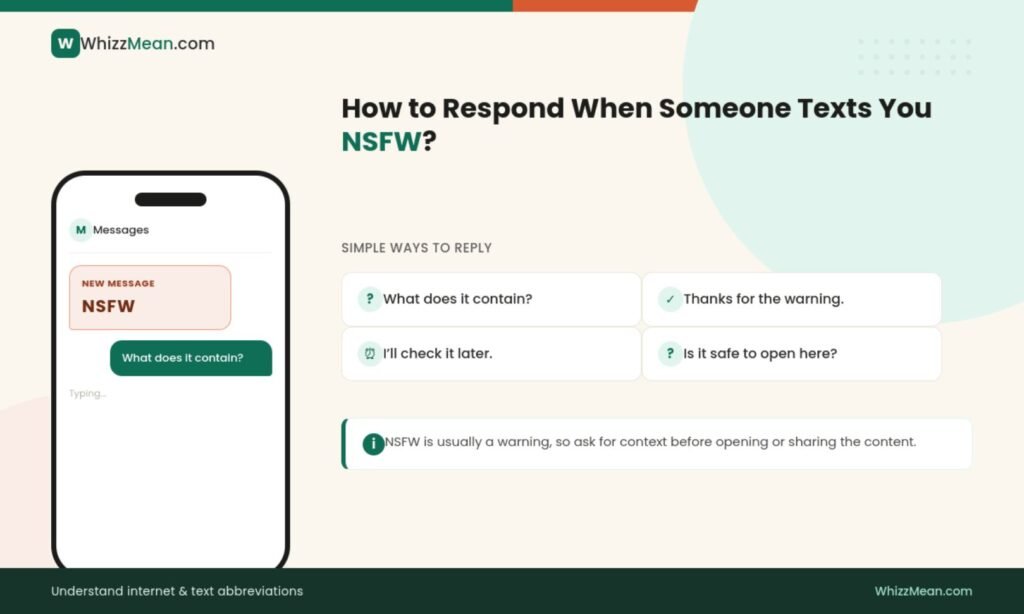
Getting an NSFW tag from a friend does not require an elaborate response. A short, casual acknowledgment is all that’s needed.
Here’s how you might reply:
“Got it, opening it later 👍”
“lol thanks for the warning”
“Noted, not opening this at my desk 😂”
“Appreciate the heads up!”
If the content feels inappropriate for your relationship with the sender (like a coworker sending something explicit), it’s completely fine to respond with a boundary.
“Hey, let’s keep work chat NSFW-free please 🙏”
When and Where You Should Avoid Using NSFW
Even though NSFW is common slang, there are clear situations where using it (or the content it labels) is a bad idea.
- Professional emails or Slack channels: even tagging something NSFW in a work environment can create HR concerns.
- Formal or academic writing: the term is too casual and its subject matter inappropriate for professional documents.
- Mixed-audience group chats:family chats, school groups, or chats involving minors should avoid NSFW content entirely, tag or no tag.
- Public social media captions: many platforms have policies against explicit content regardless of labeling.
Rule of thumb: If you have to ask whether NSFW content belongs somewhere, it probably doesn’t.
Pro Tip I Learned
One trick that saved me from an awkward moment: before sending anything tagged NSFW, read the caption out loud as if your boss were standing behind you. If it makes you cringe imagining that scenario, don’t send it in a mixed or professional setting. It’s a simple gut-check that takes two seconds and prevents a lot of regret.
Common Mistakes to Avoid When Using NSFW
People misuse the NSFW meaning in text more often than you’d think. Here are the most frequent slip-ups.
- Forgetting to tag content before sending it, rather than after, defeats the entire purpose of the warning.
- Using NSFW for content that’s simply embarrassing, not actually explicit, which confuses the reader.
- Typing it in ALL CAPS unnecessarily in casual chats, which can come across as overly dramatic.
- Assuming everyone knows the term, especially with older relatives or professional contacts who may not be familiar with internet slang.
- Using NSFW in a professional context as if it’s an acceptable joke, when it can actually violate workplace conduct policies.
Frequently Asked Questions
What does NSFW mean in a text message?
NSFW means “Not Safe For Work.” It’s a warning tag placed before content that’s explicit, graphic, or inappropriate to view in a professional or public setting.
Is NSFW always about sexual content?
Not always. While NSFW often refers to explicit sexual content, it can also warn about graphic violence, strong language, or anything generally unprofessional.
What’s the difference between NSFW and NSFL?
NSFW warns about explicit or unprofessional content, while NSFL (Not Safe For Life) warns about far more disturbing or graphic material, like violence or gore.
Can I use NSFW in a work Slack channel?
It’s best to avoid it. Even using the term casually in a professional space can raise concerns, so keep NSFW tags and content strictly for personal, private conversations.
Conclusion
The NSFW meaning in text boils down to one simple idea: it’s a courtesy warning that tells someone “this content isn’t appropriate for a professional or public setting.” Originating from early internet forums, the term has grown into a universal digital shorthand used across Reddit, Discord, group chats, and beyond.
Knowing when to use it, and just as importantly, when to avoid it altogether, keeps your conversations respectful and your professional reputation intact. Whether you’re tagging a meme for friends or deciding whether something belongs in a work chat, understanding NSFW helps you navigate digital communication with a little more confidence and a lot less awkwardness.

Muhammad Shoaib is a content creator and SEO professional who enjoys making language and vocabulary easy to understand. He writes helpful content about word meanings, phrases, slang, abbreviations, spelling differences, and everyday expressions. nThrough WhizzMean, Shoaib focuses on creating clear, simple, and practical explanations that help readers quickly understand confusing words and language-related questions.